

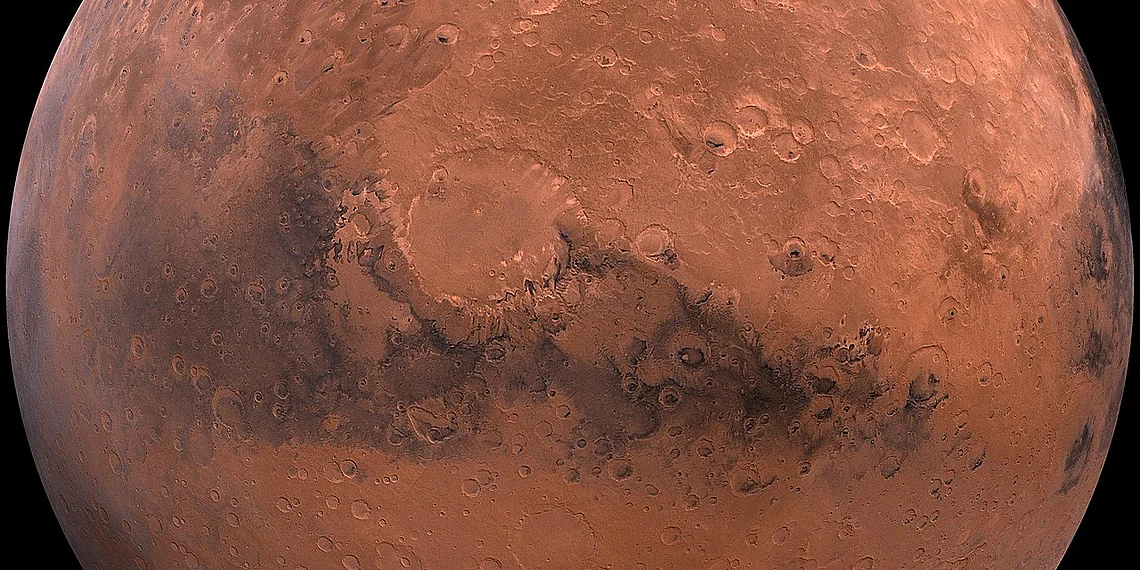
Imagine soaring over Valles Marineris, its colossal canyons stretching beyond your perception, or witnessing Olympus Mons, a volcano dwarfing anything on Earth, from orbit – that’s the perspective we’re bringing you today.
For nearly a quarter-century, one tireless spacecraft has been our silent guide, consistently delivering breathtaking imagery and invaluable scientific data: the Mars Express orbiter.
This isn’t just about pretty pictures; it’s about unlocking the secrets of a world once potentially teeming with life, a crucial component of ongoing Mars Exploration efforts.
Mars Express continues to reshape our understanding of the Red Planet’s geology, atmosphere, and subsurface composition, revealing details that ground-based observations simply can’t capture. We’ll delve into its remarkable journey and highlight some of its most significant discoveries, offering you a virtual Martian flight experience unlike any other.
Two Decades of Martian Observation
For over two decades, ESA’s Mars Express mission has been diligently observing our planetary neighbor, marking it as a cornerstone of Martian exploration. Launched in 2003, this orbiter stands as the European Space Agency’s sole operational mission currently studying Mars, a testament to its enduring reliability and scientific value. Unlike missions with shorter lifespans, Mars Express continues to provide a consistent stream of data, allowing scientists to track long-term changes in the Martian environment and build upon previous observations – a unique advantage for understanding planetary evolution.
One of Mars Express’s most significant contributions has been its detailed mapping and analysis of the Martian atmosphere. Over twenty years, it has painstakingly compiled the most complete picture yet of the planet’s atmospheric composition, revealing subtle shifts and patterns that would have been impossible to discern from shorter-duration missions. This ongoing study isn’t just about snapshots in time; it’s about understanding the dynamic processes shaping the Red Planet’s climate and potential for past or present habitability.
Beyond atmospheric studies, Mars Express has also provided unprecedented insights into Phobos, Mars’ innermost moon. High-resolution images have unveiled intricate details of its surface features, contributing to our understanding of its origin and composition. Furthermore, the orbiter’s data has been instrumental in identifying ancient geological formations – flow channels, delta fans, and chaotic terrain – providing compelling evidence that liquid water once flowed freely across Mars’ surface, a key element in the search for past life.
The mission’s legacy extends beyond raw data; stunning images captured by Mars Express have been meticulously combined to create breathtaking 3D mosaics of the Martian landscape. These visual representations not only captivate audiences but also offer scientists valuable perspectives for geological analysis and terrain mapping, further solidifying Mars Express’s pivotal role in our ongoing quest for Mars exploration.
A Legacy of Mapping & Analysis

For over two decades, the ESA’s Mars Express orbiter has diligently observed the Red Planet, establishing a legacy as Europe’s longest-serving mission to another planet. This sustained presence has allowed for an unparalleled level of atmospheric and chemical analysis, contributing significantly to our understanding of Martian processes. Unlike shorter missions, the continuous data stream from Mars Express has enabled scientists to track seasonal changes, monitor long-term trends in the atmosphere, and identify subtle variations in surface composition that would be missed by transient observations.
The orbiter’s instruments, including the Planetary Fourier Spectrometer (PFS) and the Atmospheric Trace Molecule Spectroscopy (MATM) instrument, have been instrumental in creating the most comprehensive map of Mars’s atmospheric structure. These tools analyze the absorption of sunlight to determine the abundance and distribution of various gases like water vapor, carbon dioxide, and ozone. Furthermore, data collected has revealed details about the planet’s ionosphere and how it interacts with solar wind, providing crucial insights into Mars’s climate history and potential for habitability.
Beyond atmospheric studies, Mars Express has provided invaluable data on the chemical composition of the Martian surface itself. Spectroscopic analysis reveals the presence and distribution of minerals, ice deposits, and other compounds. This information, combined with high-resolution imagery, helps scientists reconstruct past geological events and search for evidence of past or present water activity – a key ingredient in the search for life beyond Earth. The mission’s longevity ensures that these observations continue to refine our understanding of Mars, even as future missions build upon its findings.
Phobos in Stunning Detail
The Mars Express mission has consistently delivered remarkable insights into both Mars itself and its intriguing moons, but its detailed observations of Phobos stand out as particularly impressive. For over two decades, the ESA orbiter’s high-resolution cameras have captured an unprecedented level of detail on this small, irregularly shaped moon – far surpassing earlier images from missions like Viking. These aren’t just pretty pictures; they are crucial pieces in a complex puzzle aimed at understanding Phobos’ origin and evolution.
The images reveal a surface riddled with craters, grooves, and linear depressions, hinting at a tumultuous past likely involving collisions and tidal forces exerted by Mars. Scientists have painstakingly analyzed these features to determine the moon’s composition, which appears to be predominantly carbonaceous chondrite – similar to some asteroids found in our solar system. This fuels ongoing theories that Phobos might be a captured asteroid, although other hypotheses about its formation remain under investigation. The level of detail allows for precise measurements of surface topography, contributing to increasingly accurate models of the moon’s internal structure.
Beyond simply documenting Phobos’ features, Mars Express data is helping us understand how it interacts with its host planet. Its orbit is decaying slowly, suggesting a potential future collision with Mars – a scenario that necessitates detailed study of the moon’s composition and internal dynamics. The stunning mosaics constructed from these images offer scientists not only an aesthetic appreciation for Phobos’ unique beauty but also vital data to refine our understanding of this enigmatic Martian satellite and the processes shaping it.
Unveiling a Martian Moon

The ESA’s Mars Express orbiter has provided an unprecedented level of detail regarding Phobos, Mars’ innermost moon, through its High Resolution Stereo Camera (HRSC). These images reveal a surface riddled with grooves, craters, and unusual stick-and-ball formations – features previously only hinted at by lower resolution observations. The exceptional clarity allows scientists to analyze these structures in detail, moving beyond simple identification to understanding their formation processes.
Analysis of the HRSC imagery has significantly refined our understanding of Phobos’ shape. Initially thought to be a relatively smooth sphere, detailed models derived from the images indicate an irregular, elongated form with significant variations in surface altitude. The presence of linear grooves, which appear to wrap around the moon, suggests a possible origin involving tidal forces exerted by Mars or even capture of a larger object. These features are also helping researchers determine the moon’s internal structure and density.
The detailed images have fueled ongoing debate about Phobos’ origin. While some theories suggest it’s a captured asteroid, others propose formation from debris ejected during an early Martian impact event. The observed surface features – including the lack of large craters and the presence of a globally distributed regolith layer – offer clues that may eventually resolve this mystery. Future missions, informed by the data gathered by Mars Express, are being planned to directly sample Phobos’ material and further unravel its history.
Echoes of Ancient Water
The Mars Express orbiter, ESA’s stalwart presence above the Red Planet for over two decades, has been instrumental in piecing together a fascinating picture of Mars’s watery past. Beyond its impressive atmospheric mapping and detailed studies of Phobos, the mission’s data consistently reveals compelling evidence that liquid water once flowed across the Martian surface. This isn’t just a theoretical possibility; we see it etched into the landscape – vast networks of channels carved by rivers, sprawling delta fans deposited where those rivers met lakes or oceans, and chaotic terrain suggesting catastrophic flooding events. These features aren’t easily explained without invoking a period when Mars was significantly warmer and wetter than it is today.
The orbiter’s high-resolution imaging has been crucial in identifying and mapping these ancient waterways with unprecedented detail. For example, the Medusae Fossae Formation, a massive deposit of layered material, now believed to be hydrated minerals (clays and sulfates), strongly suggests prolonged interaction with water. Similarly, the discovery of recurring slope lineae – dark streaks that appear and grow during warmer months on steep slopes – hints at subsurface ice or briny water seeping out. Each new image and data set adds another layer to our understanding of how Mars transitioned from a potentially habitable world to the cold, arid desert we observe now.
The presence of past liquid water is not just scientifically intriguing; it’s directly relevant to the search for life beyond Earth. While water alone doesn’t guarantee life, it is an essential ingredient. The evidence gathered by Mars Express strengthens the possibility that Mars may have once harbored microbial life – organisms thriving in these ancient Martian lakes and rivers or even within subsurface aquifers. Future missions, informed by the data from Mars Express, will likely target regions identified as having the highest potential for preserving biosignatures – traces of past or present life.
Ultimately, the echoes of ancient water revealed by Mars Express offer a window into a dramatically different Martian history. The orbiter’s observations provide not only valuable insights into planetary climate change but also fuel our ongoing quest to understand whether we are alone in the universe. By meticulously charting these watery landscapes and analyzing their composition, Mars Express continues to refine our understanding of the Red Planet’s potential for past habitability, inspiring future exploration and driving the search for life beyond Earth – a key element of continued Mars Exploration.
Tracing Martian Rivers
The Mars Express orbiter has been instrumental in mapping extensive networks of flow channels across the Martian surface, providing compelling evidence of ancient rivers. These sinuous valleys, etched into the landscape over billions of years, clearly indicate that liquid water once carved its way through the terrain. High-resolution images from the orbiter’s cameras have allowed scientists to trace these river systems back to their origins in higher elevations, revealing a complex hydrological history far more dynamic than previously imagined.
Beyond simple channels, Mars Express data has also identified significant delta fans and chaotic terrains – further supporting the presence of past lakes and substantial bodies of water. Delta fans are fan-shaped deposits formed where rivers enter standing bodies of water, like miniature versions of Earth’s Nile River delta. ‘Chaos terrain,’ characterized by fractured and collapsed landscapes, likely resulted from underground ice melting or large-scale lake drainage events – processes requiring significant volumes of liquid water.
The discovery and mapping of these features collectively paint a picture of early Mars possessing a warmer, wetter climate capable of sustaining liquid water on its surface for extended periods. While the exact timeframe and mechanisms behind this shift to the cold, dry planet we observe today remain subjects of ongoing research, the evidence gathered by Mars Express strongly suggests that conditions may have once been suitable for microbial life – making it a crucial piece in understanding Mars’s climate history and potential habitability.
Beyond Images: Creating 3D Martian Landscapes
The stunning imagery we’ve received from missions like Mars Express is captivating, but ESA scientists are taking Martian visualization a giant leap forward: creating incredibly detailed, interactive 3D landscapes. For over two decades, Mars Express has diligently mapped the Red Planet, collecting vast amounts of data that go far beyond simple photographs. These datasets – including radar altimetry and stereo imaging – are now being meticulously processed to generate immersive models allowing for unprecedented exploration from the safety of Earth. This isn’t just about pretty pictures; it’s a crucial advancement in Mars Exploration.
The process involves complex algorithms that stitch together thousands of images, correcting distortions and generating elevation maps with remarkable accuracy. These elevation data are then draped over detailed imagery, creating a three-dimensional representation of Martian terrain – canyons like Valles Marineris, ancient riverbeds, and the polar ice caps all become navigable landscapes. Scientists can now ‘walk’ these virtual terrains, analyze geological features in detail from multiple perspectives, and test hypotheses about Mars’s past without physically setting foot on the planet. This level of interaction is simply not possible with traditional 2D images.
Beyond aiding scientific research, this technology has exciting implications for public engagement and future applications. Imagine experiencing a virtual tour of Olympus Mons, or exploring the layers of sedimentary rock in Gale Crater as if you were right there! The potential for VR/AR experiences that bring Mars Exploration to classrooms and homes worldwide is immense, fostering a deeper understanding and appreciation for our planetary neighbor. ESA’s work demonstrates how data collected over years can be transformed into powerful tools for both scientific discovery and public outreach.
Looking ahead, the techniques being developed with Mars Express data are paving the way for even more sophisticated 3D models of other celestial bodies. As future missions accumulate more comprehensive datasets – from lunar orbiters to probes exploring icy moons – we can anticipate increasingly realistic and interactive virtual environments that will revolutionize how we study and experience the cosmos. The detailed Martian landscapes created by ESA represent a significant milestone in this exciting evolution.
A New Perspective on the Red Planet
The ESA’s Mars Express mission isn’t just about capturing images; it’s about reconstructing an entire planet in three dimensions. The orbiter carries a suite of cameras, including the High Resolution Stereo Camera (HRSC), which acquires overlapping images simultaneously. These stereo pairs allow scientists to calculate depth and elevation data, effectively creating digital terrain models (DTMs). Sophisticated photogrammetry techniques then combine these DTMs with the original imagery to generate detailed, textured 3D visualizations of Martian landscapes.
These 3D models offer significant advantages for both scientific research and public engagement. Scientists can analyze geological features in unprecedented detail, better understanding processes like erosion, sedimentation, and tectonic activity that shaped Mars’ surface over billions of years. The ability to ‘fly’ through these virtual environments allows researchers to identify potential landing sites or areas of interest for future robotic missions with greater precision than relying on 2D maps alone.
Looking ahead, the technology used to create these Martian landscapes has immense potential for immersive experiences. Virtual reality (VR) and augmented reality (AR) applications could allow users to virtually explore Valles Marineris, Olympus Mons, or other iconic Martian features from the comfort of their homes. Imagine students taking a virtual field trip to Mars, or future tourists experiencing a simulated Martian landscape – these possibilities are rapidly moving closer to reality thanks to data from missions like Mars Express.
After nearly a quarter century in orbit, Mars Express continues to deliver invaluable data, proving its enduring relevance to our understanding of the Red Planet.
The mission’s contributions extend far beyond initial expectations, consistently refining models of Martian geology and atmospheric processes, and setting the stage for more ambitious endeavors.
As technology advances and we refine our techniques, the legacy of Mars Express will undoubtedly inform future missions aimed at unlocking even deeper secrets from this fascinating world – a crucial component of broader Mars Exploration efforts.
The ongoing analysis of its data promises new insights into the history of water on Mars, potential past habitability, and perhaps even clues about the planet’s evolutionary trajectory compared to Earth’s own journey. This is truly an exciting time for planetary science, fueled by missions like this one that have laid such a strong foundation. The perseverance and ingenuity demonstrated throughout its operational lifespan are inspiring to all involved in space exploration. It’s clear that Mars Express isn’t just a mission of the past; it remains a vital link to our future understanding of the cosmos. We eagerly anticipate what further discoveries will emerge from this remarkable orbital platform as scientists continue their detailed investigations and interpretations of its findings. The dedication shown by the ESA team ensures continued value for years to come, pushing the boundaries of what we know about Mars’s potential and past.
Continue reading on ByteTrending:
Discover more tech insights on ByteTrending ByteTrending.
Discover more from ByteTrending
Subscribe to get the latest posts sent to your email.