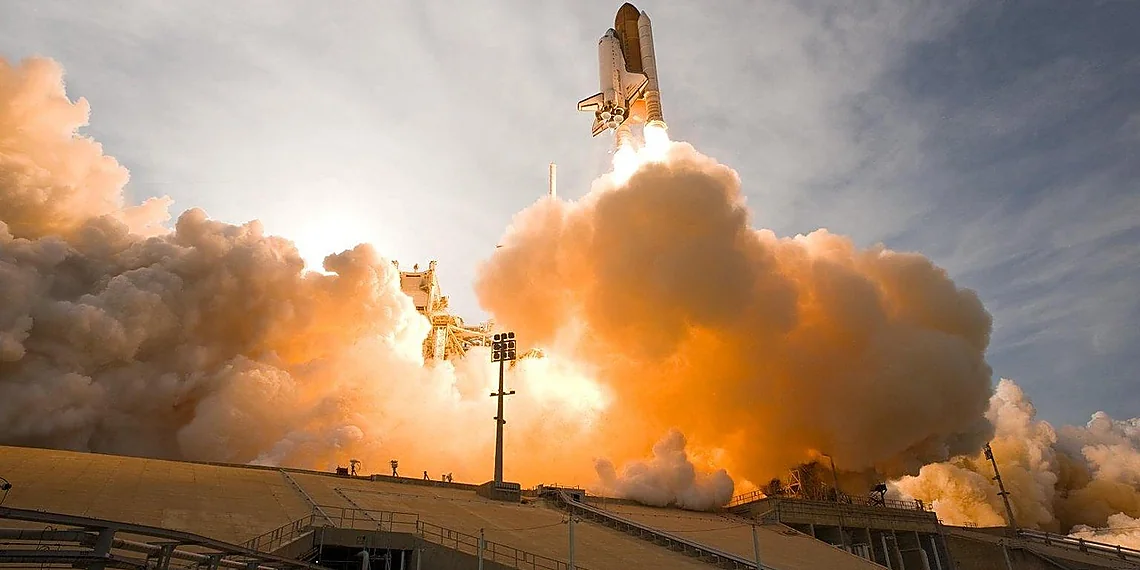



For decades, humanity has gazed at the stars and dreamed of reaching them, but our current methods of space travel feel agonizingly slow – a frustrating crawl across an immeasurable cosmic canvas.
Chemical rockets, while revolutionary in their time, are fundamentally limited by fuel mass and exhaust velocity, restricting us to relatively short trips within our solar system and leaving interstellar voyages firmly in the realm of science fiction.
Imagine shrinking those travel times from centuries to years, or even decades. What if we could truly become an interstellar species?
The pursuit of faster-than-ever space travel has led scientists down countless paths, but one concept consistently resurfaces with breathtaking potential: antimatter propulsion. Harnessing the energy released when matter and antimatter annihilate each other promises power densities unlike anything achievable with conventional fuels – a theoretical leap that could redefine our reach amongst the stars.
The Energy Problem in Space Travel
Current propulsion methods face a severe bottleneck when it comes to deep space exploration, particularly interstellar travel. Chemical rockets, the workhorses that have enabled us to reach the Moon and explore our solar system, rely on relatively slow chemical reactions for thrust. While SpaceX’s Starship represents an impressive advancement in rocket technology – capable of lifting massive payloads and facilitating interplanetary travel within our solar system – it still fundamentally operates on chemical principles. Reaching even nearby stars like Proxima Centauri, a mere 4.24 light-years away, would require velocities approaching a significant fraction of the speed of light. At these speeds, the journey times with current technology become prohibitively long, stretching into millennia.
The core issue is energy. Chemical rockets are incredibly inefficient; most of the energy released is dissipated as heat rather than converted into useful velocity. To achieve interstellar travel at reasonable timescales, we need propulsion systems that can deliver vastly more energy per unit mass. Consider the delta-v (change in velocity) needed for a round trip to Proxima Centauri: it’s orders of magnitude greater than what chemical rockets or even advanced ion engines can realistically provide within a human lifespan. This necessitates breakthroughs not just in engine design, but also in fundamentally how we generate and utilize energy in space.
The sheer scale of the energy requirements becomes readily apparent when you consider the kinetic energy equation (KE = 1/2 * m * v^2). Even modest increases in velocity demand exponentially more energy. Traditional rocket fuels simply can’t provide that power density without adding an impractical amount of mass to the spacecraft, negating any gains in speed. This is why alternative propulsion concepts, such as nuclear fusion or beamed energy systems, are being explored – and why antimatter propulsion emerges as a particularly compelling, albeit challenging, possibility.
Limitations of Chemical Rockets & Starship

Chemical rockets, while revolutionary for their time, face fundamental limitations when considering interstellar travel. Their exhaust velocity, a key determinant of maximum achievable speed, is relatively low. For example, even SpaceX’s powerful Falcon 9 rocket has an effective exhaust velocity around 3.5 km/s. Reaching Proxima Centauri, the nearest star system at approximately 4.24 light-years away, would require speeds approaching a significant fraction of the speed of light to make the journey within a human lifetime. Achieving such velocities with chemical propulsion alone is simply not feasible due to the immense propellant requirements; the spacecraft’s mass would quickly become prohibitive.
SpaceX’s Starship represents a significant advancement in rocketry, capable of carrying substantial payloads and potentially enabling travel throughout our solar system. However, even Starship’s projected performance falls far short of interstellar capabilities. While its rapid reusability and large payload capacity are game-changing for lunar or Martian missions, the sheer energy needed to accelerate a Starship to relativistic speeds remains insurmountable with chemical propulsion. The delta-v (change in velocity) required for an interstellar mission is orders of magnitude greater than what can be achieved through repeated rocket burns using conventional fuels.
To illustrate this point further, consider the energy equation: kinetic energy increases with the square of velocity. Even a modest increase in speed requires exponentially more fuel. The mass ratio – the ratio of initial launch mass to final spacecraft mass – for an interstellar mission using chemical rockets would be astronomical, likely exceeding millions or even billions. This makes such a mission practically impossible due to structural and logistical constraints; the sheer size and complexity would render it unmanageable with current technology.
Antimatter: The Ultimate Energy Source?
The search for interstellar travel has always been limited by our propulsion systems. While chemical rockets have served us well in reaching the Moon and exploring our solar system, venturing beyond necessitates a radical leap in energy efficiency – something that antimatter promises to deliver. Antimatter isn’t just ‘opposite’ matter; it’s a fascinating reflection of everything we know about particles. Every particle of matter—like an electron or proton—has a corresponding antiparticle with the same mass but opposite charge. An anti-electron, known as a positron, has the same mass as an electron but carries a positive charge instead of negative. Anti-protons are the antimatter counterparts to protons.
What makes antimatter so alluring is its potential for incredibly efficient energy release. When matter and antimatter come into contact, they annihilate each other in a process that completely converts their mass directly into pure energy – as described by Einstein’s famous equation E=mc². This isn’t like burning fuel; there are no exhaust gases or wasted products. Virtually all of the mass is transformed into energy, primarily in the form of high-energy photons (gamma rays) and other particles. Imagine a tiny amount of antimatter—a few milligrams—yielding an explosion equivalent to several tons of TNT! This unparalleled energy density makes it theoretically far more efficient than any chemical or nuclear reaction currently available.
To visualize this annihilation, picture a positron meeting an electron. They instantly disappear in a flash of gamma rays and other particles. The total mass before the collision (the combined mass of the electron and positron) is exactly equal to the total energy released after their annihilation. This process isn’t just theoretical; it’s been observed countless times in laboratories and particle accelerators. The challenge, however, lies not in understanding *how* antimatter annihilates, but in producing, storing, and safely controlling it – hurdles that present formidable engineering challenges for any potential antimatter propulsion system.
Despite these significant obstacles, the prospect of harnessing antimatter for propulsion remains a tantalizing possibility. While practical antimatter engines are likely decades away, ongoing research into antimatter production and containment continues to push the boundaries of what’s possible, potentially opening the door to interstellar travel in the distant future.
How Antimatter Annihilation Works
Antimatter is essentially the ‘opposite’ of ordinary matter. For every particle we know (like electrons or protons), there exists a corresponding antiparticle with the same mass but opposite charge. When matter and antimatter meet, they don’t bounce off each other; instead, they annihilate – completely destroy each other in a burst of energy. This process is incredibly efficient because it converts *mass* directly into energy.
The key to understanding this lies in Einstein’s famous equation, E=mc². This equation tells us that energy (E) equals mass (m) multiplied by the speed of light squared (c²). The speed of light is a huge number, so even a tiny amount of mass converted into energy releases an enormous quantity. When matter and antimatter annihilate, nearly all their mass vanishes, becoming pure energy in the form of photons (light particles) and other subatomic particles.
Imagine an electron meeting its antiparticle, a positron. They both disappear instantly, releasing gamma rays – extremely high-energy light – along with some neutrinos. This annihilation isn’t like burning fuel; it’s a direct conversion of mass into energy without producing any waste products (aside from the particles mentioned above). This makes antimatter propulsion theoretically far more efficient than traditional chemical rockets and opens up possibilities for interstellar travel.
The Challenges & The ‘Manhattan Project’ Analogy
The prospect of antimatter propulsion remains firmly in the realm of future technology, but its theoretical efficiency is staggering – complete conversion of mass into energy offers unparalleled thrust potential. However, realizing this dream faces monumental challenges that extend far beyond simply understanding the physics involved. Producing even minuscule amounts of antimatter requires immense energy and incredibly complex particle accelerators, machines orders of magnitude more sophisticated than anything currently in widespread use. Current production rates are laughably low; generating just a milligram would require power plants operating for years – and that’s before considering the losses inherent in the process.
Storing antimatter presents another formidable obstacle. Because antimatter annihilates upon contact with ordinary matter, it can only be contained within specialized magnetic traps maintained at near-absolute zero temperatures. These traps are incredibly delicate and prone to failure, leading to catastrophic annihilation events and a loss of precious antimatter – which is, itself, extraordinarily expensive to create. Scaling up storage capacity to levels needed for even modest interstellar travel would necessitate breakthroughs in materials science and cryogenic engineering that currently seem decades away.
The sheer scale of the undertaking often draws comparisons to the Manhattan Project, the World War II initiative that developed nuclear weapons. Like the Manhattan Project, antimatter propulsion demands a concerted global effort, massive investment, and the mobilization of some of the brightest minds in physics, engineering, and materials science. The potential rewards are similarly transformative: interstellar travel would revolutionize our understanding of the universe and potentially open up entirely new frontiers for humanity. However, just as with nuclear technology, stringent safety protocols and ethical considerations surrounding antimatter handling and utilization would be absolutely paramount.
While the challenges are daunting, dismissing antimatter propulsion as pure science fiction would be premature. Continued advancements in particle physics, magnetic confinement techniques, and potentially even entirely new approaches to matter-antimatter interaction could one day bring this extraordinary technology within reach. The ‘Manhattan Project’ analogy isn’t just about scale; it’s a reminder that humanity can achieve seemingly impossible feats when driven by necessity and fueled by innovation.
Production, Storage & Safety Concerns

Currently, antimatter is produced primarily through high-energy particle collisions within facilities like CERN’s Large Hadron Collider. These processes involve smashing particles together at near light speed, a tremendously energy-intensive endeavor that yields minuscule amounts of antimatter – often just a few antiprotons per collision. The efficiency is incredibly low; it takes approximately 40 billion electron volts to produce a single antiproton. This means generating even milligram quantities would require power plants operating for extended periods and vast, complex infrastructure far beyond what currently exists.
Storing antimatter presents another formidable challenge. Because antimatter annihilates upon contact with ordinary matter, it cannot be held in any conventional container. Instead, scientists rely on sophisticated magnetic traps that use powerful electromagnetic fields to suspend antiprotons or positrons (antielectrons) in a vacuum. These traps must also maintain extremely low temperatures, close to absolute zero (-273.15°C), to minimize thermal motion and prevent the antimatter from escaping and annihilating. Maintaining these conditions requires constant power and precise control systems.
The inherent safety concerns surrounding antimatter are substantial. Even small amounts of antimatter possess immense energy density; a milligram would release an explosion comparable to several tons of TNT. Accidental contact with matter could trigger catastrophic annihilation events, releasing dangerous radiation. While current research facilities have stringent safety protocols and containment measures in place – including multiple layers of shielding and redundant systems – the potential for disaster necessitates extreme caution and robust engineering solutions.
Looking Ahead: Future Possibilities & Ethical Considerations
While interstellar travel remains the most widely envisioned application of antimatter propulsion, the potential ramifications of mastering antimatter extend far beyond simply reaching distant stars. Consider the possibility of incredibly precise and localized energy delivery – a capability that could revolutionize fields like medicine. Hypothetically, minuscule amounts of antimatter annihilation could be harnessed to target cancerous tumors with unprecedented accuracy, minimizing damage to healthy tissue compared to current radiation therapies. Similarly, in industrial processes requiring extreme heat or precisely controlled reactions, antimatter’s unparalleled energy density offers tantalizing possibilities, although the cost and safety hurdles are currently astronomical.
Beyond these specific examples lies a broader spectrum of potential applications – from powering advanced micro-devices to creating entirely new materials through unique reaction pathways. It’s crucial to emphasize that these are highly speculative scenarios; the technological challenges in manipulating and containing antimatter at such scales are immense, requiring breakthroughs far beyond our current capabilities. However, even incremental progress in antimatter research could yield unforeseen benefits across various scientific and engineering disciplines, expanding its value proposition considerably.
However, the sheer power inherent in antimatter technology inevitably raises significant ethical considerations. The ability to generate vast amounts of energy, while beneficial for space exploration or medical advancements, also presents a potential risk if misused. Safeguarding against weaponization is paramount, requiring robust international regulations and stringent oversight protocols from the very beginning of widespread research and development. A future with accessible antimatter demands careful deliberation about its responsible use and equitable distribution to prevent exacerbating existing global inequalities.
Ultimately, the path forward for antimatter propulsion – and indeed, any technology wielding such immense power – necessitates a balanced approach: fostering innovation while proactively addressing potential risks. Open dialogue involving scientists, policymakers, ethicists, and the public is essential to ensure that this transformative technology serves humanity’s best interests, guiding its development along a trajectory of responsible advancement.
Beyond Propulsion: Medical Applications?
While antimatter’s primary allure currently lies in its potential for revolutionary propulsion systems, exploring its broader utility reveals intriguing possibilities. One area gaining traction is targeted cancer treatment. Traditional radiation therapy can damage healthy tissue alongside cancerous cells. Antimatter annihilation, however, offers the theoretical prospect of delivering extremely precise and localized doses of energy directly to tumors, minimizing harm to surrounding areas. This would require incredibly sophisticated targeting mechanisms and containment strategies, but the potential for improved patient outcomes makes it a subject of ongoing research.
Beyond oncology, antimatter’s unique properties could find applications in advanced materials science or even industrial processes requiring extremely high-energy inputs. For example, controlled antimatter reactions might be used to synthesize rare isotopes or create novel materials with tailored properties that are currently inaccessible through conventional methods. These applications remain largely conceptual due to the immense challenges associated with antimatter production and handling.
However, any widespread application of antimatter, whether in medicine or industry, necessitates careful ethical consideration. The sheer power contained within even minute quantities of antimatter presents significant safety risks and potential for misuse. Robust international regulations and stringent oversight would be crucial to ensure responsible development and prevent the technology from falling into the wrong hands.

The journey from theoretical concept to functional reality for antimatter propulsion remains a monumental undertaking, demanding breakthroughs across multiple scientific disciplines.
Successfully harnessing the immense energy locked within antimatter presents challenges in production, storage, and controlled annihilation that currently stretch the limits of our engineering capabilities.
While widespread interstellar travel powered by antimatter propulsion might seem like science fiction today, the persistent research into particle physics and advanced materials offers glimmers of genuine progress.
The sheer scale of investment required is undeniable; however, the potential rewards – revolutionizing space exploration and fundamentally altering our understanding of the universe – are simply too compelling to ignore completely. Even incremental advances in antimatter handling or containment would be transformative for other fields like medical imaging and materials science, justifying continued investigation.
Continue reading on ByteTrending:
Discover more tech insights on ByteTrending ByteTrending.
Discover more from ByteTrending
Subscribe to get the latest posts sent to your email.