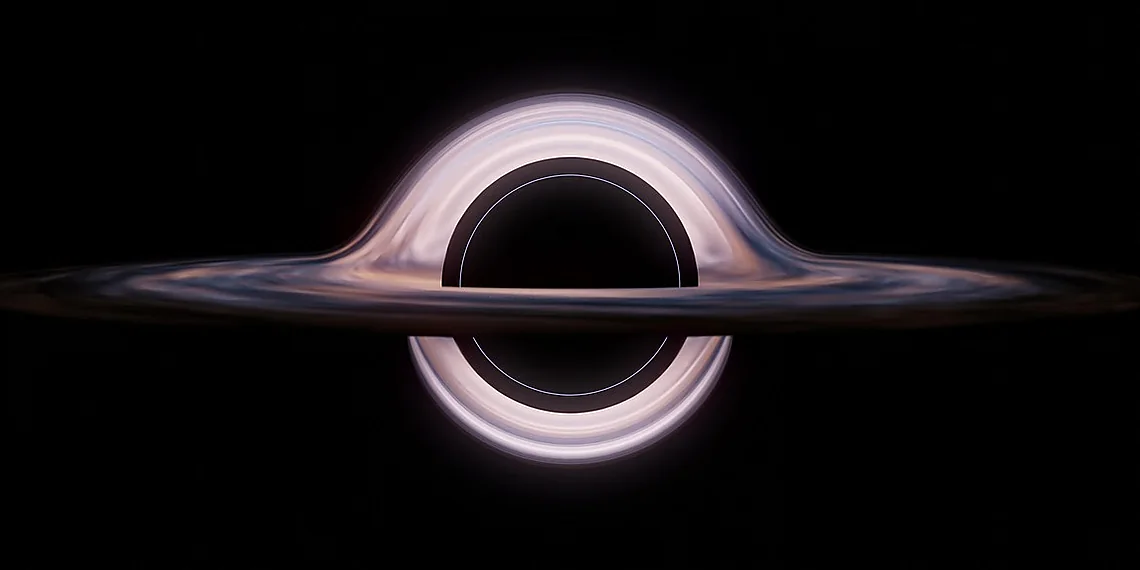

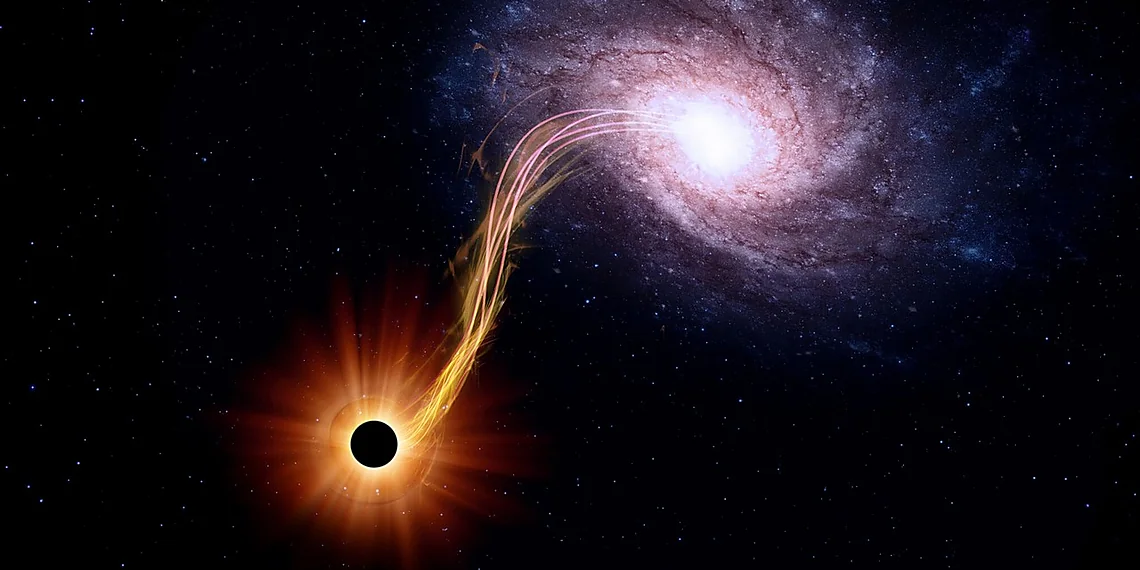
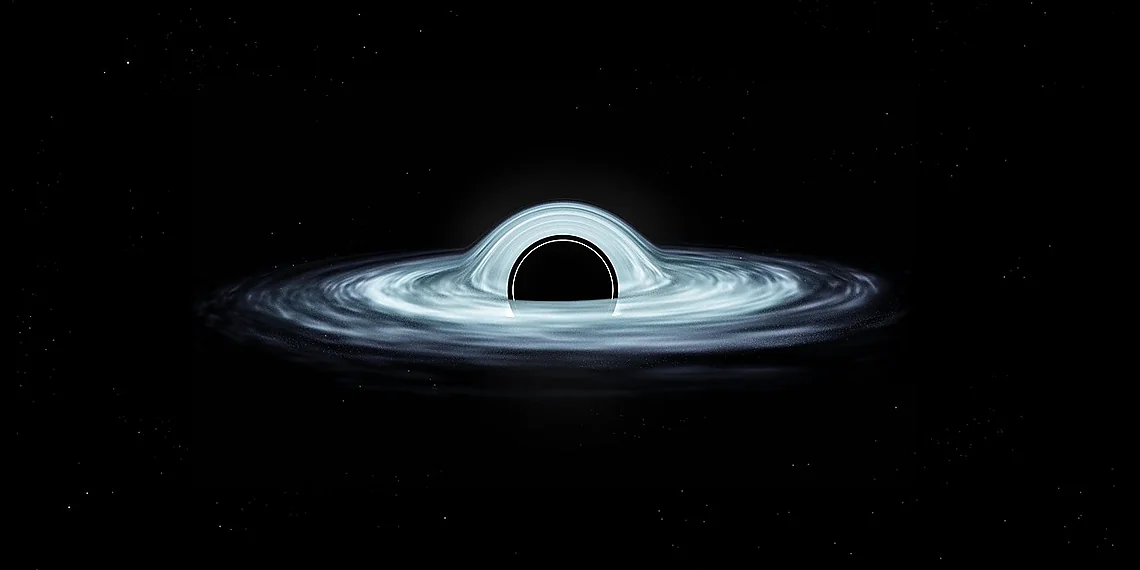
Imagine two cosmic titans, locked in a dance of destruction, spiraling towards each other not in a graceful waltz, but with an erratic, unpredictable wobble. That’s the reality of eccentric black hole mergers, events that challenge our understanding of how these behemoths find each other and collide. We typically picture black holes merging along neat, circular paths, but recent observations are revealing something far more chaotic – orbits that resemble a lopsided ellipse, stretching and pulling as they draw closer. This unusual behavior introduces fascinating complexities into the final moments before their ultimate union.
These cosmic collisions don’t just create light or matter; they ripple through spacetime itself, generating gravitational waves. Think of dropping a pebble into a pond – the disturbance radiates outwards as waves. Similarly, accelerating massive objects like black holes generate these faint distortions in the fabric of the universe, which we can now detect with incredibly sensitive instruments like LIGO and Virgo. Analyzing these waves provides an unprecedented window into the most extreme environments imaginable.
The discovery of GW200208_222617 stands out as a particularly compelling case study, showcasing an exceptionally high degree of *Black Hole Eccentricity*. This event’s gravitational wave signal was unlike anything we’d previously observed, revealing a merger with a highly elongated orbit – one that defies many of our standard models. It suggests black holes can find each other through more dynamic and less predictable pathways than we initially thought, opening up exciting new avenues for research into the formation and evolution of these cosmic giants.
The Standard Black Hole Dance
Most models of black hole mergers predict a graceful, almost balletic dance leading up to the final, violent collision. These models assume that the two black holes involved have spent eons orbiting each other in relatively circular paths. Think of it like planets circling a star – generally stable and predictable. This ‘standard’ scenario arises because gravitational interactions tend to smooth out any initial irregularities in an orbit over vast timescales. As black holes repeatedly swing around one another, any slight deviations from a perfect circle are gradually dampened by the exchange of energy and momentum through gravitational waves.
The prevalence of circular orbits among observed black hole mergers isn’t just a matter of convenience; it’s deeply rooted in how we understand their formation and evolution. Many black holes form from the collapse of massive stars within binary systems – two stars orbiting each other. These stellar binaries often evolve to have fairly well-ordered, near-circular orbits before one star explodes as a supernova, leaving behind a black hole. Later mergers of these ‘stellar mass’ black holes tend to inherit this circularity, making them the most commonly observed type.
Furthermore, when two black holes interact and lose energy through gravitational waves, that energy loss tends to favor circular orbits. Imagine shaking a rope tied to a fixed point; it’s much easier to make it swing in a circle than an oval. The emission of gravitational waves acts similarly, gently pushing the orbit towards a more circular configuration as the black holes draw closer together. This process effectively ‘tidies up’ any initial eccentricity before the final moments of their merger.
Therefore, when scientists detect a merger like GW200208_222617 exhibiting significant orbital eccentricity – an oval-shaped path instead of a circular one – it immediately raises questions. It suggests that something unusual happened in the black holes’ history, potentially involving complex interactions or formation pathways that deviate from the standard model, and offers exciting new avenues for investigation.
Circular Orbits: The Usual Suspects

Most gravitational wave detections from merging black hole binaries have followed a remarkably predictable pattern: they spiral inwards along nearly circular orbits. These ‘standard’ mergers arise because black holes typically lose energy through gravitational waves most efficiently when their orbits are close to being perfectly circular. Any initial eccentricity, or oval shape, tends to be damped out over time as the black holes orbit each other.
The physics behind this predictability is rooted in how gravitational waves carry away angular momentum and energy. A circular orbit allows for a consistent and predictable emission of these waves, causing the orbit to shrink smoothly. Deviations from circularity create more complex wave patterns that are less efficient at radiating energy, leading to a gradual return towards a circular path.
Because of this efficient damping process, astronomers expected most black hole mergers to be observed with nearly circular orbits prior to the final plunge. The vast majority of detections made by LIGO and Virgo have indeed confirmed these expectations, establishing the ‘standard’ model for black hole binary evolution as one characterized by increasingly tight, circular spirals.
GW200208_222617: An Orbital Oddity
GW200208_222617 presents a fascinating anomaly in the growing catalog of black hole mergers detected by LIGO and Virgo observatories. Unlike most previously observed events, which exhibited near-circular orbits as they spiraled towards each other, this merger displayed a strikingly eccentric orbit – essentially an elongated, oval shape rather than a perfect circle. This eccentricity isn’t just a minor deviation; it fundamentally alters the dynamics of the collision and provides invaluable clues about the black holes’ history and how they came to be in such a peculiar configuration.
The detection itself wasn’t immediately obvious as eccentric. Gravitational waves are ripples in spacetime, and their ‘shape’ carries information about the colliding objects. A circular orbit produces a relatively smooth, predictable signal as the waves increase in frequency and amplitude (the ‘chirp’). However, GW200208_222617’s signal exhibited distinct features – specifically, an unusually long “inspiral” phase where the black holes gradually drew closer. This prolonged approach is a hallmark of eccentric orbits; it’s as if the black holes were taking a circuitous route to their final embrace.
What makes this eccentricity so unusual? Most black hole mergers are thought to form from compact objects within relatively stable stellar systems, leading to circularization over time. For GW200208_222617 to have such an eccentric orbit, it suggests a more dramatic origin story – perhaps the black holes were captured in a chaotic environment like a dense star cluster or underwent a complex series of gravitational interactions that disrupted their initial paths. Further analysis is ongoing, but this event provides strong evidence that black hole formation and evolution can be far messier and less predictable than previously assumed.
The implications extend beyond just understanding the merger itself. By studying these ‘orbital oddities,’ scientists hope to refine models of stellar evolution, galaxy dynamics, and even probe the environments where extreme gravitational phenomena occur. GW200208_222617 is a vital piece in this puzzle, demonstrating that the universe’s black hole mergers aren’t always predictable or elegant – sometimes they’re wonderfully strange.
Decoding the Gravitational Wave Signal
Gravitational wave observatories like LIGO (Laser Interferometer Gravitational-Wave Observatory) and Virgo detect ripples in spacetime caused by incredibly energetic events, such as black hole mergers. These signals aren’t just simple ‘dings’; they are complex waveforms that change over time. When two black holes spiral towards each other, the gravitational wave signal gets louder and faster as they get closer. Scientists analyze the shape of this waveform – its frequency (how fast it oscillates) and amplitude (how strong it is) – to learn about the masses and distances of the colliding objects.
GW200208_222617 presented a distinctive signal. Typically, black hole mergers are expected to follow nearly circular orbits. As these objects spiral inward, their orbital speed remains relatively constant until the very end when they accelerate rapidly. However, the GW200208_222617 signal showed an unusually long period of acceleration – much longer than predicted for a circular orbit. This extended acceleration indicated that the black holes were initially quite far apart and on a highly elliptical, or ‘squashed,’ path.
The prolonged acceleration is a direct consequence of the eccentricity of the orbit. Imagine two cars circling each other; if they’re in a perfect circle, their speed remains consistent. But if one car has an oval track, it moves much faster when it’s closer and slower when farther away. Similarly, black holes on eccentric orbits gain significant speed as they dive toward each other, creating the observed pattern of extended acceleration within the gravitational wave signal. This makes GW200208_222617 a particularly valuable event for understanding how black hole binaries form and evolve.
Where Did This Eccentricity Come From?
The discovery of GW200208_222617, a black hole merger exhibiting significant orbital eccentricity, has sparked intense investigation into the origins of these unusual orbits. Unlike most observed black hole mergers which follow relatively circular paths, this event showcased a highly elongated, oval-shaped trajectory – a stark departure from what’s typically expected. This begs the question: where did this eccentricity come from? The answer likely lies in complex interactions and dynamic processes occurring within galaxies long before these black holes ever began their final spiral towards each other.
One leading theory suggests that close encounters with other stars or even smaller black holes could have disrupted an initially circular orbit. Imagine a binary black hole system peacefully orbiting one another; a passing star’s gravitational tug could ‘kick’ one of the black holes, stretching and distorting their shared path into a more eccentric shape. Similarly, interactions with galaxies – perhaps during a galactic merger or flyby – can impart significant energy and angular momentum to binary systems, leading to orbital distortions. These events aren’t necessarily catastrophic in themselves; they simply reshape the orbit over vast timescales.
Another key process potentially responsible for eccentricity is dynamical friction. Within dense stellar environments like globular clusters or galactic centers, black holes experience a constant gravitational tug from surrounding stars. This ‘friction’ can alter their orbits, gradually shifting them and introducing eccentricities as they lose energy through interactions with the stellar population. The strength of this effect depends on factors such as the density of stars and the mass of the black hole binary – meaning that some environments are far more conducive to generating eccentricity than others.
Ultimately, understanding the origins of black hole eccentricity offers a powerful window into the dynamic histories of galaxies and the complex gravitational interactions occurring within them. While GW200208_222617 represents just one example, it highlights the potential for diverse and fascinating orbital evolution scenarios, pushing astronomers to refine their models of galaxy mergers, stellar dynamics, and the ultimate fate of black hole binaries.
Shifting Orbits: Possible Origins

The transformation of an initially circular orbit into an eccentric one typically requires a significant external disturbance. One plausible scenario involves close encounters with other stars within the same galaxy. As a binary black hole system moves through a star cluster or globular cluster, gravitational interactions with passing stars can impart energy and alter its orbit, pushing it from a neat circle to a more elongated ellipse. These interactions aren’t necessarily direct collisions; even near-misses can subtly shift the orbital parameters over time.
Galactic mergers also provide a rich environment for generating eccentric black hole binaries. When galaxies collide, their stars and stellar remnants (including black holes) experience chaotic gravitational jostling. A binary black hole initially in a circular orbit within one of the merging galaxies could find itself flung into a more eccentric trajectory due to these disruptive interactions during the merger process. The complex interplay of gravitational forces can dramatically reshape orbits.
A less dramatic, but still important, mechanism is dynamical friction. This effect arises when a binary black hole system moves through a dense stellar environment. As it travels, the gravity of the black holes pulls on surrounding stars, creating a ‘wake’ that slows the binary down and gradually alters its orbit. Over long timescales, this process can lead to orbital eccentricity, though typically less extreme than the changes caused by direct encounters or galactic mergers.
Implications for Black Hole Research
The discovery of eccentric black hole mergers like GW200208_222617 is revolutionizing our understanding of how these cosmic behemoths form and evolve within galaxies. For years, the prevailing theory assumed that most black hole binaries would settle into near-circular orbits before merging due to gravitational radiation damping – a process where orbital energy is lost as gravitational waves are emitted. Detecting a merger with significant eccentricity throws this assumption into question and suggests alternative formation pathways we hadn’t fully considered.
Understanding black hole eccentricity provides crucial clues about the environments in which these mergers occur. Eccentric orbits often imply that the black holes didn’t initially form in stable, isolated binaries. Instead, they likely experienced disruptive gravitational interactions – perhaps with a third star or another binary system – that flung them together on an elongated path. This points towards scenarios involving dense stellar clusters or galactic nuclei where chaotic encounters are common, offering valuable insights into how galaxies assemble and the dynamics within them.
Furthermore, analyzing the properties of eccentric black hole mergers allows us to probe the physics of strong gravity in unprecedented detail. The gravitational wave signals from these events carry information about the black holes’ masses, spins, and orbital parameters throughout their entire journey – including the highly distorted orbits characteristic of eccentricity. Precise measurements of these signals can test Einstein’s theory of general relativity under extreme conditions and potentially reveal new phenomena related to black hole behavior.
Ultimately, eccentric black hole mergers are not just anomalies; they represent a missing piece in the puzzle of cosmic evolution. By studying them, we’re gaining a more complete picture of how black holes form, interact, and shape the galaxies around them – pushing the boundaries of our knowledge about the universe’s most extreme objects.

The detection of GW200208_222617 was far from just another gravitational wave event; it represented a pivotal moment in our exploration of the cosmos.
This extraordinary signal, characterized by its prolonged and complex waveform, strongly suggested a merger involving black holes with significant orbital eccentricity – a property we now understand better thanks to this observation.
The implications are profound. Such high levels of Black Hole Eccentricity challenge existing models of stellar evolution and binary system formation, hinting at potentially exotic origins for these massive objects, perhaps involving interactions within dense star clusters or even more unusual astrophysical processes.
GW200208_222617 has opened a new window into the universe, allowing us to probe environments and phenomena previously hidden from view. The data provides invaluable constraints on theoretical models and pushes the boundaries of our understanding of gravity itself. Future observations promise even greater insights as detector sensitivity improves and we scan larger volumes of space for these elusive signals. We are only beginning to scratch the surface of what gravitational wave astronomy can reveal about the universe’s most extreme events, including the formation and behavior of black holes in all their fascinating variety. The ongoing quest to understand these cosmic collisions will undoubtedly yield further surprises and reshape our cosmological picture. Stay tuned – the next groundbreaking discovery could be just around the corner! To delve deeper into this exciting field, we encourage you to explore resources from organizations like LIGO and Virgo, and actively follow updates on new gravitational wave detections; the universe is whispering its secrets, and it’s up to us to listen.
Continue reading on ByteTrending:
Discover more tech insights on ByteTrending ByteTrending.
Discover more from ByteTrending
Subscribe to get the latest posts sent to your email.