
Imagine witnessing a cosmic demolition derby, where gravity reigns supreme and stars meet their untimely end. That’s precisely what astronomers recently observed in a startling discovery that’s shaking up our understanding of the universe. A nearby star, seemingly drifting peacefully through interstellar space, abruptly vanished – swallowed whole by an unseen force. This wasn’t your typical black hole encounter; it was something far more unexpected and dramatic. The culprit? What scientists are now calling a ‘rogue black hole,’ one that isn’t orbiting a galaxy or residing within a star cluster like we typically expect. Its sudden appearance and destructive power challenge long-held assumptions about how these gravitational behemoths behave and where they might be lurking. This event provides an unprecedented opportunity to study the dynamics of stellar consumption, offering invaluable insights into the hidden population of black holes scattered throughout our galaxy and beyond.
Until now, most black hole detections have been linked to galactic centers or dense star systems, making their movements relatively predictable. However, this newly observed phenomenon suggests a far more chaotic universe than we previously imagined, filled with wandering gravitational giants capable of disrupting the cosmic order. The data paints a vivid picture of a stellar demise unlike any seen before, and it compels us to rethink our models of black hole formation and distribution. Further investigation promises to unlock secrets about these enigmatic objects and reveal how they shape the evolution of galaxies.
The Unconventional Discovery
For decades, astronomers have understood that supermassive black holes typically reside at the heart of galaxies, acting as gravitational anchors and often surrounded by swirling disks of gas and dust. These galactic nuclei are where we expect to find these cosmic behemoths, actively feeding on nearby material. However, a groundbreaking new observation has shattered this conventional understanding: scientists have detected a massive black hole actively consuming a star, not near any galaxy at all, but instead wandering freely in the vast expanse of intergalactic space. This unprecedented event is sending ripples through the astrophysics community and forcing a re-evaluation of how these enigmatic objects form and evolve.
The discovery hinges on exceptionally bright radio waves emitted during this stellar feast – a phenomenon previously unseen outside of galactic environments. Typically, when a black hole devours a star, it creates an accretion disk of superheated material that emits X-rays and other forms of radiation. However, the sheer intensity of the radio signal suggests a particularly violent and energetic interaction, hinting at a black hole significantly larger than initially anticipated. The fact that this event occurred so far from any galaxy – essentially adrift in the cosmic void – is what makes it truly exceptional and challenges our established models.
The existence of such a ‘rogue black hole,’ as it’s now being termed, raises intriguing questions about its origin. Did it get ejected from a galaxy during a collision or other gravitational disturbance? Was it formed through some process we don’t yet understand outside the confines of galactic structures? Finding these solitary giants helps us unravel the mysteries surrounding their formation and distribution throughout the universe. Further observations will be critical to determine if this is an isolated incident, or if there are many more such intergalactic black holes waiting to be discovered.
This finding highlights just how much we still have to learn about the universe’s most extreme objects. While black holes were once thought of as relatively predictable entities confined to galactic centers, this discovery demonstrates their potential for surprising and unexpected behavior. The continued study of this ‘rogue black hole’ promises to illuminate new pathways in our understanding of galaxy evolution, gravitational interactions, and the distribution of dark matter throughout the cosmos.
Black Holes: Beyond Galactic Centers

For decades, astronomers have primarily associated black holes with galactic centers. These supermassive black holes, millions or even billions of times the mass of our Sun, reside at the heart of nearly every galaxy, acting as gravitational anchors and often fueling active galactic nuclei. Smaller ‘stellar-mass’ black holes, formed from the collapse of massive stars, are also typically found within galaxies, scattered amongst the stars and gas clouds.
The recently observed phenomenon challenges this established understanding. This particular black hole was detected far outside any galaxy, wandering freely in intergalactic space – a vast expanse between galaxies that is largely considered empty. Its presence so isolated is exceptionally rare; it’s like finding a lion roaming the middle of the Pacific Ocean instead of on an African savanna.
The discovery has significant implications for our understanding of black hole formation and evolution. It raises questions about how this ‘rogue’ black hole became separated from its original galaxy – was it ejected through a galactic merger, or did it form in a now-disintegrated dwarf galaxy? Further research promises to shed light on these processes and potentially reveal more wandering black holes lurking in the intergalactic void.
Witnessing Stellar Consumption
Astronomers have witnessed an extraordinary event – a ‘rogue black hole’ actively consuming a star far from the usual hub of galactic activity. What makes this observation truly remarkable is that scientists were able to detect it through intense radio wave emissions, marking the first time such a stellar feeding frenzy has been observed in this way. This isn’t your typical black hole gorging on material within a galaxy’s central nucleus; this one appears to be wandering freely, gravitationally disrupting and devouring a lone star. The event challenges existing models of black hole behavior and offers unprecedented insights into their growth mechanisms.
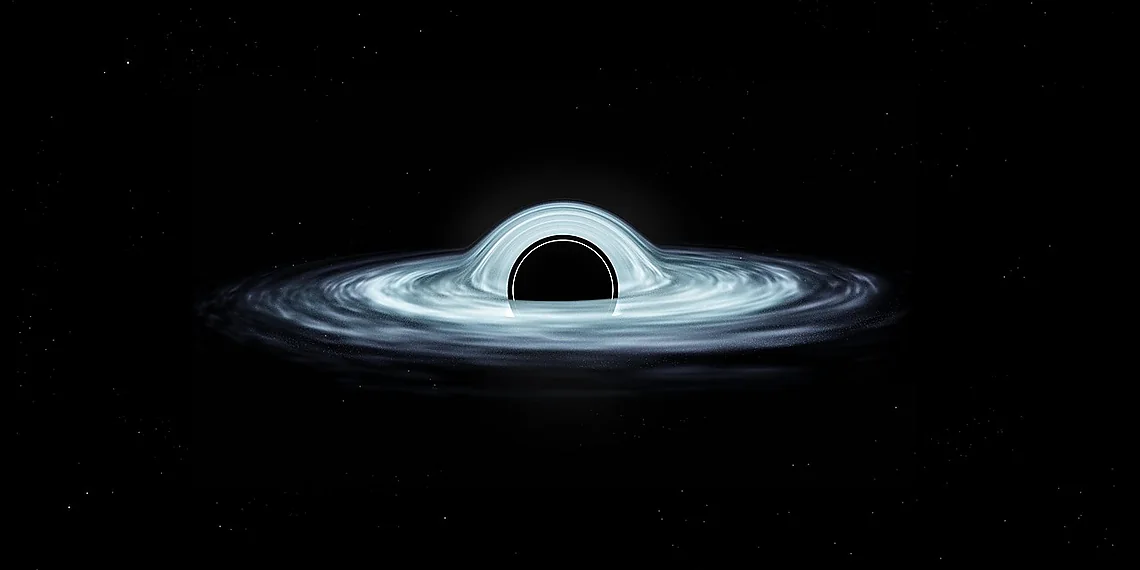
The radio waves themselves are the key to understanding what’s happening. As the star gets pulled towards the ‘rogue black hole,’ it doesn’t simply disappear; instead, material is ripped away from the star forming a swirling disk around the black hole – an ‘accretion disk.’ This disk isn’t just passively orbiting; intense friction and magnetic fields within this disk accelerate particles to near-light speed. These accelerated charged particles then emit radio waves as they spiral inwards. Think of it like miniature particle accelerators operating on a cosmic scale, powered by gravity.
The strength and characteristics of these observed radio emissions are providing crucial data about the black hole’s feeding habits. The intensity suggests an unusually efficient process – more material is being converted into energy (and hence radio waves) than previously thought possible for such a distant, isolated black hole. Scientists believe that strong magnetic fields within the accretion disk play a critical role in funneling this material and boosting the radio emission, hinting at a complex interplay between gravity, magnetism, and particle physics happening right on the event horizon.
Further observations are planned to track the ongoing consumption process and refine models of how these ‘rogue black holes’ grow. The data promises to shed light not only on this specific stellar snack but also on the population and behavior of these wandering behemoths throughout the universe, ultimately helping us better understand the evolution of galaxies and the distribution of dark matter.
Radio Waves as a Cosmic Meal Signal

When a ‘rogue’ black hole, one not residing at the center of a galaxy, encounters and begins to consume a star, it’s not as simple as a clean vacuuming action. Much of the stellar material doesn’t immediately fall into the black hole; instead, it forms a swirling disk around it called an accretion disk. This disk is incredibly hot due to friction from particles colliding as they orbit at tremendous speeds—think of water circling a drain, but with plasma and far more energy involved.
This intense heat causes the material in the accretion disk to emit radiation across the electromagnetic spectrum, including visible light and X-rays. However, crucially, it also generates strong magnetic fields. These fields become twisted and tangled by the rotation of the disk and the black hole’s gravity—a process known as magnetohydrodynamic instability. This twisting action accelerates charged particles within the disk to near-light speeds.
These accelerated particles then emit radio waves through a mechanism called synchrotron radiation. Essentially, they’re like tiny antennas spiraling around in magnetic fields, broadcasting energy as radio frequencies. The brightness and characteristics of these radio signals provide scientists with valuable insights into the black hole’s mass, spin, and feeding rate – allowing them to ‘listen’ to how it devours its stellar meals.
The Rogue’s Origin Story?
The recent observation of a massive black hole actively devouring a star far from any galaxy’s core raises a fascinating question: how did this ‘rogue black hole’ end up so adrift? Unlike most black holes we know, which reside at the centers of galaxies, this one is wandering in intergalactic space, seemingly unmoored and alone. Understanding its origin requires us to consider some truly dramatic astrophysical events – scenarios that challenge our current models of galactic evolution and black hole formation.
One compelling theory involves ‘ejection events.’ Galaxies frequently collide and interact gravitationally; during these cosmic dances, smaller black holes can be flung out like pebbles from a slingshot. A supermassive black hole, perhaps initially residing at the heart of a smaller galaxy that was consumed by a larger one, could have been accelerated to incredible speeds and ejected into intergalactic space. Detecting this ejection would require extremely precise measurements of the black hole’s motion, which is currently very difficult given their vast distances.
Another possibility centers on black hole mergers. Over cosmic timescales, smaller black holes can spiral towards each other and coalesce, creating a larger one. If several primordial or intermediate-mass black holes formed early in the universe, they might have merged repeatedly to create this wandering behemoth. This scenario is particularly intriguing because it suggests the existence of populations of ‘intermediate-mass’ black holes – those between stellar-mass and supermassive black holes – which remain largely elusive.
Future research will likely focus on attempting to measure the rogue black hole’s velocity with greater accuracy, hoping to trace its trajectory back towards a potential ‘parent galaxy.’ Searching for other similar wandering black holes could also reveal patterns indicative of ejection events or merger histories. Ultimately, unraveling the mystery of this lone predator offers a unique window into the violent and dynamic processes that shape our universe.
Ejection Events & Black Hole Formation
The existence of a ‘rogue’ black hole, one wandering the intergalactic void far from any host galaxy, presents a fascinating puzzle regarding its origin. One leading theory suggests these black holes are ejected through gravitational interactions within galaxies. When two galaxies merge, their central supermassive black holes can orbit each other and eventually spiral inwards to coalesce. This process often releases tremendous energy in the form of gravitational waves, sometimes powerful enough to ‘slingshot’ one of the black holes out into intergalactic space at incredible speeds – effectively creating a rogue object.
Another possibility involves the merger of smaller black holes. Stellar-mass black holes, formed from the collapse of massive stars, can also merge over cosmic timescales. Repeated mergers could potentially create a black hole large enough to be observed consuming a star, and if these mergers occur in dense environments like globular clusters or dwarf galaxies that are subsequently disrupted, the resulting black hole might find itself adrift. A more speculative but intriguing idea is primordial black hole formation – tiny black holes formed shortly after the Big Bang due to density fluctuations in the early universe; some of these could have survived until today and exist independently.
Confirming any of these origin theories is extraordinarily challenging. Gravitational slingshot events are rare and difficult to witness directly, leaving little observational evidence behind. Mergers of smaller black holes often occur silently, without producing bright electromagnetic signals. Primordial black hole existence remains largely theoretical, although future gravitational wave observatories might be able to detect their mergers and provide clues about their abundance and formation mechanisms. The current observation of this rogue black hole actively feeding provides a unique opportunity to further investigate these possibilities through continued radio and potentially X-ray observations.
Future Implications & Research
This unprecedented observation of a ‘rogue black hole’ devouring a star has profound implications for our understanding of these enigmatic objects and their role in the universe. Previously, we largely believed that most black holes resided within galaxies, at their centers or formed from collapsing stars. Finding one actively feeding outside this galactic context challenges that assumption, suggesting that far more ‘wanderers’ might exist than previously thought. It forces us to rethink how black holes are born, distributed, and the mechanisms that eject them from their parent systems – processes which could involve complex interactions between galaxies or powerful stellar explosions.
The discovery opens up exciting avenues for future research focused on characterizing these cosmic wanderers. Scientists will now prioritize searches for similar events using radio telescopes like MeerKAT and eventually the Square Kilometre Array (SKA). The faint radio signatures emitted during the star-eating process offer a unique way to detect otherwise invisible black holes, allowing us to map their distribution across vast swathes of space. Identifying more rogue black holes could reveal hidden populations influencing galaxy formation and evolution.
Beyond simply cataloging these objects, studying them provides a chance to test fundamental physics. The extreme gravitational conditions near a feeding black hole offer a natural laboratory for exploring Einstein’s theory of general relativity. Precise measurements of the accretion disk – the swirling mass of gas and dust falling into the black hole – could reveal subtle deviations from predicted behavior, potentially hinting at new physics beyond our current understanding. Further analysis of the ejected material might also provide clues about the black hole’s initial mass and spin.
Ultimately, unraveling the mystery of rogue black holes requires a multi-faceted approach combining radio astronomy, optical observations, and advanced simulations. Future missions designed to probe dark matter distribution may also serendipitously detect these wandering giants, as their gravitational influence could subtly warp spacetime. The ongoing quest to find and study them promises not only to populate our cosmic map with new inhabitants but also to deepen our comprehension of the universe’s most extreme phenomena.
Expanding Our Cosmic Map
The recent observation of a ‘rogue’ black hole consuming a star highlights the potential for these wandering behemoths to reshape our understanding of galaxy evolution. While we typically associate black holes with galactic centers, rogue black holes – ejected from their birthplaces through gravitational interactions – roam intergalactic space. Mapping their distribution provides crucial insights into how galaxies form and merge; their ejection events are essentially ‘fingerprints’ revealing past collisions and the complex dynamics within those early stages.
Furthermore, the abundance and distribution of rogue black holes offer a unique probe for dark matter. Because these objects don’t emit light themselves, they can only be detected through gravitational lensing or interactions with surrounding material, as demonstrated in this recent observation. Studying their clustering patterns could reveal correlations with dark matter halos, helping us better understand the nature and structure of this invisible substance which makes up a significant portion of the universe’s mass.
Future observational efforts are planned to increase our detection rate of these elusive objects. Projects like the Vera C. Rubin Observatory’s Legacy Survey of Space and Time (LSST) will systematically scan vast swathes of the sky, searching for microlensing events – brief brightenings of background stars caused by a rogue black hole’s gravity. These surveys also offer opportunities to test fundamental physics; precise measurements of gravitational waves emitted during interactions with stars could provide stringent tests of general relativity in extreme environments.
The recent observation of this stellar demise, a star tragically consumed by an unseen force, underscores just how dynamic and often violent our universe can be. Analyzing the debris field left behind provides invaluable data about the mass and trajectory of the object responsible – a likely rogue black hole, wandering interstellar space without a companion galaxy. This event highlights the limitations of our current observational capabilities; many such dark behemoths undoubtedly exist, silently influencing galactic dynamics from afar. The sheer scale of energy released during this interaction serves as a powerful reminder that even seemingly empty regions of space can harbor extraordinary phenomena. It’s humbling to consider how much we still don’t know about these cosmic giants and their impact on the universe around them. Understanding events like this helps refine our models of galactic evolution and dark matter distribution, pushing the boundaries of astrophysics. The discovery sparks a renewed sense of wonder, prompting us to question what other secrets lie hidden within the vast expanse of space. If you’ve been captivated by this glimpse into the cosmos, we encourage you to delve deeper – explore resources from NASA, ESA, and leading universities to learn more about black hole research, gravitational waves, and the ongoing quest to unravel the universe’s mysteries.
Further investigation will undoubtedly lead to a greater understanding of how these wandering objects interact with their surroundings. The data collected from this event is already inspiring new simulations and theoretical models which could help us identify other potential targets for future observations. It’s an exciting time to be involved in astrophysics, witnessing firsthand the unveiling of previously unimaginable cosmic events. Consider exploring articles on gravitational lensing, accretion disks, and the Event Horizon Telescope – each offers a fascinating window into these incredible phenomena.
Continue reading on ByteTrending:
Discover more tech insights on ByteTrending ByteTrending.
Discover more from ByteTrending
Subscribe to get the latest posts sent to your email.