
Imagine a cosmic dance between two stars, a gravitational ballet that seems inherently chaotic – and then picture planets forming within it. For years, astronomers believed stable planetary systems required a single star at their center, but recent observations are rewriting the rulebook in spectacular fashion.
A groundbreaking discovery has just sent ripples of excitement through the astrophysics community: we’ve found three Earth-sized planets orbiting a binary star system, Kepler-1647. This isn’t just another exoplanet find; it challenges our fundamental understanding of planet formation and demonstrates the surprising resilience of planetary systems.
The very existence of these worlds – particularly their size and relative stability – is astonishing because the gravitational forces involved in a binary system are incredibly complex, making the conditions for planet formation seem almost impossible. This discovery pushes us to reconsider how common planets might be throughout the galaxy, especially when considering environments with multiple stars.
The Kepler-1647 system’s inhabitants represent a fascinating case study in planetary science and provide invaluable insight into the potential diversity of planetary arrangements; it’s a testament to nature’s ability to surprise us. This opens up exciting new avenues for research, particularly focusing on how planets can form and persist within these complex gravitational landscapes – leading to further investigation of binary exoplanets.
A Rare Find: Introducing TOI-2267
Astronomers have announced a truly exceptional discovery: three Earth-sized planets orbiting within the binary star system designated TOI-2267, located approximately 190 light-years from Earth. This finding is particularly significant because binary systems – those containing two stars gravitationally bound together – were previously thought to be largely inhospitable environments for planet formation. The existence of *three* planets in such a dynamic setting challenges our current understanding and opens up exciting new avenues for research into how planetary systems arise under complex conditions.
TOI-2267 itself is composed of two stars: one slightly larger than our Sun (a G-type star) and another, smaller K-type star. These stars orbit each other with a period of roughly 34 days at a relatively close distance – about half the distance between Mercury and our Sun. The system was initially identified as a potential binary through data gathered by NASA’s Transiting Exoplanet Survey Satellite (TESS), which searches for dips in starlight caused by planets passing in front of their host stars, a technique known as the transit method. Further observations using ground-based telescopes were critical to confirming the binary nature and characterizing its components.
The three planets within TOI-2267 – tentatively designated b, c, and d – are all remarkably close in size to Earth, with masses estimated to be between 0.5 and 2 times that of our home planet. Planet ‘b’ orbits the larger star closest to both stars, completing a revolution every 8 days. Planet ‘c’ orbits further out, at a distance equivalent to about half an astronomical unit (AU), taking roughly 37 days. Planet ‘d’, the outermost of the three, has an orbital period of approximately 94 days. The close proximity of these planets to their stars means they are likely too hot to support liquid water on their surfaces, but their existence in a binary system is what makes them so fascinating.
The discovery of these binary exoplanets provides invaluable data for refining our models of planetary formation and stability. How did these Earth-sized worlds manage to coalesce within the gravitational influence of two stars? What mechanisms allowed their orbits to remain stable over billions of years? Answering these questions will necessitate a deeper understanding of how gravity, stellar interactions, and protoplanetary disks behave in binary systems – ultimately helping us better understand not only TOI-2267 but also the potential for planetary diversity throughout our galaxy.
Decoding TOI-2267: The Stellar Duo
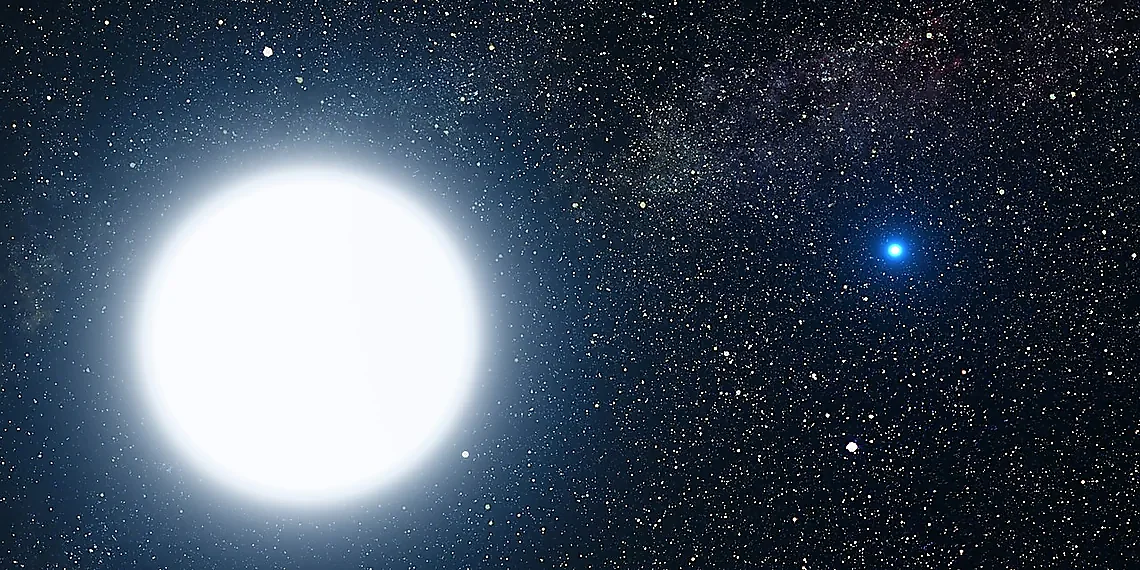
TOI-2267 is a fascinating binary star system composed of two stars designated TOI-2267A and TOI-2267B. The primary star, TOI-2267A, is a G9 dwarf – slightly cooler and less massive than our own Sun. It has an estimated mass of around 0.83 solar masses and a radius about 81% that of the Sun. The secondary star, TOI-2267B, is a K dwarf, significantly smaller and cooler than its companion. This star boasts a mass roughly equivalent to 0.49 solar masses and a radius approximately 53% that of the Sun.
These two stars are locked in a close orbit around each other, completing one revolution every 17.8 days. Their proximity makes them appear as a single point of light when observed from Earth without specialized instruments. The orbital inclination of this binary system is relatively high at approximately 53 degrees relative to our line of sight, which proves advantageous for detecting transiting planets.
The existence of TOI-2267 as a binary system was initially identified through data collected by NASA’s Transiting Exoplanet Survey Satellite (TESS). TESS monitors the brightness of hundreds of thousands of stars, searching for periodic dips in light caused by planets passing in front of them. The unusual and complex dimming pattern observed from TOI-2267 indicated the presence of two stars rather than a single one, prompting further investigation to confirm this binary nature.
The Planetary Trio: Size and Orbit
The newly discovered planetary system orbiting TOI-2267 presents a fascinating puzzle for astronomers – three planets, all roughly Earth-sized, thriving within a binary star system. This is particularly surprising because the gravitational complexities of two stars pulling on forming planets were long thought to make stable planetary orbits exceedingly rare. The innermost planet, TOI-2267 b, clocks in at approximately 1.05 times the size of Earth and completes an orbit every 9.8 days. Planet c is slightly larger, estimated at roughly 1.3 times Earth’s radius, with an orbital period of around 14.8 days. Finally, TOI-2267 d, the outermost planet in this trio, measures about 1.25 times Earth’s size and orbits every 30.6 days.
The sizes of these planets offer intriguing clues about their composition. While a definitive determination requires further observation (such as transit spectroscopy to analyze atmospheric content), initial estimates suggest that all three are likely rocky worlds, similar in density to Earth or Venus. However, the close proximity of each planet to its stars raises significant questions about habitability. TOI-2267 b and c receive significantly more stellar radiation than Earth does from our Sun, making surface temperatures extremely high – far too hot for liquid water as we know it. Planet d receives a slightly less intense flux, but still faces challenges regarding atmospheric retention due to its proximity.
Understanding the orbital dynamics within this binary system is critical. The planets’ orbits are relatively close together and tightly bound around both stars, suggesting a complex gravitational dance that somehow allowed them to form and remain stable over billions of years. Researchers believe the planets likely formed further out in a protoplanetary disk and then migrated inward due to interactions with the binary star system’s gravity. Further observations using instruments like the James Webb Space Telescope will be crucial for refining orbital parameters, characterizing atmospheric conditions (if any), and testing models of planetary formation in these challenging environments.
Despite the unlikely nature of their existence, the discovery of TOI-2267’s triple threat of binary exoplanets forces a reevaluation of our understanding of planet formation. It demonstrates that stable, Earth-sized planets *can* form and persist around binary stars, expanding the potential number of habitable worlds in our galaxy. While these particular planets themselves are unlikely to harbor life as we know it, their existence highlights the need for continued exploration and more sophisticated models to account for planetary systems unlike our own.
Planet Profiles: A Closer Look at Each World
The innermost planet, TOI-2267 b, is approximately 1.18 times the size of Earth and orbits its stars every 9.5 days. Due to its proximity to the binary system – specifically, orbiting around 0.06 Astronomical Units (AU) from the combined stellar mass – it experiences incredibly high irradiation, resulting in an estimated surface temperature of roughly 473 Kelvin (200°C or 392°F). This extreme heat makes liquid water on its surface highly improbable and rules out any possibility of Earth-like life as we know it. Determining the precise atmospheric composition remains challenging given the distance and stellar activity, but current models suggest a runaway greenhouse effect is likely.
Moving outwards, TOI-2267 c boasts a size slightly larger than Earth at 1.35 times its radius. Its orbital period is significantly longer, completing one orbit every 34.8 days, placing it at approximately 0.19 AU from the binary stars. While this distance offers a slightly cooler environment compared to planet ‘b,’ with an estimated temperature of around 367 Kelvin (94°C or 201°F), the intense stellar radiation still presents formidable challenges for habitability. The orbital stability of TOI-2267 c is also subject to ongoing research; gravitational interactions within the binary system could lead to subtle, long-term variations in its orbit that are currently difficult to precisely model.
Finally, TOI-2267 d, the outermost planet, is the largest of the three, measuring 1.58 times Earth’s radius and orbiting with a period of 94.3 days at roughly 0.45 AU. This distance results in an estimated surface temperature of approximately 286 Kelvin (13°C or 55°F). While this temperature range is potentially more conducive to liquid water, the planet’s size suggests a higher probability of being a gas-rich ‘mini-Neptune’ rather than a rocky world like Earth. Further observations, particularly spectroscopic analysis of its atmosphere (if it has one), are crucial to determine its true composition and whether it possesses any characteristics that might support life, although current data provides only estimates with significant uncertainties.
Challenging Planetary Formation Theories
The recent discovery of three Earth-sized planets orbiting the binary star system TOI-2267 is sending ripples through the exoplanet research community. While finding a single planet outside our solar system is exciting, detecting *three* roughly Earth-sized worlds in such an environment – located about 190 light-years away – fundamentally challenges long-held assumptions about planetary formation. This isn’t just another exoplanet find; it’s a direct confrontation with the prevailing models that dictate how planets come into existence.
The core of the surprise lies within what’s known as ‘The Binary Paradox.’ Conventional wisdom dictates that binary star systems – those featuring two stars gravitationally bound together – are incredibly chaotic environments. The gravitational tug-of-war between the two stars creates a dynamically unstable landscape, making it exceedingly difficult for planets to coalesce and maintain stable orbits. Material needed to form planets is often scattered or ejected entirely, leading scientists to believe that complex planetary systems like ours would be virtually impossible in such setups. TOI-2267, however, demonstrates precisely what we thought couldn’t happen.
The existence of these binary exoplanets forces us to reconsider the mechanisms driving planet formation. Current models often rely on a relatively stable protoplanetary disk – a swirling cloud of gas and dust – surrounding a single star. How could such a disk form and persist in the turbulent gravitational environment of a binary system? Did the planets form *before* the stars settled into their binary configuration, or did they somehow manage to assemble themselves later despite the instability? The discovery suggests that either our understanding of protoplanetary disks is incomplete, or that planetary formation processes are far more robust and adaptable than previously believed. Further observation and theoretical work will be crucial to unraveling this mystery.
Ultimately, TOI-2267 offers a tantalizing glimpse into the diversity of planetary systems beyond our own. It highlights that the universe often operates in ways we don’t fully comprehend, pushing us to refine our scientific theories and expand our understanding of how planets – and potentially life – can arise in unexpected corners of the cosmos. This discovery underscores the importance of continued exoplanet research as we strive to answer fundamental questions about our place in the Universe.
The Binary Paradox: How Did They Form?
For decades, astronomers have held a conventional understanding that binary star systems – those containing two stars orbiting each other – present significant hurdles to planet formation. The gravitational interactions between the two stars create dynamically unstable environments. These complex forces are generally thought to disrupt protoplanetary disks, the swirling clouds of gas and dust from which planets form, preventing them from coalescing into stable planetary bodies. Simulations consistently predicted that long-lived planetary systems in binary settings would be exceedingly rare, if they could exist at all.
The recent discovery of TOI-2267, a binary system hosting three Earth-sized exoplanets, dramatically challenges this established paradigm. Located approximately 190 light-years from Earth, the system features two stars orbiting each other relatively closely, while the three planets – designated TOI-2267 b, c, and d – reside in a surprisingly stable configuration around both stars. The inner planets orbit closer to one star than the other, creating an orbital architecture that was previously considered unlikely given the predicted gravitational chaos.
The existence of this ‘binary paradox’ forces astronomers to re-evaluate current planetary formation models. It suggests that either our understanding of how protoplanetary disks behave in binary systems is incomplete or that there are mechanisms allowing for planet formation and long-term stability that we haven’t yet accounted for. Future research will focus on refining simulations, exploring alternative formation scenarios (such as planets forming further out and then migrating inwards), and searching for other similar multi-planet systems to better understand the prevalence of planetary systems in binary environments.
Future Research and the Search for Life
The discovery of three Earth-sized planets orbiting within the TOI-2267 binary system opens exciting new avenues for future research, particularly concerning our understanding of planetary formation and habitability. One immediate focus will be on characterizing the atmospheres of these worlds. Telescopes like the James Webb Space Telescope (JWST) offer unprecedented capabilities to analyze starlight filtering through exoplanetary atmospheres, potentially revealing the presence of key molecules – including biosignatures indicative of life. However, observing planets in a binary system presents unique challenges; the complex gravitational interactions and varying stellar radiation can significantly complicate atmospheric analysis, requiring sophisticated modeling and observation techniques.
Beyond atmospheric characterization, future studies will likely delve deeper into refining our models of planetary system architecture around binaries. The existence of these three planets defies previous assumptions about stability in such environments. Detailed dynamical simulations are crucial to understanding how they formed and maintained their orbits over billions of years. This includes investigating the role of stellar companions’ gravitational influence on planet migration and orbital resonance, which could provide valuable insights into the frequency with which stable planetary systems might arise around binary stars – a previously underestimated possibility.
This discovery fundamentally impacts our search for extraterrestrial life by expanding the scope of potentially habitable environments. For years, binary star systems were largely dismissed as unlikely places to find planets capable of supporting life due to perceived instability and harsh conditions. TOI-2267 challenges this view, suggesting that complex planetary systems may be far more common than previously thought. Consequently, future exoplanet surveys should prioritize searching for similar configurations, increasing the probability of finding other ‘binary exoplanets’ harboring potentially habitable worlds.
Ultimately, continued observation and theoretical modeling are essential to unraveling the mysteries surrounding TOI-2267 and its planetary companions. The data gathered will not only refine our understanding of this specific system but also contribute significantly to broader theories about planet formation, orbital stability, and the distribution of potentially life-supporting worlds across the galaxy – fundamentally reshaping our perspective on where we might find life beyond Earth.
Next Steps: Characterizing Planetary Atmospheres
The next crucial step in understanding TOI-2267 b, c, and d involves detailed atmospheric characterization. The James Webb Space Telescope (JWST) is ideally suited for this task; its infrared capabilities can probe the chemical composition of planetary atmospheres by analyzing how starlight filters through them. Scientists will be looking for biosignatures – gases like oxygen or methane that could indicate the presence of life, though abiotic processes must also be carefully considered and ruled out.
However, studying exoplanet atmospheres in binary systems presents unique challenges. The gravitational influence of two stars can lead to complex orbital dynamics and potentially unstable planetary environments. This instability can affect atmospheric retention; planets might lose their atmospheres more readily than those orbiting single stars. Furthermore, the varying light intensity from the two stars makes it difficult to obtain consistent and accurate measurements of a planet’s atmosphere.
Future research will also focus on refining models of planetary system formation in binary environments. The existence of three Earth-sized planets like these demonstrates that such systems can be more common and potentially habitable than previously thought, prompting a reevaluation of our understanding of where to search for life beyond Earth. Continued observations with JWST and other advanced telescopes are vital to unraveling the mysteries surrounding TOI-2267 and similar binary exoplanetary systems.
The discovery of Earth-sized planets orbiting a star within a binary system fundamentally challenges our preconceived notions about planetary formation, demonstrating that stable orbits and potentially habitable zones can exist in far more complex environments than previously imagined.
This triple threat – three planets circling one star locked in gravitational dance with another – provides invaluable data points for refining our models of planetesimal accretion and orbital dynamics. The existence of these binary exoplanets suggests that planetary systems may be surprisingly common, even around stars not typically considered ideal hosts.
The implications extend beyond simply identifying new worlds; it pushes us to reconsider the very definition of a ‘planetary system’ and opens up exciting avenues for exploring the diversity of celestial architectures throughout our galaxy. Further study will undoubtedly reveal more about the atmospheric composition and potential habitability of these intriguing planets.
This is an incredibly dynamic field, with new discoveries constantly reshaping our understanding of the cosmos. To stay abreast of groundbreaking findings like this one, we encourage you to follow leading astronomical institutions, subscribe to science news outlets, and engage in online communities dedicated to exoplanet research; the future promises even more astonishing revelations.
Continue reading on ByteTrending:
Discover more tech insights on ByteTrending ByteTrending.
Discover more from ByteTrending
Subscribe to get the latest posts sent to your email.