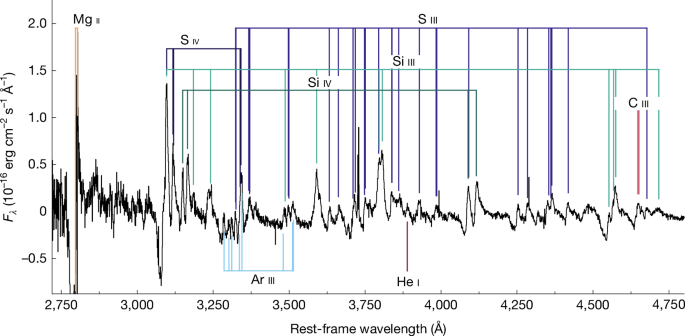


The study of supernova formation has long been a cornerstone of astrophysics, revealing the dramatic processes at play when massive stars meet their end. Recent observations of Supernova 2021yfj, detailed in a Nature publication, are providing unprecedented insights into this cataclysmic event. This discovery challenges existing stellar evolution models and fundamentally shifts our understanding of how these celestial explosions occur.
The core finding revolves around the progenitor star of SN 2021yfj, which was stripped down to its O/Si/S core before ultimately exploding as a supernova. Remarkably, this process continued for an extended period, releasing vast quantities of silicon-, sulfur-, and argon-rich material into space – a significant deviation from previously held assumptions. This finding directly impacts our understanding of the conditions necessary for a star’s demise, and how efficiently elements are dispersed during the supernova formation process. The sheer volume of material ejected by this star underscores the importance of accurately modeling stellar evolution, particularly for massive stars.
Progenitor Star Stripping
The stripping of the progenitor star’s core is a critical element in understanding the dynamics of supernova formation. Traditionally, it was believed that a star would exhaust its fuel and directly collapse into a black hole or neutron star. However, this new research suggests a more complex scenario—a massive star undergoes repeated interactions with its binary companion, leading to progressive depletion of its outer layers. This stripping process isn’t just about removing mass; it fundamentally alters the star’s internal structure, creating a dense core rich in heavy elements. Furthermore, the continued ejection of material from this stripped core before the explosion itself indicates an extended phase of activity that wasn’t previously accounted for in stellar models. The detailed analysis of SN 2021yfj provides crucial data to refine these models and better predict the outcomes of similar events. As a result, we are able to learn more about the processes involved in supernova formation, including the elements produced and dispersed into the surrounding space.
Elemental Enrichment and Stellar Evolution Models
The discovery of silicon-, sulfur-, and argon-rich material being expelled alongside the explosion is particularly noteworthy. These heavy elements are predominantly formed within the cores of massive stars through nuclear fusion—a process that doesn’t occur in smaller stars. Therefore, supernovae are primary sources of these elements throughout the universe, enriching interstellar space with the building blocks for future generations of stars and planets. The fact that this particular supernova continued to produce and eject these elements long after its core collapse demonstrates a previously underestimated stage in stellar evolution. Moreover, it highlights the need to incorporate such complex processes into our models of stellar death. Currently, many models simply don’t account for extended periods of stripping or sustained ejection following core collapse. Consequently, this research necessitates a reevaluation of existing assumptions and potentially requires entirely new theoretical frameworks to accurately describe supernova formation. It’s clear that studying events like SN 2021yfj provides invaluable data for improving our understanding of how stars evolve and contribute to the chemical makeup of the cosmos. The implications are far-reaching, impacting not only stellar astrophysics but also our broader comprehension of the universe’s evolution.
In conclusion, the observations of Supernova 2021yfj represent a significant advancement in our knowledge of supernova formation. The evidence presented—particularly the prolonged stripping of the progenitor star and the subsequent ejection of heavy elements—challenges conventional stellar evolution models and emphasizes the need for more sophisticated simulations. Further research into similar events will undoubtedly refine our understanding of this spectacular cosmic phenomenon, offering new insights into the processes that shape galaxies and ultimately, the universe itself. The continued study of supernovae formation is therefore pivotal to unraveling some of the most fundamental mysteries in astrophysics.
Source: Read the original article here.
Discover more tech insights on ByteTrending.
Discover more from ByteTrending
Subscribe to get the latest posts sent to your email.