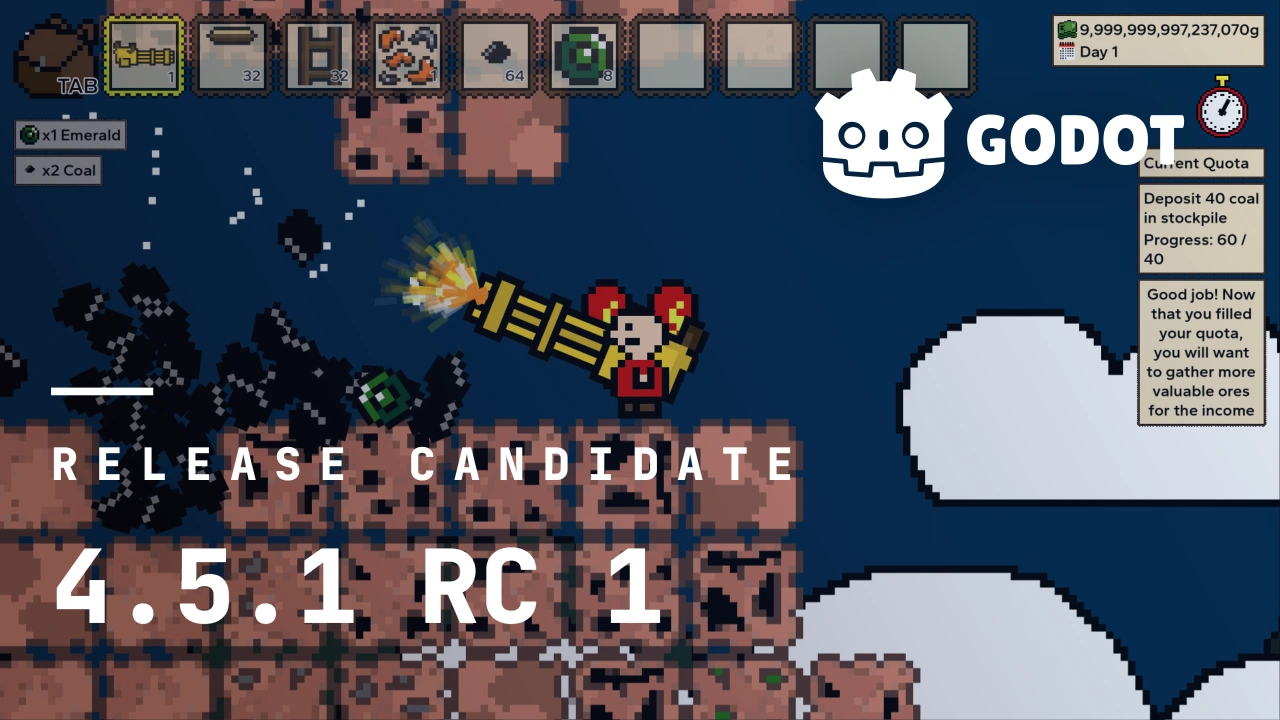

It’s been just over two weeks since the release of Godot 4.5, and the overwhelmingly positive community response has been truly remarkable! Recognizing this momentum, our dedicated contributors have already begun development on Godot 4.6, leading to the release of our initial snapshot earlier this week. This early look provides a glimpse into exciting future developments.
However, the immediate priority was addressing newly reported regressions encountered after the 4.5 release and integrating fixes that were previously deemed too risky for direct merging. Consequently, we’ve prepared several regression fixes for an upcoming 4.5.1 maintenance release. This release candidate serves a crucial purpose: validating these fixes in an isolated environment separate from the new enhancements already present in Godot 4.6. Your testing is invaluable to identify and resolve any unforeseen issues that weren’t present in the stable 4.5 version, ensuring a smooth upgrade process.
Furthermore, if you are able, please consider supporting the project financially; Godot’s continued development depends on contributions from passionate individuals like yourself. Donations directly sponsor our contributors and enable them to focus their efforts on enhancing this powerful engine.
Jump to the Downloads section to try it out right now, or continue reading for more details about these improvements. You can also experience this release through the Web editor, the XR editor, or the Android editor. If you’re interested in testing the Android build specifically, please request to join our dedicated testing group to gain access to pre-release builds.

Understanding the Improvements in Godot 4.5.1 RC 1
A total of 31 contributors submitted 33 improvements for this release, demonstrating the vibrant and collaborative spirit within the Godot community. For a comprehensive overview of all changes since the 4.5-stable release, please refer to our interactive changelog.
Audio Fixes and Optimizations
Several enhancements were implemented to improve the audio experience within Godot. Notably, a padding frame was added to the QOA buffer for short streams (GH-110515), which helps prevent potential playback issues. Furthermore, adjustments were made to the build system on Windows, migrating the godot.manifest file and ensuring its inclusion as a dependency (GH-110897).
Core Engine Enhancements
Improvements have been made to several core engine functionalities. For example, the Quaternion variant is now initialized with identity (GH-84658). Additionally, repeated “_copy_on_write()” calls in Array::resize() were avoided for efficiency (GH-110535), leading to performance gains. Importantly, string parsing functions now include checks for NUL characters (GH-110556) preventing unexpected errors.
Rendering and SceneTree Stability
Significant effort was dedicated to enhancing the stability of the rendering pipeline and scene management within Godot. A crash that occurred when creating a new instance of VisualServer::ArrayMesh has been resolved (GH-84739). Similarly, a crash related to an empty RasterizerInterface has also been fixed (GH-106955), ensuring more robust rendering performance. Lastly, the scene tree now avoids passing signals to freed nodes, preventing potential crashes and errors (GH-84723).
Accessing the Release Candidate
You can download the release candidate here and begin testing immediately. This is a crucial step in ensuring the stability of future Godot releases.
Supporting Continued Development
If you appreciate the power and flexibility of Godot and wish to see its continued improvement, please consider donating to the Godot Foundation. These contributions are vital for sustaining development efforts and ensuring that Godot remains a free and open-source game engine.
Source: Read the original article here.
Discover more tech insights on ByteTrending.
Discover more from ByteTrending
Subscribe to get the latest posts sent to your email.