
Imagine a time before galaxies as we know them existed, when the cosmos was shrouded in darkness and filled with a fog of hydrogen and helium. Astronomers are now peering back into that epoch like never before, revealing glimpses of an era previously relegated to theoretical models. Recent observations have shaken up our understanding of how the universe evolved from its infancy – and what we’re seeing is truly breathtaking. The sheer scale and brilliance of these newly discovered objects challenges existing theories about star formation itself.
For decades, scientists have theorized about the existence of extremely massive stars that ignited in the early universe, but direct observation remained elusive until now. These weren’t your average suns; they were behemoths, potentially hundreds or even thousands of times more massive than our own, burning with an unimaginable intensity. We’re talking about what are often referred to as primordial stars – the very first generation of stellar objects to light up the cosmos.
The James Webb Space Telescope (JWST) is proving instrumental in this revolutionary era of discovery, its infrared capabilities uniquely suited to pierce through cosmic dust and reveal these ancient lights. JWST’s sensitive instruments allow us to analyze the faint signals emanating from incredibly distant sources, providing unprecedented data about their composition and behavior. These findings are reshaping our understanding of how galaxies formed and evolved, offering crucial insights into the conditions that birthed the universe we inhabit today.
The Cosmic Dawn and Its Mysteries
The universe as we know it began with a bang – the Big Bang – but what happened *after* that initial explosion is shrouded in cosmic mystery. We’re talking about the ‘cosmic dawn,’ a pivotal epoch roughly 100 to 500 million years after the Big Bang, when the first stars ignited and pierced the pervasive darkness. Understanding this period is absolutely crucial for cosmology because it represents a key transition: from a universe filled with neutral hydrogen gas to one increasingly shaped by starlight and the heavier elements forged within those very first stars. It’s essentially the dawn of our familiar cosmos, but we’ve been peering into that dawn with frustratingly limited clarity until now.


Before cosmic dawn, the early universe was an incredibly hostile place. Temperatures were searingly hot, matter existed in a dense plasma state, and there were virtually no elements heavier than hydrogen and helium – the products of Big Bang nucleosynthesis. This extreme environment profoundly impacted how stars formed. Unlike today’s stellar nurseries, which rely on complex molecular clouds enriched with heavy elements, primordial star formation likely occurred through a much more direct collapse of vast gas clouds. These conditions suggest these first stars were fundamentally different from what we observe now – significantly larger, hotter, and far shorter-lived.
Despite decades of theoretical modeling and indirect observations, significant gaps remain in our knowledge of the cosmic dawn. We’ve struggled to directly observe these early stars due to their immense distance and the intervening gas that obscures our view. Until recently, our understanding has largely relied on inferring their existence based on the behavior of neutral hydrogen – how it absorbed light from later generations of quasars. However, this indirect approach leaves many questions unanswered: How massive were these primordial stars? What was their distribution across the universe? And most importantly, how did they ultimately shape the evolution of galaxies?
The recent discovery of chemical fingerprints pointing to gigantic primordial stars, thanks to observations from the James Webb Space Telescope, is a monumental step forward. These findings promise to revolutionize our understanding of this critical era and finally allow us to begin directly probing the conditions that gave birth to the universe we see today – potentially rewriting textbooks and challenging existing cosmological models in the process.
What Was the Early Universe Like?
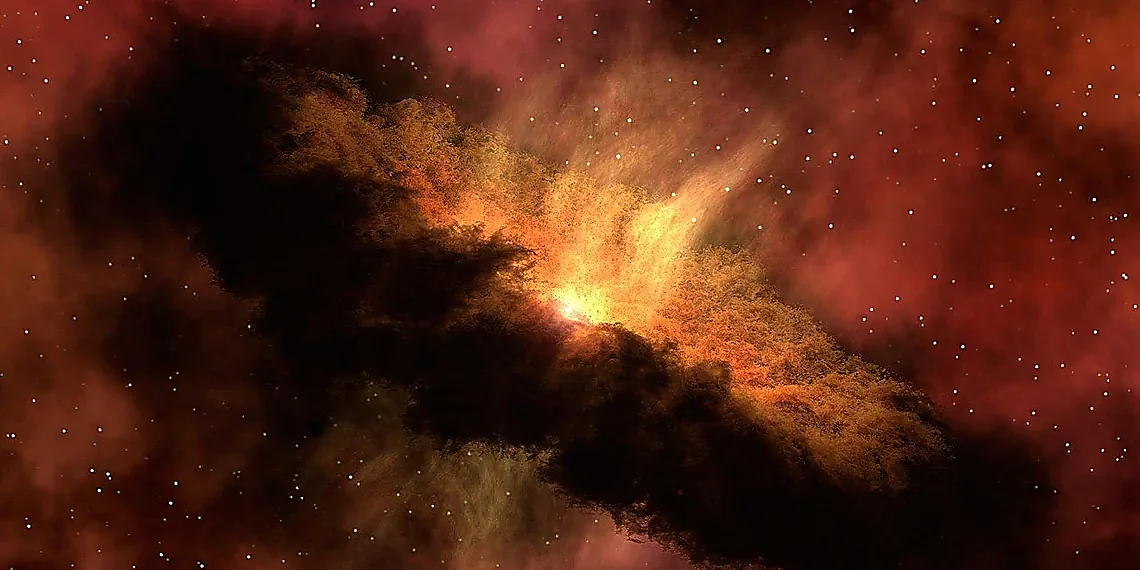
The era known as the ‘Cosmic Dawn’ marks a pivotal period in the universe’s history, roughly 100 million to one billion years after the Big Bang. Before this time, the universe existed as an incredibly hot and dense plasma – essentially a soup of fundamental particles like quarks and electrons. As the universe expanded and cooled, these particles eventually combined to form neutral hydrogen atoms. Understanding Cosmic Dawn is crucial because it represents the moment when light began to permeate the cosmos, transitioning from an opaque state to one we can now observe, and allowing for the formation of the first stars and galaxies.
The conditions immediately following the Big Bang were radically different from anything we experience today. The extreme heat meant that gravity had a difficult time pulling matter together; everything was dispersed and energetic. Furthermore, the universe was almost entirely composed of hydrogen and helium – the lightest elements forged in the initial moments after the Big Bang. This lack of heavier elements, like carbon or oxygen, profoundly impacted how stars formed because these elements are vital for efficient nuclear fusion and stellar stability.
Because there were no heavy elements to act as catalysts, primordial star formation likely proceeded very differently from what we see today. The absence of these ‘metals’ meant that the first stars had to be significantly more massive than modern stars – potentially hundreds or even thousands of times larger. These behemoths would have burned through their fuel incredibly quickly and ended their lives in spectacular supernovae, seeding the universe with heavier elements for subsequent generations of stars to form.
Meet the ‘Monster Stars’
Forget everything you think you know about stars. While our Sun is impressive, it pales in comparison to the behemoths that lit up the early universe – what astronomers are now calling ‘monster stars.’ These weren’t your average stellar nurseries; they were colossal, incredibly massive objects born just a few hundred million years after the Big Bang. Unlike today’s stars, which have relatively low masses and are rich in elements like carbon and oxygen (elements forged within earlier generations of stars), primordial stars were fundamentally different – vastly larger, significantly more massive, and composed almost entirely of hydrogen and helium, the raw ingredients left over from the universe’s fiery beginning.
So, what made these ‘monster’ stars so monstrous? The key lies in the lack of heavier elements. Modern star formation relies on a process called radiative cooling, where heavier elements act like tiny radiators, efficiently shedding heat. In the early universe, however, these elements were scarce. This meant that gas clouds couldn’t cool down as effectively, preventing them from fragmenting into smaller clumps and forming numerous smaller stars. Instead, they collapsed directly into single, gargantuan objects – some estimates suggest they could have been 30 to 300 times the mass of our Sun! The name ‘monster stars’ isn’t just hyperbole; it reflects their truly exceptional size.
The physics behind their formation is fascinating. Without efficient cooling mechanisms, gas accretion onto a forming star became a runaway process. Imagine trying to build a sandcastle with no way to compact the sand – it would pile up rapidly and become unstable. Similarly, the primordial gas simply kept falling onto the growing stellar core, fueling its massive growth. This period of rapid, unchecked accretion ultimately resulted in stars that were far more massive than anything we see today, creating these truly remarkable cosmic entities.
The recent discovery of chemical fingerprints – subtle traces left behind by these ancient giants – using the James Webb Space Telescope is providing unprecedented insights into this pivotal era of cosmic history. It’s allowing scientists to piece together a clearer picture of how the universe evolved from its initial state, and ultimately, how we came to be.
Size Matters: Why Were They So Huge?

The ‘monster stars’ discovered by researchers are a stark contrast to the familiar stars we see today. These primordial stars, born just hundreds of millions of years after the Big Bang, were incredibly massive – estimates suggest some could have been 30 to 300 times the mass of our Sun, and potentially even larger. To put this in perspective, most modern stars are significantly smaller, with a maximum mass around 100 solar masses. Their sheer size earned them the moniker ‘monster stars’ due to their exceptional scale compared to contemporary stellar populations.
The extraordinary size of these primordial giants stemmed from the unique conditions of the early universe. Unlike today’s cosmos, which is enriched by elements forged in previous generations of stars (what astronomers call ‘metals’), the early universe was almost entirely hydrogen and helium. This lack of heavier elements had a crucial impact on how these stars formed. Metals help radiate heat away from collapsing gas clouds; without them, the cooling process was dramatically less efficient.
This inefficient cooling led to what’s known as ‘runaway accretion.’ As a primordial star began to form, gravity pulled in surrounding gas and dust. Because there were fewer metals to dissipate the heat generated by this infall, the core temperature soared, preventing the cloud from fragmenting into smaller stars. Instead, all available material continued to collapse onto the central protostar, resulting in an enormous object – a ‘monster star’ – far larger than anything we typically observe today.
JWST’s Revelation: Chemical Fingerprints
The James Webb Space Telescope (JWST) is rewriting our understanding of the early universe, and its latest discovery is nothing short of spectacular: direct evidence of primordial stars – some of the very first stars to ignite after the Big Bang. These weren’t your average stars; they were colossal behemoths, hundreds or even thousands of times more massive than our Sun, blazing with an intensity that shaped the cosmos. JWST’s unprecedented infrared vision is allowing us to peer further back in time than ever before, and it’s revealing astonishing details about these cosmic giants through their distinct chemical signatures.
The key to unlocking this ancient history lies in spectral analysis – a technique astronomers use to decode the light emitted from distant objects. When starlight passes through space or an atmosphere, certain wavelengths are absorbed by specific elements. These absorptions create dark lines in the spectrum of light, acting like fingerprints that identify what’s present. JWST’s observations have detected unusual abundance ratios of elements in extremely distant galaxies – specifically, a surprising prevalence of carbon and nitrogen relative to oxygen. This imbalance is a telltale sign of massive primordial stars going through rapid cycles of nuclear fusion, burning through their fuel at an astonishing rate.
These chemical fingerprints aren’t just about identifying the elements; they paint a picture of the stars’ lifecycle. The high abundance of carbon and nitrogen suggests these monster stars underwent multiple supernova explosions – each explosion enriching the surrounding gas with heavier elements. This process seeded the universe with the building blocks for future generations of stars and planets, ultimately contributing to the conditions that allowed life as we know it to emerge. JWST’s data is allowing scientists to refine models of stellar evolution in these early epochs, revealing a far more dynamic and complex picture than previously imagined.
Furthermore, the observed abundances challenge existing theories about how primordial stars formed and evolved. The unexpected ratios suggest different formation mechanisms or earlier generations of even larger, more short-lived stars might have existed. Ongoing JWST observations are now focused on analyzing light from even further galaxies, promising to uncover even more detailed chemical fingerprints that will continue to refine our understanding of these primordial giants and the dawn of cosmic light.
Decoding the Light: Spectral Analysis Explained
Astronomers are like cosmic detectives, and spectral analysis is their primary tool for identifying what faraway objects are made of. When light from a star or galaxy reaches us, it’s broken down into its component colors – essentially creating a rainbow-like spectrum. Dark lines appear within this spectrum; these ‘absorption lines’ occur when specific elements in the object absorb certain wavelengths of light. Each element has a unique pattern of absorption lines—a kind of chemical fingerprint—allowing astronomers to identify their presence, even across vast distances.
The James Webb Space Telescope (JWST) is revolutionizing our ability to perform this analysis due to its exceptional sensitivity and infrared capabilities. The primordial stars, being incredibly distant and faint, emit most of their light in the infrared spectrum. JWST’s observations of these ancient galaxies have revealed spectral fingerprints indicating a surprising abundance of elements like carbon, nitrogen, and oxygen – far more than previously expected for objects formed so early in the universe’s history. These weren’t just trace amounts; the relative proportions of these elements are also providing crucial insights.
The presence of these heavier elements suggests that these ‘monster stars’ underwent a rapid lifecycle. They likely burned through their fuel incredibly quickly, undergoing multiple cycles of star formation and supernova explosions which seeded the surrounding gas with newly synthesized elements. Analyzing the specific ratios of these elements helps astronomers understand how many generations of stars existed before these primordial giants formed, refining our models of the early universe’s chemical evolution.
Implications and Future Exploration
The detection of these primordial stars, marked by their unique chemical signatures, carries profound implications for our understanding of the universe’s infancy. Current cosmological models predict a certain population of early stars, but the sheer size and abundance revealed by JWST data may necessitate revisions. Specifically, these findings challenge assumptions about the efficiency of early star formation and the conditions prevalent in those nascent environments. We’re effectively rewriting cosmic history, needing to reassess how quickly galaxies assembled and evolved after the Big Bang – a period previously shrouded in observational uncertainty.
A crucial aspect of this discovery lies in its potential to shed light on the reionization epoch—a pivotal moment when the neutral hydrogen that filled the early universe was ionized by energetic radiation. These massive primordial stars, burning intensely and emitting vast amounts of ultraviolet light, are prime candidates for driving this process. The observed chemical fingerprints offer clues about the distribution and intensity of this ionizing radiation, allowing us to refine models of how reionization progressed across cosmic time and understand its impact on subsequent galaxy formation. Were these stars more numerous or longer-lived than previously thought? That’s a key question we now need to address.
Future exploration will focus intensely on characterizing more primordial star candidates identified by JWST. Spectroscopic follow-up observations, utilizing even more sensitive instruments currently in development, are essential for precisely determining their elemental abundances and physical properties. Furthermore, theoretical simulations must be updated to incorporate these new observational constraints, allowing us to test the viability of different star formation scenarios and refine our understanding of the early universe’s chemical evolution. The hunt isn’t just about finding more stars; it’s about piecing together a complete picture of that formative era.
Beyond JWST, future missions like the Extremely Large Telescope (ELT) will provide complementary ground-based observations, enabling detailed studies of these distant objects and their surrounding environments. Combining data from space-based and terrestrial telescopes promises to unlock even more secrets about the primordial stars and their role in shaping the cosmos we observe today. Ultimately, this research pushes us closer to answering fundamental questions: How did the first galaxies form? What was the universe like in its earliest moments? And what does it tell us about our own origins?
Rewriting Cosmic History?
The detection of these primordial stars’ chemical signatures through JWST observations presents a potential challenge to existing cosmological models, particularly those detailing the initial conditions and processes following the Big Bang. Current Lambda-CDM models predict a gradual build-up of early stellar populations, primarily composed of smaller, less massive stars. The observed abundance of heavy elements – specifically carbon and oxygen – in these newly discovered behemoths suggests that they formed much faster and more efficiently than previously thought, potentially requiring revisions to our understanding of the initial gas density fluctuations and star formation rates during the cosmic dawn.
A significant implication lies in how these massive primordial stars influenced the reionization epoch. This period marked when the neutral hydrogen filling the early universe was ionized by ultraviolet radiation from the first stars and quasars. The sheer luminosity of these ‘monster stars’ would have dramatically accelerated this process, potentially leading to a faster and more uneven reionization than previously modeled. Current models often struggle to fully explain the observed properties of high-redshift galaxies; incorporating these massive early stars could provide a crucial missing piece in understanding their formation and evolution.
Future research will focus on refining the measurements of elemental abundances in these primordial stellar remnants, seeking further evidence to constrain their masses and lifetimes. Spectroscopic follow-up with JWST and future telescopes like the Extremely Large Telescope (ELT) will be vital for characterizing more of these objects and mapping their distribution across the early universe. Ultimately, this work aims to build a more comprehensive picture of the cosmic dawn – how galaxies formed, when reionization occurred, and the fundamental processes that shaped the universe we observe today.
The recent observations, made possible by instruments like the James Webb Space Telescope, have fundamentally reshaped our understanding of the early universe and offer compelling evidence for the existence of these colossal stellar behemoths.
We’ve seen firsthand how rapidly our models are evolving as we gather data from further back in time; the sheer scale of some of these detected light signatures suggests a population of incredibly massive, short-lived stars – what we might consider early examples of primordial stars – unlike anything previously imagined.
The implications extend far beyond simply adding another chapter to cosmic history. Understanding how these monster stars formed and influenced their environments is crucial for piecing together the puzzle of galaxy evolution and the distribution of heavy elements throughout the cosmos.
While we’ve made incredible strides, this is just the beginning; future observations promise even greater detail and potentially reveal entirely new surprises about the universe’s infancy. The ongoing analysis of JWST data will undoubtedly continue to refine our theories and challenge existing paradigms for years to come, pushing the boundaries of astronomical knowledge further than ever before. The quest to understand the very first light is an incredibly exciting journey, and we’re only just getting started exploring its depths. It’s a testament to human ingenuity and our relentless pursuit of understanding our place within this vast universe. There’s so much more waiting to be discovered, and these initial findings are merely a tantalizing glimpse into the wonders that await us at the edge of observable space and time. The future of astronomical research looks brighter than ever before, fueled by technological innovation and boundless curiosity. Discoveries like these remind us how much we still have to learn about our universe’s origins and evolution. We invite you to delve deeper into this fascinating subject – explore the incredible capabilities of the James Webb Space Telescope and uncover even more groundbreaking discoveries shaping our cosmic perspective.
Continue reading on ByteTrending:
Discover more tech insights on ByteTrending ByteTrending.
Discover more from ByteTrending
Subscribe to get the latest posts sent to your email.