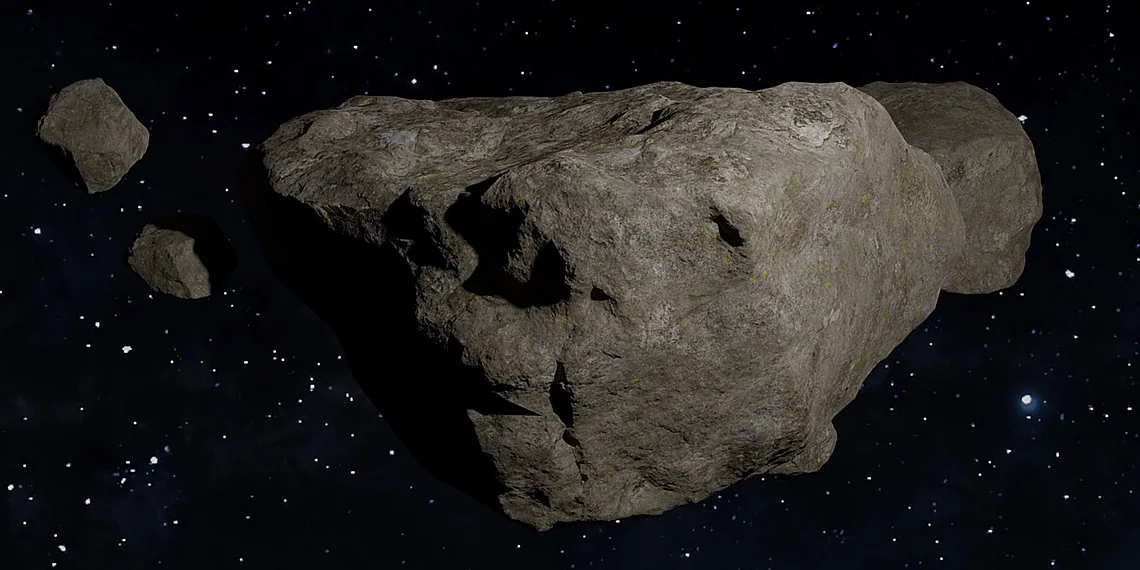


Imagine a future where precious metals aren’t just dug from Earth, but harvested from celestial bodies orbiting far beyond our atmosphere – that future is closer than you think.
The concept of resource extraction in space has long captivated science fiction enthusiasts, and now it’s rapidly transitioning into tangible reality thanks to advancements in robotics, materials science, and propulsion technology.
A pioneering field known as asteroid mining promises not only a new source of vital resources but also the potential to revolutionize space exploration itself, opening up possibilities previously confined to dreams.
While many nations are exploring this frontier, Spain is quietly asserting its leadership with groundbreaking research spearheaded by the Institute for Chemical Engineering – CSIC (ICE-CSIC). Their recent study offers crucial insights into a key challenge: efficiently extracting water ice from asteroids, which could be used as propellant and life support in deep space missions. This work significantly advances the feasibility of asteroid mining operations we once considered decades away. It’s an exciting development that positions Spain at the forefront of this emerging industry, and we’ll delve into their findings shortly.
The Promise of Asteroid Resources
The allure of asteroid mining lies in its potential to unlock vast reserves of resources currently locked away beyond Earth. Our planet’s resources are finite, and as demand for materials like rare earth elements – crucial for everything from smartphones to electric vehicle batteries – continues to surge, terrestrial mines face increasing pressure. Extraction on Earth often involves environmentally damaging practices and geopolitical complexities. Asteroid mining presents a compelling alternative: access to an essentially limitless supply of raw materials that could revolutionize industries and fundamentally reshape our global economy.
Beyond the precious metals like platinum and gold, asteroids hold significant quantities of water ice. This isn’t just valuable for scientific research; it’s a game-changer for deep space exploration. Water can be broken down into hydrogen and oxygen, which are powerful rocket propellants. Establishing ‘space gas stations’ at strategically located asteroids would dramatically reduce the cost and complexity of missions further into our solar system, enabling everything from lunar bases to Mars colonization.
The economic implications are staggering. While the initial investment in asteroid mining technology is substantial, the potential return on investment dwarfs anything currently achievable through terrestrial resource extraction. Imagine a future where vital materials are readily available without the environmental and political challenges associated with Earth-based mining – this isn’t science fiction; it’s a realistic possibility within our lifetimes. The Spanish Institute of Space Sciences (ICE-CSIC)’s pioneering work, as highlighted by Space Daily, represents a crucial step towards realizing that future.
Ultimately, asteroid mining is about more than just extracting resources; it’s about expanding humanity’s reach and securing its long-term sustainability. By looking beyond Earth’s limits and harnessing the wealth of our solar system, we can address resource scarcity, fuel further space exploration, and unlock unprecedented technological advancements – all while potentially mitigating some of the environmental burdens associated with traditional mining practices.
Beyond Earth’s Limits

For decades, humanity has relied on Earth’s finite resources to fuel technological advancements and economic growth. However, many essential materials are becoming increasingly scarce and difficult – and expensive – to extract. Rare earth elements crucial for electronics, advanced manufacturing, and renewable energy technologies are concentrated in a few regions globally, leading to geopolitical dependencies and price volatility. Furthermore, the environmental impact of terrestrial mining operations, including deforestation, habitat destruction, and pollution, presents a significant challenge to sustainable development.
Asteroid mining offers a compelling solution to these limitations by providing access to vast reserves of resources beyond Earth’s confines. Asteroids are essentially ‘space rocks’ containing valuable minerals like platinum group metals (PGMs), nickel, iron, cobalt, and water ice. Water, in particular, is incredibly valuable as it can be broken down into hydrogen and oxygen – the key components of rocket propellant. This capability would dramatically reduce the cost and complexity of deep-space exploration by enabling ‘in-situ resource utilization’ (ISRU) and eliminating the need to transport fuel from Earth.
The economic impact of asteroid mining could be transformative. While initial investment costs are substantial, successful extraction and processing of resources like PGMs – currently valued at thousands of dollars per kilogram – would generate significant returns. Beyond direct revenue generation, the development of asteroid mining technologies will spur innovation in robotics, autonomous systems, materials science, and space infrastructure, creating new industries and high-paying jobs here on Earth.
Spain’s ICE-CSIC Study: A Closer Look
Spain isn’t just reaching for the stars; it’s planning to mine them. The Instituto de Ciencias del Espacio (ICE-CSIC), a Spanish research institute, is spearheading an innovative study into the feasibility of asteroid mining – and their approach sets them apart. While the idea of extracting valuable resources from asteroids has captured imaginations for years, a major hurdle has been accurately determining what these space rocks are actually made of, particularly when it comes to smaller, less-studied asteroids.
The ICE-CSIC study tackles this challenge head-on. Their research focuses on developing sophisticated models and techniques to analyze the spectral signatures – essentially, how light reflects off an asteroid’s surface – to infer its chemical composition. Think of it like identifying a plant species by looking at the color and texture of its leaves; the ICE-CSIC team is doing something similar with asteroids, but using more complex data analysis. Early findings suggest that smaller asteroids might contain higher concentrations of valuable metals than previously thought, making them potentially even more attractive targets for future mining operations.
What’s truly innovative about ICE-CSIC’s work isn’t just the goal of asteroid mining itself, but their commitment to a detailed and methodical understanding of these celestial bodies. They aren’t simply looking for riches; they are building the foundational knowledge necessary to make asteroid mining a sustainable and scientifically sound endeavor. This includes refining our ability to predict asteroid behavior and developing strategies for efficient resource extraction – all crucial steps before any actual mining can begin.
The Spanish institute’s research underscores that asteroid mining isn’t just about futuristic technology; it’s about rigorous scientific investigation. By focusing on the fundamental question of ‘what are we dealing with?’ ICE-CSIC is paving the way for a future where space resources become a reality, and Spain stands at the forefront of this exciting frontier.
Unlocking Asteroid Composition Secrets

A significant hurdle in asteroid mining is accurately determining the chemical composition of smaller asteroids. Unlike larger bodies where radar and spectral analysis provide relatively clear data, these smaller objects present a challenge due to their size, distance, and often irregular shapes. Knowing precisely what resources – water ice, precious metals like platinum, or other valuable materials – an asteroid contains is crucial for assessing its mining potential and planning extraction strategies.
Researchers at the Instituto de Ciencias del Espacio (ICE-CSIC) in Spain are tackling this challenge with a novel approach. Their study utilizes a combination of laboratory simulations and advanced modeling techniques. They create artificial regoliths, mimicking the surface material of asteroids, using data from meteorite samples and orbital observations. These simulated surfaces are then subjected to various conditions – temperature changes, radiation exposure – to understand how their spectral signatures evolve over time.
Initial findings from the ICE-CSIC study suggest that previously underestimated factors, such as subtle variations in mineral grain size and the presence of even trace amounts of volatile compounds like water ice, can significantly alter an asteroid’s observed reflectance. This means existing remote sensing data might be misleading if not properly interpreted, highlighting the need for more sophisticated analytical methods to accurately characterize potential mining targets.
Technological Hurdles & Future Steps
While Spain’s pioneering research into asteroid mining represents a significant leap forward, the path to realizing this ambition is fraught with considerable technological hurdles. Successfully extracting resources from asteroids isn’t simply about locating them; it demands sophisticated autonomous robotics capable of navigating complex celestial environments, landing on low-gravity bodies, and performing precise excavation tasks. Current robotic systems are largely Earth-bound or designed for relatively controlled planetary surfaces – adapting them to the unpredictable nature of asteroid terrain presents a major engineering challenge.
Propulsion is another critical bottleneck. Reaching asteroids requires significantly more efficient propulsion systems than those currently used for interplanetary travel. Traditional chemical rockets are simply too inefficient and costly for repeated journeys and cargo transport within the asteroid belt. Research into advanced technologies like solar electric propulsion, fusion drives, and even beamed energy propulsion is crucial to making asteroid mining economically viable. Furthermore, returning extracted resources back to Earth or utilizing them in space necessitates equally robust return capabilities.
Resource extraction itself poses unique challenges. We need to develop methods for identifying valuable minerals within asteroids – often requiring detailed remote sensing and potentially even sample retrieval for analysis. Then, we’ll need to devise efficient and environmentally responsible techniques for extracting those resources without contaminating the asteroid or disrupting its orbit. This includes innovative approaches to mineral processing in a vacuum environment with limited power availability; In-Situ Resource Utilization (ISRU) will be paramount.
Looking ahead, potential milestones include demonstrating robotic prospecting missions within the next 5-10 years, followed by initial resource extraction pilot projects within 10-20 years. A more comprehensive and commercially viable asteroid mining operation could realistically emerge in 25-35 years, contingent on continued investment in research and development across these critical technological areas. International collaboration, likely involving partnerships between space agencies like ESA and private sector companies, will be essential to accelerating progress and sharing the risks and rewards of this ambitious endeavor.
From Concept to Reality: The Road Ahead
Realizing the dream of asteroid mining requires substantial advancements across several key technological domains. Autonomous robotics are paramount; rovers and mining platforms must operate with minimal human intervention given the vast distances involved and communication delays. These robots need sophisticated AI for navigation, resource identification, and decision-making in unpredictable environments. Furthermore, developing robust systems capable of withstanding extreme temperatures, radiation exposure, and micrometeoroid impacts is crucial for long-term operational viability.
In-Situ Resource Utilization (ISRU) – the ability to extract and process resources directly on the asteroid – is another critical hurdle. This includes technologies for excavating regolith, separating valuable minerals like platinum group metals or water ice, and refining them into usable materials. Efficient propulsion systems are also essential; current chemical rockets are too slow and costly for frequent asteroid retrieval missions. Research into advanced options such as solar electric propulsion (SEP) and potentially even fusion-based propulsion is actively underway to reduce transit times and increase payload capacity.
Collaboration between space agencies, private companies, and research institutions will likely be vital in overcoming these challenges. The Spanish Institute of Space Sciences’ (ICE-CSIC) work highlights the potential for European leadership in this field, and partnerships with entities like NASA or commercial space exploration firms could accelerate progress. While fully operational asteroid mining is still decades away, milestones such as successful robotic sample return missions from near-Earth asteroids within the next 10-15 years represent achievable targets that would pave the way for resource extraction.
The Broader Implications & Ethical Considerations
The prospect of asteroid mining isn’t just about extracting valuable minerals; it holds profound implications for the future of space exploration and humanity’s relationship with celestial bodies. Successfully tapping into these resources could fundamentally reshape our understanding of what constitutes ‘space resources,’ potentially ushering in entirely new industries focused on refining, manufacturing, and distributing materials sourced from asteroids. Imagine spacecraft built using asteroid-derived metals, or habitats constructed utilizing locally available regolith – the possibilities are transformative, though significant technological hurdles remain.
Currently, international law surrounding resource extraction in space is a complex and evolving area. The 1967 Outer Space Treaty prohibits national appropriation of celestial bodies but leaves room for interpretation regarding resource utilization. While no explicit laws govern asteroid mining, ongoing discussions within organizations like the United Nations Committee on the Peaceful Uses of Outer Space (COPUOS) aim to establish clearer guidelines. This ambiguity necessitates a proactive approach to ensure any future exploitation is conducted responsibly and equitably.
Beyond legal frameworks, serious ethical considerations arise with asteroid mining. The question of resource ownership – who has the right to mine which asteroids – remains contentious. Furthermore, we must consider the potential environmental impact of large-scale asteroid extraction. While asteroids are often perceived as barren rocks, disrupting their composition could have unforeseen consequences for nearby celestial bodies or even alter orbital dynamics. A robust ethical framework, developed in parallel with technological advancements, is crucial to mitigate these risks.
Ultimately, Spain’s leadership in this pioneering study highlights the growing global interest in asteroid mining and its potential to unlock a new era of space exploration. However, realizing this vision requires not only innovative engineering but also careful consideration of the broader implications – ensuring that our pursuit of resources beyond Earth is conducted sustainably, ethically, and for the benefit of all humankind.
Space Resources: A New Frontier?
The prospect of asteroid mining represents a fundamental shift in our perception of space resources. Historically viewed as barren and empty, near-Earth asteroids are now recognized as repositories of valuable materials like water ice, platinum group metals (PGMs), nickel, iron, and rare earth elements. These resources could revolutionize space exploration by providing propellant for spacecraft, building materials for orbital habitats, and raw materials to support in-space manufacturing – drastically reducing the cost and complexity of missions originating from Earth. Furthermore, access to these materials could alleviate resource scarcity on our planet, although the scale of that impact remains a subject of ongoing research.
The emergence of asteroid mining also poses complex legal challenges. The 1967 Outer Space Treaty forms the cornerstone of international space law, stipulating that outer space is free for exploration and use by all nations and prohibiting national appropriation of celestial bodies. However, the treaty doesn’t explicitly address resource extraction. Subsequent interpretations and emerging frameworks, like those proposed by organizations such as the Resource Extraction in Space (RES) project, attempt to clarify permissible activities while ensuring equitable access and preventing conflict. The legal landscape is still evolving, and international consensus on a robust regulatory framework remains crucial.
Beyond the economic and legal considerations, ethical concerns surrounding asteroid mining are beginning to surface. These include questions of environmental impact – even though asteroids lack an atmosphere, dust generated during mining could affect orbital environments – as well as issues related to resource ownership and equitable distribution. While current efforts focus on smaller, less scientifically significant asteroids, future ambitions might target larger bodies with greater scientific value, necessitating careful consideration of planetary protection protocols and potential disruption of the solar system’s architecture.
Spain’s proactive approach to space exploration, particularly its significant investment in research related to asteroid mining, positions it as a surprisingly pivotal player in this burgeoning field. The nation’s focus on robotic systems and advanced materials is directly contributing to overcoming some of the most pressing hurdles facing commercial space resource extraction. While challenges remain – from developing efficient propulsion methods to refining ore processing techniques in zero gravity – Spain’s innovative spirit offers tangible progress towards realizing a future where resources are sourced beyond Earth. The potential benefits, including reduced reliance on terrestrial mining and access to rare metals crucial for technological advancement, are simply too significant to ignore. Asteroid mining represents more than just scientific curiosity; it’s a strategic imperative for long-term sustainability and economic growth, and Spain is demonstrably at the forefront of shaping its trajectory. The coming years promise further breakthroughs as research continues and international collaboration intensifies, bringing us closer to unlocking the vast wealth held within our solar system. We invite you to stay informed about this exciting evolution – follow the latest developments in space resource utilization and be a part of witnessing humanity’s next giant leap.
$100 million investment from Spain, along with its technological advancements, is paving the way for asteroid mining.
Continue reading on ByteTrending:
Discover more tech insights on ByteTrending ByteTrending.
Discover more from ByteTrending
Subscribe to get the latest posts sent to your email.