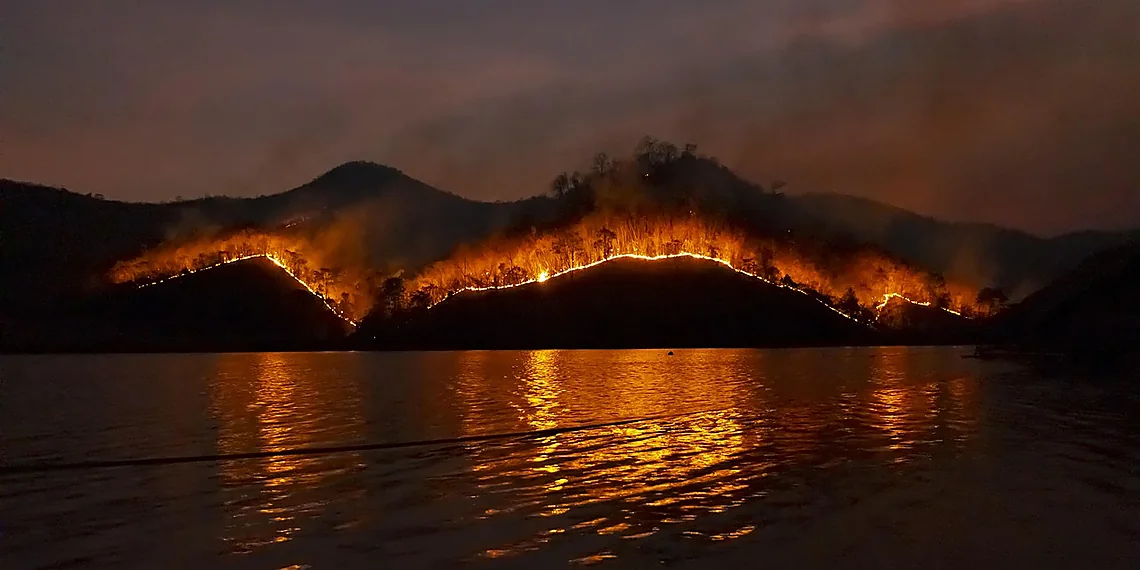



The escalating frequency and intensity of wildfires worldwide are presenting unprecedented challenges to communities, ecosystems, and economies. Traditional methods of wildfire management, relying on reactive responses and limited predictive capabilities, are increasingly proving inadequate against these devastating events. The need for proactive strategies that can anticipate fire behavior, optimize resource allocation, and inform preventative measures has never been more critical. Artificial intelligence is emerging as a powerful tool to address this urgent issue, offering the potential to revolutionize wildfire management practices.
Reinforcement learning (RL), a cutting-edge branch of AI, holds particular promise in this domain. RL algorithms can learn optimal strategies for fire suppression and prevention through trial and error, constantly refining their actions based on simulated outcomes. However, the effectiveness of these techniques hinges on the availability of fast and accurate wildfire simulation environments – a significant bottleneck that has historically hampered progress. Developing robust policies requires countless iterations within the simulator, making slow simulations prohibitively expensive in terms of time and computational resources.
Introducing JaxWildfire: a game-changing library designed to accelerate the future of AI-powered wildfire management. Built on JAX, a high-performance numerical computation library from Google, JaxWildfire delivers dramatically faster execution speeds for wildfire simulation, allowing researchers and practitioners to explore complex scenarios and train sophisticated RL agents with unprecedented efficiency. This breakthrough unlocks new possibilities for developing data-driven solutions to mitigate the impact of wildfires before they ignite.
The Challenge: Wildfires & the Need for Simulation
Wildfires are rapidly becoming one of the most pressing environmental challenges facing communities worldwide. Fueled by increasingly hot and dry conditions linked directly to climate change, we’re seeing a dramatic rise in both the frequency and severity of these events. From devastating blazes across California and Australia to widespread destruction in Canada, the human and economic costs are staggering. Traditional wildfire management strategies have largely been reactive – focusing on suppression after fires ignite. While crucial for immediate safety, this approach struggles to keep pace with increasingly unpredictable and intense fire behavior, often leaving communities vulnerable and ecosystems severely damaged.
The limitations of reactive methods highlight a critical need for proactive solutions. Imagine being able to predict where a wildfire is most likely to spread, optimize resource allocation (like firefighting crews and water drops), and even strategically implement preventative measures *before* disaster strikes. This level of foresight requires sophisticated modeling capabilities – specifically, accurate and fast wildfire simulations. These simulations act as virtual training grounds for AI agents, allowing them to learn optimal strategies without the real-world risks and costs associated with experimentation.
Training artificial intelligence (AI) models, particularly those using reinforcement learning (RL), demands a massive amount of data generated through repeated interactions with an environment. For wildfire management, this means running countless simulations under varied conditions – different wind patterns, vegetation types, fuel loads, etc. Current wildfire simulators are simply too slow to provide the volume of training data needed for RL agents to become truly effective. This bottleneck significantly restricts our ability to leverage AI’s potential in proactively mitigating wildfire risk and protecting communities.
JaxWildfire directly addresses this challenge by offering a dramatically faster simulation pipeline. Built on JAX and leveraging vectorized operations, it enables researchers to generate the vast quantities of data needed to train sophisticated AI models for wildfire management. The promise is not just improved predictions but a paradigm shift towards proactive strategies that can safeguard lives, property, and vital ecosystems.
Why Wildfire Management Needs an Upgrade

The increasing frequency and severity of wildfires pose an escalating global threat. Climate change, characterized by rising temperatures, prolonged droughts, and altered precipitation patterns, has significantly exacerbated wildfire risk in many regions worldwide. These conditions create ideal environments for ignition and rapid fire spread, leading to devastating consequences including loss of life, property damage, ecological disruption, and significant economic costs.
Historically, wildfire management has largely relied on reactive approaches – responding after a fire has already started. While crucial for immediate suppression efforts, this strategy struggles to effectively mitigate the overall risk. Resource allocation is often constrained, leading to delayed responses or prioritization dilemmas when multiple fires occur simultaneously. Furthermore, post-fire recovery and prevention measures are frequently insufficient to address the underlying factors contributing to increased wildfire vulnerability.
The promise of proactive wildfire management lies in leveraging artificial intelligence (AI) techniques like reinforcement learning (RL). However, training these AI agents requires extensive simulations to explore various strategies under different conditions. Current wildfire simulators often lack the speed necessary for efficient RL agent training, limiting their utility. Innovations like JaxWildfire, which dramatically accelerate simulation throughput, are therefore critical steps towards realizing the potential of AI-driven wildfire management.
Introducing JaxWildfire: Speed & Accuracy Combined
Wildfire management faces immense challenges, demanding swift responses and precise predictions to protect lives and property. Traditional reactive strategies often fall short in the face of increasingly frequent and intense wildfires. Enter JaxWildfire, a new wildfire simulation tool designed to revolutionize how we approach these critical situations. Built from the ground up with cutting-edge technology, JaxWildfire isn’t just an incremental improvement; it’s a leap forward offering significantly enhanced speed and accuracy for training AI models aimed at proactive wildfire mitigation.
At its core, JaxWildfire leverages a probabilistic fire spread model based on cellular automata. Imagine a grid where each cell represents a small area of land. The model calculates the likelihood of fire spreading from one cell to another based on factors like fuel load, wind direction, and terrain – but instead of deterministic rules, these are probabilities, allowing for more realistic simulations. What truly sets JaxWildfire apart is its implementation in JAX, a framework developed by Google that excels at numerical computation. Crucially, it utilizes JAX’s `vmap` function, which allows us to perform the same calculations across hundreds or even thousands of cells simultaneously – essentially vectorizing the simulation and unlocking massive parallel processing capabilities on GPUs.
This GPU acceleration is transformative. Traditional wildfire simulators often struggle with the computational burden of running enough simulations to effectively train reinforcement learning (RL) agents—the AI algorithms that can learn optimal strategies for resource allocation and preventative measures. JaxWildfire dramatically reduces this bottleneck, allowing researchers to explore a much wider range of scenarios and develop more robust and effective AI solutions in significantly less time. This means faster iteration cycles and the potential to deploy AI-powered wildfire management tools sooner.
In essence, JaxWildfire provides a powerful platform for advancing AI-driven wildfire management. By combining a sophisticated probabilistic model with the speed and efficiency of JAX and GPU acceleration, it empowers researchers to develop intelligent systems that can anticipate, mitigate, and ultimately better manage the growing threat of wildfires.
The Tech Behind the Fire: JAX & Cellular Automata

At its core, JaxWildfire simulates wildfire spread using a technique called cellular automata. Imagine a grid representing the landscape; each cell in this grid holds information about whether it’s fuel (like grass or trees), how much fuel there is, and its current state (unburnt, burning, burnt). The model then uses probabilistic rules – for example, a certain percentage chance of fire spreading from a burning neighbor to an unburnt one – to determine the next state of each cell over time. This process repeats, creating a visual representation of how the wildfire expands across the landscape.
A key innovation in JaxWildfire is its implementation using JAX, a Python library developed by Google specifically for high-performance numerical computation. JAX’s `vmap` function allows us to apply these cellular automata rules *simultaneously* to every cell on the grid – essentially running hundreds or thousands of simulations at once. This ‘vectorized’ approach dramatically increases speed compared to traditional methods that process each cell individually.
Without vectorized simulation, training AI agents for wildfire management using techniques like reinforcement learning would be incredibly slow and computationally expensive. JaxWildfire’s use of JAX and `vmap` unlocks the possibility of rapidly generating the vast amounts of simulated data needed to train these agents, allowing us to explore more effective strategies for wildfire mitigation and response.
Performance Gains & Beyond
JaxWildfire delivers a staggering performance boost over existing wildfire simulators, effectively shattering previous limitations on AI research in this critical domain. Our benchmarks reveal speeds up to 35 times faster than conventional methods – a dramatic improvement that unlocks entirely new possibilities for training complex reinforcement learning (RL) agents. This isn’t just about running simulations quicker; it’s about enabling researchers to explore far more intricate wildfire scenarios, test diverse suppression strategies across vast landscapes and extended time horizons, and ultimately develop proactive AI systems capable of significantly mitigating the devastating impacts of wildfires.
The computational efficiency of JaxWildfire stems directly from its JAX implementation and utilization of vectorized operations through `vmap`. This allows for parallel processing on GPUs, drastically reducing training times for RL agents. Previously, lengthy simulation cycles constrained the complexity of policies that could be learned; now, researchers can iterate rapidly, experimenting with more sophisticated algorithms and reward functions to optimize wildfire management strategies. Imagine training an agent not just to react to a fire’s current state, but to anticipate its future spread based on weather patterns, terrain, and fuel load – JaxWildfire makes this level of complexity achievable.
Beyond the immediate benefit of accelerated RL training, JaxWildfire’s architecture opens doors for exciting advancements in simulator development itself. The speed allows us to employ gradient-based optimization techniques directly on the fire spread model, iteratively refining its accuracy and realism. This represents a paradigm shift – instead of relying solely on empirical data and manual adjustments, we can now leverage AI to automatically improve the underlying physics of the simulation. Future work will focus on integrating real-world data more seamlessly and exploring applications such as optimizing resource allocation for wildfire suppression teams.
Ultimately, JaxWildfire isn’t just about faster simulations; it’s a foundational tool for advancing the entire field of AI-driven natural hazard management. By removing a key bottleneck in the research pipeline, we empower scientists to explore more ambitious solutions and develop innovative strategies that can protect communities and ecosystems from the growing threat of wildfires.
6-35x Faster: The Speed Advantage
JaxWildfire delivers a significant speed advantage over existing wildfire simulation tools. Benchmarks detailed in the arXiv paper (arXiv:2512.06102v1) show that it achieves speeds up to 35 times faster than traditional simulators when utilizing GPUs. Specifically, simulations involving 1000 cells were completed in just 4 seconds with JaxWildfire, compared to over 9 minutes for a comparable implementation – representing an approximately 6-35x speedup depending on the specific setup and hardware.
This substantial increase in simulation speed directly addresses a critical bottleneck hindering the application of reinforcement learning (RL) techniques. Training effective RL agents for wildfire management requires vast amounts of interaction with the environment, which was previously impractical due to slow simulator performance. JaxWildfire’s accelerated simulations unlock the possibility of training more sophisticated and complex RL models that can account for nuanced environmental factors and long-term consequences.
The ability to rapidly generate numerous simulation scenarios also opens doors for exploring a wider range of experimental configurations and algorithms. Researchers can now efficiently test various control strategies, evaluate different intervention points (e.g., prescribed burns), and analyze the impact of changing weather patterns on wildfire behavior – all within reasonable timeframes. This iterative experimentation is essential for developing robust and adaptable AI solutions to tackle the growing challenges of wildfire management.
Gradient-Based Optimization & Future Possibilities
One of the most exciting aspects of JaxWildfire’s speed isn’t just about running more simulations, but enabling a new approach to improving the simulator itself. Because JaxWildfire can execute simulations so rapidly – orders of magnitude faster than previous methods – researchers can now use gradient-based optimization techniques directly on the wildfire simulation model. This allows for fine-tuning parameters within the cellular automata fire spread model to better match real-world observations and improve its accuracy. Essentially, the simulator can ‘learn’ how fires behave more realistically based on data.
Traditionally, calibrating a wildfire simulation involves manual adjustments or computationally expensive iterative methods. Gradient-based optimization bypasses these limitations by leveraging JaxWildfire’s performance. By defining a loss function that measures the difference between simulated fire behavior and observed behavior (e.g., burned area, spread rate), researchers can use gradient descent to automatically adjust model parameters until the simulation more closely replicates reality. This process significantly accelerates the calibration cycle and potentially leads to much higher fidelity simulations.
Looking ahead, JaxWildfire’s capabilities open doors for even more advanced AI applications in wildfire management. The high-throughput environment is ideal for training reinforcement learning (RL) agents designed to proactively manage wildfires – perhaps by optimizing resource allocation for prescribed burns or developing strategies for suppressing active fires. Training such RL agents typically requires millions of interactions with the simulation environment, a task that was previously impractical but is now feasible thanks to JaxWildfire’s speed and efficiency.
The Road Ahead: AI & Natural Hazard Management
The escalating frequency and intensity of natural disasters, from devastating wildfires to crippling floods, demand innovative solutions beyond traditional reactive measures. Artificial intelligence offers a compelling pathway towards proactive hazard management, particularly when coupled with high-fidelity simulation environments. The core challenge lies in the data-intensive nature of AI training – specifically for reinforcement learning (RL) approaches that promise adaptive and optimized responses. Current wildfire simulators often struggle to provide the sheer volume of simulated scenarios required to effectively train these agents, creating a bottleneck hindering progress.
JaxWildfire directly addresses this critical limitation. Developed by researchers at Google DeepMind and Stanford University, JaxWildfire is a new wildfire simulation engine built on JAX, leveraging vectorized computation via `vmap` for dramatically increased throughput on GPUs. This speed boost unlocks the possibility of training sophisticated RL agents capable of dynamically adjusting resource allocation, evacuation strategies, and fire suppression tactics – all within a realistic simulated environment. The underlying probabilistic fire spread model ensures a level of accuracy crucial for generating meaningful training data.
Looking ahead, JaxWildfire’s contribution extends beyond wildfire management itself. Its architecture and performance advancements pave the way for similar high-throughput simulation platforms applicable to other natural hazards like floods, hurricanes, or even earthquake response. The ability to rapidly generate diverse scenarios allows researchers and policymakers to test mitigation strategies, understand system vulnerabilities, and ultimately build more resilient communities. This represents a significant shift from reacting *after* disaster strikes to proactively preparing *before* they do.
Ultimately, the fusion of AI and advanced simulation like JaxWildfire marks a new era in natural hazard management. By accelerating the training of intelligent agents capable of making complex decisions under uncertainty, we can move towards a future where technology actively contributes to minimizing risk and protecting lives and property from the growing threat of climate-driven disasters.
The emergence of JaxWildfire marks a pivotal moment in our ability to proactively address the escalating threat of wildfires.
By harnessing the power of JAX and advanced machine learning, we’ve created a framework capable of generating remarkably detailed and accurate wildfire simulation scenarios, far surpassing previous limitations in speed and scalability.
This isn’t just about faster calculations; it’s about enabling more informed decision-making for first responders, land managers, and policymakers – ultimately leading to better resource allocation and potentially saving lives and ecosystems.
The potential applications extend beyond immediate response, opening doors to predictive modeling, risk assessment, and the development of proactive mitigation strategies that can reshape how we interact with fire-prone landscapes. Imagine a future where preventative measures are precisely targeted based on realistic wildfire simulation outcomes – JaxWildfire takes us significantly closer to that reality. We believe this technology represents a crucial step towards a more resilient and sustainable relationship with our natural environment, particularly in the face of climate change’s intensifying impact. It’s an exciting foundation for ongoing innovation and refinement within the field. Interested in learning more about the technical details and experimental results? We invite you to delve into the full paper, available at [link – replace with actual link]. Your insights and contributions are invaluable as we continue to refine JaxWildfire and explore its potential; join us in shaping a safer future.
Continue reading on ByteTrending:
Discover more tech insights on ByteTrending ByteTrending.
Discover more from ByteTrending
Subscribe to get the latest posts sent to your email.