


The relentless pursuit of sustainable energy solutions has brought us face to face with a significant hurdle: effectively removing carbon dioxide from industrial emissions.
Traditional methods for scrubbing CO2 are notoriously power-hungry, often requiring substantial energy input that ironically undermines their environmental benefits.
Imagine needing to expend nearly as much energy cleaning up pollution as the process creating it – it’s a frustrating paradox we urgently need to solve.
Scientists and engineers are increasingly turning to nature for inspiration, seeking elegant and efficient solutions already perfected through millions of years of evolution; this is where biomimicry comes into play in tackling CO2 capture challenges effectively and sustainably. Specifically, researchers have been studying surprisingly effective strategies found in unexpected places – like the coordinated movements of schools of fish, which are now informing a revolutionary approach to carbon removal technology.
The Problem with Current CO2 Scrubbing
Existing carbon dioxide scrubbing technologies, vital for enclosed environments like spacecraft and submarines, face a significant hurdle: they’re incredibly energy-intensive. The conventional methods often rely on chemical absorption or adsorption processes that necessitate extremely high temperatures – frequently reaching upwards of 200°C – to effectively remove CO2 from the air. This thermal requirement translates directly into substantial energy expenditure, which is particularly problematic in resource-constrained environments like long-duration space missions where every kilowatt matters.
The sheer amount of power needed isn’t just a minor inconvenience; it’s a critical limitation impacting mission feasibility and cost. Consider that maintaining temperatures near 200°C requires significant heating systems, adding weight and complexity to the overall design. This not only increases launch costs but also demands robust cooling systems to prevent overheating elsewhere on the vessel or spacecraft – further exacerbating energy consumption and creating potential system vulnerabilities.
Traditional CO2 capture processes aren’t just inefficient in terms of immediate energy use; they also often have secondary environmental impacts related to the production and disposal of the chemicals involved. The reliance on high temperatures frequently necessitates specialized materials that can withstand those conditions, contributing to a larger carbon footprint throughout the entire lifecycle of these scrubbing systems. This highlights the urgent need for alternative approaches that minimize both energy demand and environmental impact.
Ultimately, the limitations of current CO2 capture methods underscore the importance of innovation in this field. The high-temperature requirements create a significant barrier to wider adoption and sustainable implementation, particularly as we look towards increasingly complex closed-loop life support systems for future space exploration and other demanding applications.
Energy Demands of Traditional Systems

Traditional carbon dioxide capture systems, vital for applications ranging from submarines to industrial processes, often rely on chemical absorption or adsorption techniques. A significant drawback of these methods is the high temperatures required for efficient CO2 release and regeneration of the absorbent material. Many conventional systems necessitate heating to temperatures as high as 150-200°C (302-392°F) to effectively strip the captured CO2, making them energy intensive.
The substantial energy input needed for this thermal swing represents a considerable operational cost and environmental burden. For example, in large-scale industrial carbon capture, the heat requirement can account for upwards of 70% of the total energy consumed by the process. This high energy demand severely limits the scalability and overall sustainability of current CO2 scrubbing technologies.
Furthermore, the reliance on high temperatures often necessitates complex heating systems and increases equipment size and weight – a critical consideration for mobile or space-constrained applications like spacecraft life support where minimizing power consumption and physical footprint is paramount.
Inspired by Nature: The Schooling Swarm
The quest for efficient CO2 capture often pushes scientists to explore unconventional approaches. Dr. Hui He’s team at Guangxi University found inspiration in an unexpected place: the mesmerizing behavior of fish schools. Schooling, a phenomenon observed in many aquatic species, isn’t simply about following each other blindly. It’s a complex dance where individual fish adjust their movements based on the position and velocity of their neighbors, resulting in remarkably coordinated group motion. This collective intelligence allows them to evade predators, find food more effectively, and navigate efficiently – all without a central leader dictating their actions.
This principle of decentralized coordination directly informed the design of the team’s “micro/nano reconfigurable robots” (MNRMs) for CO2 capture. Each MNRM acts as an individual unit, equipped with sensors that allow it to detect and respond to its surrounding environment and nearby robots. Just like fish in a school, these tiny robots adjust their positions and movements based on the actions of their neighbors, forming dynamic clusters. This self-organization allows them to collectively maximize CO2 absorption across a surface area far greater than what a single robot could achieve.
The beauty of this biomimicry lies not just in the efficiency gain but also in the adaptability of the system. As CO2 concentrations vary within a confined space, the MNRM ‘school’ can dynamically reconfigure itself to focus on areas with higher concentrations. This responsiveness eliminates the need for energy-intensive heating processes – a significant advancement over traditional CO2 capture methods that require temperatures as high as 200°C. By mimicking nature’s elegant solutions, Dr. He and his team have created a potentially transformative approach to scrubbing carbon dioxide in critical environments like spacecraft or submarines.
Mimicking Collective Behavior
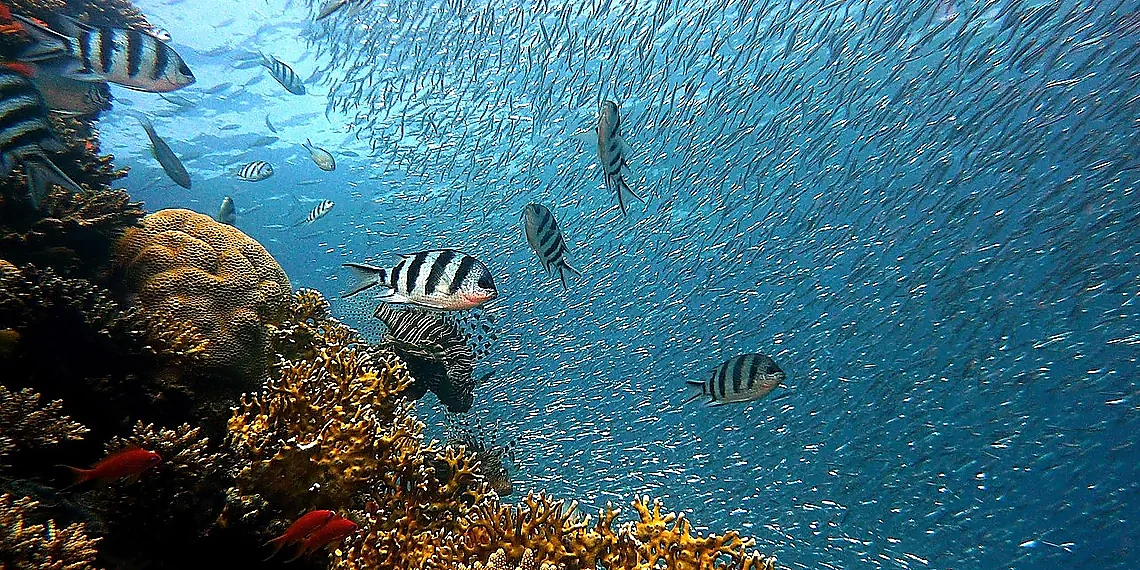
The coordinated movements of schooling fish offer a compelling example of emergent behavior – complex, large-scale actions arising from simple individual rules. Each fish in a school isn’t consciously directing the entire group; instead, they follow basic guidelines like maintaining proximity to their neighbors and aligning direction. These local interactions create a fluid, dynamic structure that allows the school to rapidly change course, evade predators, and efficiently forage – all without centralized control or explicit communication.
This seemingly effortless coordination stems from each fish reacting to the position and velocity of those immediately around it. A slight adjustment in one fish’s direction is mirrored by its neighbors, creating a wave-like effect that propagates through the school. This decentralized approach allows for remarkable flexibility and responsiveness; the school can quickly adapt to changing environmental conditions or threats.
Recognizing the efficiency inherent in this natural system, Dr. He’s team drew inspiration from schooling behavior when designing their MNRMs. The robots are programmed with similar principles of local interaction – each robot adjusts its position and movement based on the actions of its neighbors – to create a collective ‘swarm’ that maximizes CO2 capture surface area and optimizes flow through the material. This biomimetic approach aims to replicate the efficiency and adaptability seen in fish schools, but applied to carbon dioxide removal.
How Micro/Nano Reconfigurable Robots (MNRMs) Work
The innovative approach developed by Dr. He’s team centers around Micro/Nano Reconfigurable Robots (MNRMs), a novel material designed for significantly more efficient CO2 capture compared to existing methods. These MNRMs aren’t traditional robots in the sense of having motors or complex programming; instead, they are microscopic particles—specifically, magnetic microparticles coated with a metal-organic framework (MOF) – that self-assemble and reconfigure based on external stimuli. The MOFs themselves are key: these porous materials provide an exceptionally large surface area for CO2 adsorption, dramatically increasing the material’s capture capacity.
The magic of MNRMs lies in their dynamic behavior facilitated by magnetic fields. Researchers use precisely controlled magnetic fields to manipulate these microparticles, guiding them to aggregate into larger structures or disperse as needed. This allows for a ‘scrubbing’ action where the MOF-coated particles move through the air, absorbing CO2. Crucially, this aggregation and dispersal process is reversible; after saturation with CO2, another magnetic field can be applied to release the captured gas – often at much lower temperatures than traditional systems (significantly reducing energy consumption). The specific MOF used in this study is likely a variant of ZIF-8 or similar, chosen for its demonstrated effectiveness in adsorbing CO2.
The chemical process of CO2 absorption within the MOF involves physisorption – weak electrostatic interactions between the CO2 molecules and the metal ions within the framework. This differs from chemisorption, which forms strong chemical bonds. Physisorption requires less energy to occur and release, contributing to the MNRMs’ reduced operational temperature. The magnetic microparticles themselves don’t directly participate in the CO2 absorption; their role is purely mechanical—to deliver the MOF to the CO2 source and facilitate its efficient removal and regeneration.
Ultimately, this reconfigurable architecture allows for a highly adaptable system. By adjusting the strength and pattern of the applied magnetic fields, researchers can fine-tune the MNRMs’ movement and aggregation behavior, optimizing their performance in various environments – crucial for applications like spacecraft life support where conditions fluctuate considerably. The ability to remotely control and regenerate these microscale systems presents a significant advancement in CO2 capture technology.
Magnetic Manipulation & CO2 Absorption
The MNRMs leverage magnetic fields to precisely control their movement and aggregation, eliminating the need for bulky pumps or fans typically found in traditional CO2 scrubbers. Each micro/nano robot is coated with a layer of magnetite (Fe3O4), a naturally occurring iron oxide that exhibits strong magnetic properties. By applying an external magnetic field – generated by strategically placed electromagnets – researchers can direct these particles to specific locations within the system, causing them to coalesce into larger clusters or disperse as needed. This dynamic control allows for efficient sweeping of air across the CO2-absorbing material and facilitates regeneration processes.
The core of the CO2 absorption process lies in a metal-organic framework (MOF) coating on the MNRMs. The specific MOF used, ZIF-67 (zeolitic imidazolate framework), is chosen for its high affinity to CO2 molecules. ZIF-67 possesses a porous structure with abundant nitrogen sites that chemically bind with carbon dioxide through Lewis acid-base interactions. When exposed to air containing CO2, these nitrogen atoms attract and capture the CO2 molecules within the MOF’s pores. This binding is reversible; applying vacuum or altering temperature allows the captured CO2 to be released, regenerating the MOF for subsequent absorption cycles.
The combination of magnetic manipulation and ZIF-67’s chemical absorption capability offers a significant advantage over conventional methods. The magnetic control minimizes energy consumption associated with air circulation, while the MOF’s selective CO2 capture operates at much lower temperatures (around room temperature) compared to high-temperature adsorption processes. This reduced energy demand promises a more sustainable and efficient solution for CO2 removal in enclosed environments, such as spacecraft or submarines.
Potential Applications & Future Directions
While the initial application of these micro/nano reconfigurable robots (MNRMs) focuses on enhancing life support systems within spacecraft and submarines – a vital need for extended missions – the potential extends far beyond this niche. The efficiency gains achieved by Dr. He’s team, drastically reducing the energy requirements compared to traditional CO2 capture methods, open doors to adapting this technology for broader environmental applications. Imagine integrating MNRMs into industrial settings to directly scrub CO2 from flue gas streams emitted by power plants or factories; a significantly more cost-effective and sustainable alternative to current carbon capture solutions.
Furthermore, the principles behind MNRM CO2 capture could contribute to direct air capture (DAC) initiatives aimed at removing existing greenhouse gases from the atmosphere. Although scaling up this technology for DAC presents substantial challenges – requiring vast surface areas of active material and addressing logistical hurdles in deployment and maintenance – the reduced energy footprint is a compelling advantage. The current system’s reliance on specific materials and its operational conditions would need significant refinement to be truly viable for large-scale atmospheric CO2 removal, but the core concept demonstrates a promising pathway.
Looking ahead, research should prioritize several key areas. Firstly, exploring alternative, more readily available and sustainable materials beyond those currently utilized in the MNRMs is crucial for scalability and cost reduction. Secondly, enhancing the robots’ selectivity to capture only CO2 while minimizing the absorption of other atmospheric components would improve overall efficiency. Finally, investigations into self-healing capabilities and autonomous operation within complex environments could greatly simplify maintenance and deployment in diverse settings – from industrial facilities to remote direct air capture installations.
Beyond Spacecraft: Environmental Impact?
While initially conceived for spacecraft life support, the core principles behind these micro/nano reconfigurable robots (MNRMs) hold promise for broader CO2 capture applications. The efficiency gains achieved – operating at significantly lower temperatures compared to conventional methods – could make them viable for capturing CO2 from industrial sources like power plants or cement factories. Integrating MNRMs into existing exhaust systems, potentially as a coating or filtration layer, presents an intriguing pathway to reduce emissions directly at the source. Furthermore, research is exploring their use in direct air capture (DAC) technologies, which aim to remove CO2 already present in the atmosphere.
However, significant challenges remain before widespread adoption becomes reality. Scaling up the production of MNRMs to industrial levels while maintaining cost-effectiveness is a major hurdle. Current fabrication methods are complex and likely expensive. The long-term durability and stability of these robots within harsh industrial environments – exposed to pollutants, varying temperatures, and potential mechanical stress – also need rigorous evaluation. Further research must focus on improving the CO2 absorption capacity of the materials used in MNRMs and optimizing their configuration for maximum efficiency across a range of conditions.
Future avenues of investigation include exploring different nanomaterials with enhanced CO2 selectivity and developing self-healing capabilities within the MNRM structures to extend their operational lifespan. Combining MNRM technology with other carbon capture methods, such as mineralization or algae-based systems, could potentially create hybrid approaches that leverage the strengths of each technique while mitigating individual weaknesses. The ongoing research aims to transition this exciting development from a laboratory curiosity into a practical solution for tackling global CO2 emissions.
The journey through nature’s ingenuity has revealed a powerful truth: solutions to our most pressing technological challenges often lie waiting, perfectly honed by millions of years of evolution.
From the intricate structures of coral reefs to the efficient respiration of plants, biomimicry offers a roadmap for innovation that transcends traditional engineering approaches.
We’ve seen how mimicking natural processes can lead to breakthroughs in diverse fields, and particularly exciting is the potential for advancements in areas like sustainable materials and even CO2 capture technologies, inspired by photosynthetic organisms.
The examples explored highlight not just *what* nature does, but *how*, providing invaluable insights into efficient design, resource utilization, and resilience – principles essential for a future facing climate change and resource scarcity. This is far more than simply copying; it’s understanding the underlying strategies that drive natural success and adapting them to human needs. The promise of biomimicry isn’t just about creating new technologies, but about shifting our perspective on how we innovate as a species, fostering a deeper respect for the planet in the process. Ultimately, embracing this approach represents a vital step toward sustainable progress and a more harmonious relationship with the natural world around us. The potential is enormous, and its applications will only continue to expand as we deepen our understanding of biological systems. It’s clear that nature holds countless secrets still waiting to be unlocked, ready to inspire the next generation of innovators and problem-solvers. So, don’t just take our word for it; dive deeper into this fascinating field yourself! Explore the boundless possibilities of biomimicry – your curiosity could spark the next revolutionary discovery.
Continue reading on ByteTrending:
Discover more tech insights on ByteTrending ByteTrending.
Discover more from ByteTrending
Subscribe to get the latest posts sent to your email.