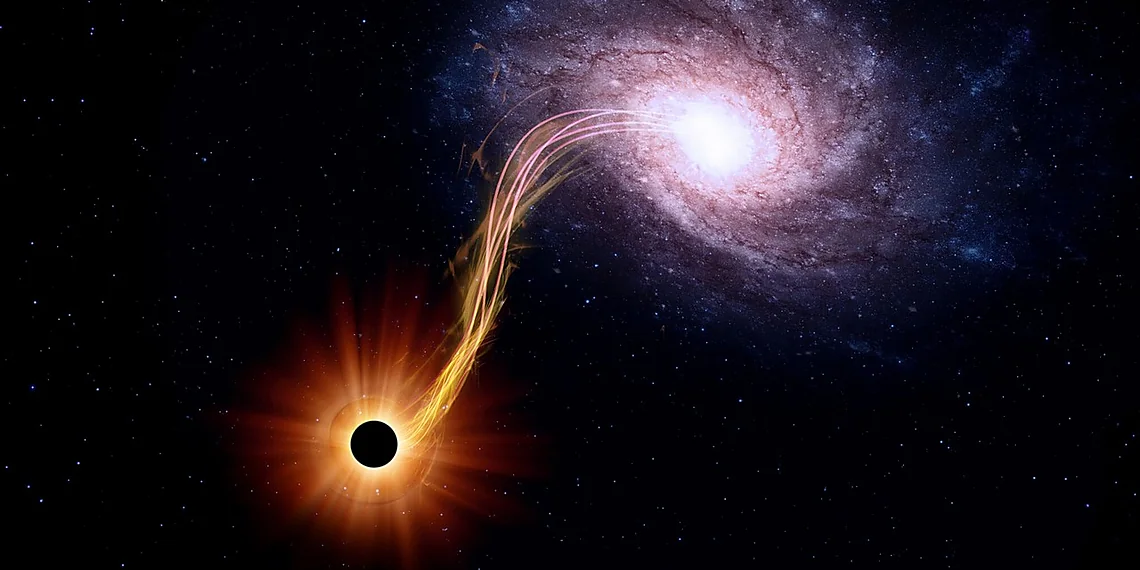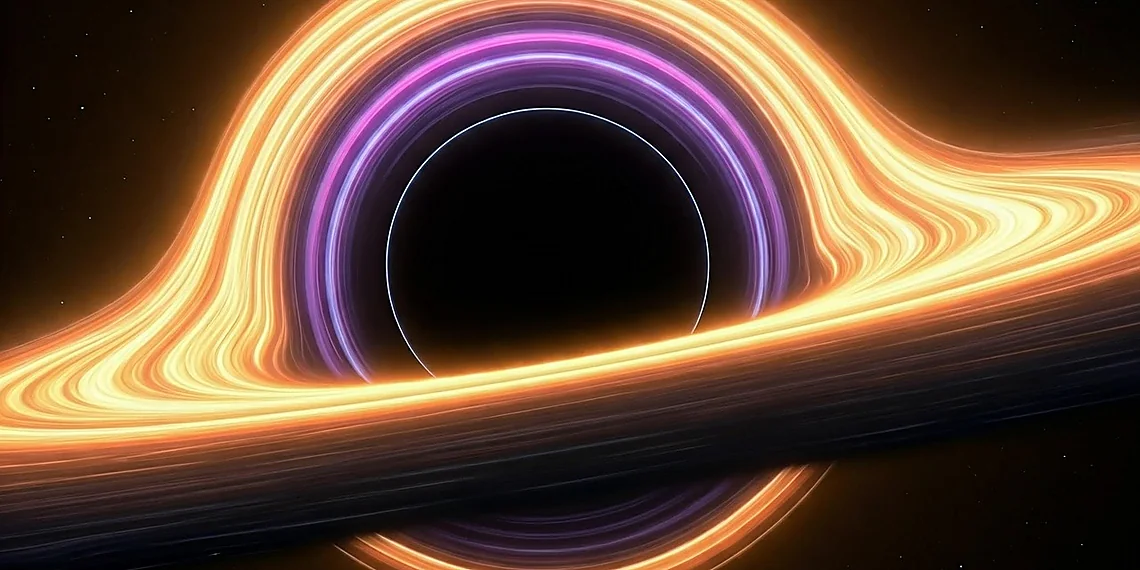



For decades, understanding these cosmic behemoths – black holes – has been one of science’s most formidable challenges. Their immense gravity warps spacetime itself, making direct observation incredibly difficult and traditional simulations computationally expensive nightmares. Scientists have long wrestled with creating accurate representations of these celestial objects, a process often requiring supercomputers and teams of researchers just to produce a single frame of animation. The sheer complexity involved in black hole modeling has historically been a significant barrier to broader exploration and deeper insights. Now, however, a groundbreaking new approach is poised to revolutionize how we visualize and study these enigmatic entities. Researchers are leveraging intricate patterns of light to dramatically simplify the process, offering unprecedented accessibility and potential for discovery. This innovative technique promises not only faster simulations but also opens doors for citizen scientists and educators to engage with black hole physics in entirely novel ways.
The traditional methods used for black hole modeling often involve solving Einstein’s field equations numerically, a task that demands immense processing power and sophisticated algorithms. These calculations are notoriously sensitive to initial conditions, and even minor errors can lead to significant deviations from reality over time. While crucial advancements have been made, the resource intensity has limited the scope of research and slowed down progress in areas like accretion disk dynamics and gravitational wave analysis. This new light-pattern based method circumvents many of these limitations by cleverly encoding complex spacetime geometries into easily observable phenomena – essentially translating abstract mathematical concepts into visual patterns that are much easier to compute and interpret.
Imagine being able to explore the swirling maelstrom around a black hole with just a standard desktop computer. That’s the potential this breakthrough unlocks. We’ll delve into the specifics of how these light patterns work, exploring the underlying principles and demonstrating the significant advantages over existing techniques. Get ready to witness a paradigm shift in our understanding and visualization of the universe’s most captivating mysteries.
The Challenge of Traditional Black Hole Models
For decades, scientists have strived to create increasingly sophisticated models of black holes, those cosmic behemoths warping spacetime itself. However, conventional black hole modeling faces a significant hurdle: the singularity. At the heart of every black hole, according to general relativity, lies a point of infinite density – a mathematical anomaly where our current understanding of physics breaks down entirely. This singularity isn’t just an inconvenient detail; it fundamentally prevents us from accurately simulating what happens *within* a black hole or even precisely at its boundary using standard techniques.
The presence of the singularity forces researchers to employ complex workarounds and approximations in their models, often leading to inaccuracies that become more pronounced as we attempt to simulate increasingly realistic scenarios. These workarounds are necessary because any simulation attempting to directly calculate conditions *at* a singularity inevitably crashes or produces nonsensical results. Effectively, traditional methods can only describe the black hole’s influence on its surroundings, not the physics at its core.
Beyond the theoretical challenge of the singularity, there’s also an immense practical barrier: computational limitations. Simulating even relatively simple astrophysical phenomena demands extraordinary computing power. Black hole models, especially those incorporating complex gravitational interactions and relativistic effects, are exponentially more demanding. Traditional approaches rely on solving incredibly intricate equations numerically, a process that can take days or weeks – even with state-of-the-art supercomputers – to produce a single frame of simulation. This makes iterative refinement and exploration of various parameters exceedingly difficult.
The sheer scale of the calculations involved means researchers are often forced to make compromises, simplifying aspects of the black hole environment or reducing the resolution of their simulations. These limitations restrict our ability to fully understand these fascinating objects and test theoretical predictions about their behavior – a challenge that recent breakthroughs, like the light pattern-based modeling approach highlighted in this article, aim to overcome.
Singularities & Computational Complexity
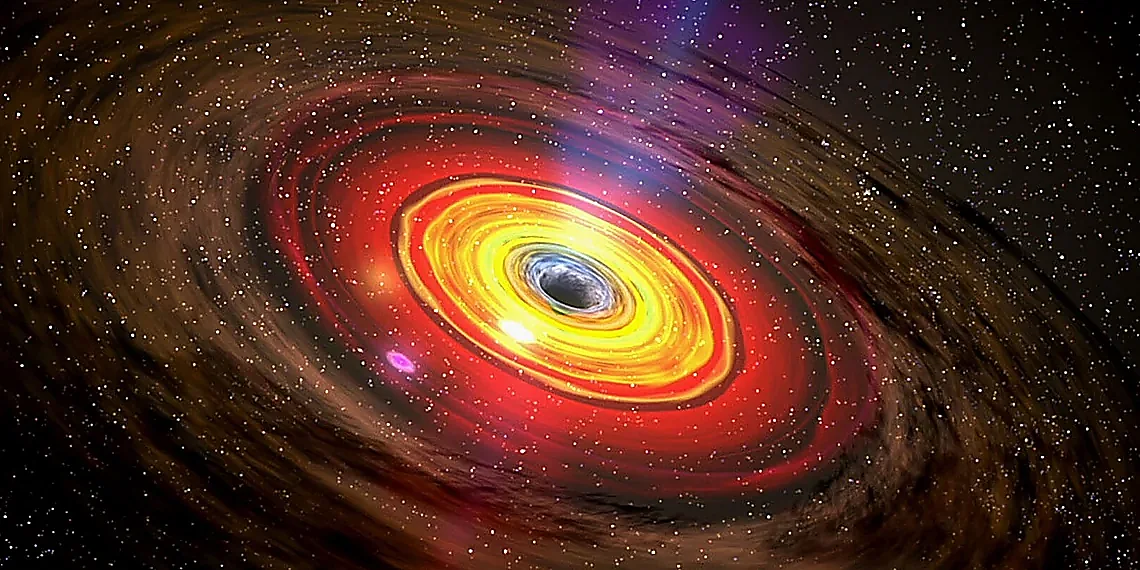
Traditional black hole models face a fundamental obstacle in the concept of a singularity – a point within the black hole where density is theoretically infinite and spacetime curvature becomes unbounded. Mathematically, this presents an insurmountable barrier for accurate simulations because standard equations break down at these points. Attempting to model what happens *at* the singularity itself is inherently impossible using current theoretical frameworks, forcing researchers to work around it with approximations that inevitably introduce inaccuracies into the overall simulation.
The computational demands of simulating black holes, even avoiding direct modeling of the singularity, are staggering. Numerical relativity, a common approach, requires solving Einstein’s field equations, which are incredibly complex and non-linear. This necessitates extremely fine meshes to capture the intricate gravitational fields surrounding the black hole – meaning vast numbers of calculations must be performed for each point in spacetime at each timestep. Simulating even a relatively small region around a black hole can easily require thousands of processor cores working for extended periods.
Consequently, traditional black hole modeling is exceptionally slow and resource-intensive. Each simulation run consumes significant energy and time, limiting the exploration of different scenarios or parameters. This has historically restricted our ability to test theoretical predictions about black hole behavior under extreme conditions, hindering progress in understanding these enigmatic objects and their role in the universe.
Introducing the ‘Flickering Light’ Approach
For decades, accurately modeling black holes has been a monumental challenge in astrophysics. Traditional methods often run into an insurmountable roadblock: the singularity—a point of infinite density at the heart of a black hole where our current understanding of physics breaks down. This singularity makes simulations unstable and computationally expensive, limiting what we can learn about these cosmic behemoths. Now, researchers are pioneering a novel approach that circumvents this issue entirely, opening up exciting new avenues for exploration.
The innovative technique, dubbed the ‘Flickering Light’ approach, focuses on analyzing the light patterns emitted from a black hole’s accretion disk – the swirling mass of gas and dust surrounding it. Instead of attempting to directly model the singularity itself, scientists utilize what they call a non-singular black hole model. These models modify Einstein’s equations slightly to prevent the formation of a true singularity, effectively replacing it with a region of extremely high but finite density. This seemingly small change has significant implications.
The benefits of employing these non-singular models are substantial. Simulations become dramatically more stable and require significantly less computational power, leading to faster processing times. Furthermore, while not universally applicable, in certain scenarios, they can offer greater accuracy than traditional methods that struggle to handle the singularity’s unpredictable behavior. By concentrating on the observable light patterns – analyzing how they flicker, bend, and shift – researchers can glean valuable insights into the black hole’s properties without directly confronting the problematic singularity.
This ‘Flickering Light’ approach represents a paradigm shift in black hole modeling, demonstrating that we don’t necessarily need to solve the complete mystery of the singularity to unlock crucial information about these fascinating objects. The ability to simulate and analyze black holes with greater efficiency and potentially increased accuracy promises to deepen our understanding of galaxy formation, gravitational waves, and the very fabric of spacetime.
Non-Singular Models & Their Benefits
Traditional black hole models, derived from Einstein’s theory of general relativity, predict a singularity at their center – a point of infinite density where the laws of physics as we understand them break down. This singularity poses significant challenges for computer simulations; attempting to model it often leads to instability and inaccurate results. A growing area of research focuses on ‘non-singular’ black hole models which replace this problematic singularity with a region of extremely high, but finite, density. These alternative models offer a pathway to more stable and reliable numerical simulations.
The Hayward black hole is one example of such a non-singular model. Researchers are increasingly employing these alternatives because they circumvent the computational bottlenecks associated with singularities. Simulations using non-singular models require significantly less processing power and can be run much faster, allowing for exploration of a wider range of scenarios and parameters. This efficiency also opens doors to more complex simulations incorporating factors previously deemed too computationally expensive.
While non-singular models might not perfectly replicate all aspects of general relativity (and are actively being researched to improve their accuracy), they offer distinct advantages in certain situations. For instance, they can provide valuable insights into the behavior of matter and energy near a black hole’s event horizon without encountering the mathematical difficulties associated with singularities. This approach allows for greater flexibility in exploring phenomena like gravitational waves and accretion disk dynamics.
Decoding the Light: How It Works
The groundbreaking research hinges on meticulously analyzing the ‘light echoes’ – photons that bounce off material orbiting a black hole before reaching our telescopes. These aren’t just random flashes of light; they carry incredibly detailed information about the environment surrounding the black hole and, crucially, properties of the black hole itself. Scientists are leveraging advanced algorithms to sift through these complex patterns, effectively treating them as fingerprints unique to each black hole system. Imagine trying to reconstruct a 3D object from only reflected beams – that’s essentially what they’re doing, but with light and incredibly powerful computational tools.
A core technique involves Fourier analysis, which decomposes the incoming light into its constituent frequencies. Shifts in these frequencies, known as Doppler shifts, reveal information about the orbital velocity of the material emitting the light. By analyzing how different wavelengths are blueshifted (shifted towards shorter wavelengths) or redshifted (shifted towards longer wavelengths), researchers can infer the speed and direction of orbiting gas clouds. Further analysis incorporates techniques like time-series modeling to track changes in these patterns over time, allowing them to map out the dynamics of the accretion disk – the swirling mass of matter feeding the black hole.
Beyond velocity, the intensity and polarization of the light also provide crucial clues. Variations in brightness can indicate density fluctuations within the accretion disk or obscuring material along our line of sight. Polarization, which describes the orientation of light waves, is sensitive to magnetic fields – powerful forces shaping the behavior of matter near a black hole. By correlating these different aspects of the light patterns—frequency shifts, intensity changes, and polarization—scientists can build increasingly accurate models of the black hole’s mass, spin (how fast it’s rotating), and even the structure of its surrounding environment.
The real innovation lies not just in using these techniques individually, but in combining them within sophisticated computational frameworks. These frameworks allow researchers to test different theoretical models against observed light patterns, iteratively refining their understanding of black hole behavior. This iterative process is akin to a complex optimization problem – the algorithms are constantly adjusting parameters within the model until it best replicates the observed data, ultimately providing unprecedented insights into these enigmatic cosmic objects.
Analyzing Emission Patterns for Insights

Scientists studying black holes often can’t ‘see’ them directly – they’re essentially invisible! Instead, researchers analyze the light emitted from material swirling *around* the black hole in a structure called an accretion disk. This light isn’t uniform; it varies in brightness and color over time, creating complex patterns. These variations are caused by factors like temperature changes within the disk, gravitational lensing (where the black hole’s gravity bends light), and relativistic effects as material approaches near-light speed.
To decipher these intricate light patterns, scientists employ sophisticated algorithms and data analysis techniques – a bit like reverse engineering. They use mathematical models that simulate how matter behaves in the extreme conditions near a black hole. By comparing the observed light patterns to simulations with different assumptions about the black hole’s mass, spin (how fast it’s rotating), and the properties of its surrounding disk, they can find the model that best matches reality.
Essentially, each characteristic – mass, spin, or the density of gas in the accretion disk – subtly alters the light pattern. By meticulously analyzing these variations and comparing them to theoretical models, scientists are able to indirectly ‘measure’ these otherwise inaccessible properties. This process allows for a deeper understanding of black holes and their role in galaxy evolution, even without directly observing the event horizon.
Future Implications & Potential Applications
The implications of this new black hole modeling technique extend far beyond simply creating more accurate simulations. By shifting away from the traditional reliance on singularities – points of infinite density that have always presented a significant hurdle in theoretical physics – researchers open up exciting avenues for understanding the fundamental nature of these cosmic behemoths. This light-pattern based approach allows for explorations of black hole behavior previously inaccessible, potentially revealing nuances in accretion disks, jet formation, and even the very structure of spacetime around these objects.
Looking ahead, we can anticipate a significant impact on astrophysical research. The ability to analyze observational data – such as that gathered by future generations of telescopes like the Extremely Large Telescope (ELT) or gravitational wave observatories – through this new modeling lens could unlock unprecedented insights into real black holes. Imagine refining our understanding of how supermassive black holes influence galaxy evolution, or precisely mapping their spin and mass distribution with greater accuracy than ever before.
Beyond pure astrophysics, the principles underpinning this technique might even inspire technological advancements. The sophisticated algorithms used to process light patterns and reconstruct these complex models could find applications in areas like advanced image processing, data analysis for medical imaging, or even novel sensor technologies. While direct parallels are still speculative, the development of new mathematical tools often leads to unexpected breakthroughs across diverse fields.
Ultimately, this breakthrough in black hole modeling represents a crucial step towards bridging the gap between theoretical predictions and observational reality. It’s not just about creating better simulations; it’s about providing researchers with powerful new instruments to probe the universe’s most enigmatic objects and potentially sparking unforeseen innovations that benefit society as a whole.
Beyond Simulations: Real-World Impact?
The innovative light-pattern based black hole modeling approach detailed in the recent study holds significant promise for analyzing observational data from telescopes like the Event Horizon Telescope (EHT). Currently, interpreting EHT images relies heavily on existing theoretical models and assumptions about black hole properties. This new technique could allow scientists to test these assumptions against actual observations with greater precision, potentially revealing subtle deviations that might indicate previously unknown physics or unexpected behavior in real black holes. By comparing observed light patterns directly with the results of this modeling approach, researchers can refine their understanding of accretion disks, jet formation, and other phenomena surrounding black holes.
Furthermore, the advancements in computational efficiency achieved through this method could lead to breakthroughs in gravitational wave detection. Analyzing gravitational waves requires complex simulations involving extreme spacetime distortions; a more efficient modeling framework would enable scientists to process larger datasets and search for weaker or more nuanced signals. This might reveal previously undetectable events like mergers of smaller black holes or interactions between black holes and surrounding matter, offering unprecedented insights into the universe’s most energetic processes.
Looking further ahead, this technique’s ability to accurately simulate complex light patterns could find application in other areas requiring advanced rendering capabilities – perhaps even contributing to more realistic visualizations for scientific education or virtual reality experiences focused on astronomical phenomena. While still nascent, the potential for cross-disciplinary impact stemming from this black hole modeling breakthrough is considerable, highlighting its broader relevance beyond purely astrophysical research.
The recent advancements detailed offer a genuinely exciting shift in how we approach understanding these cosmic behemoths, potentially unlocking new avenues for exploring extreme gravitational phenomena.
For decades, traditional black hole modeling has relied on complex mathematical frameworks, but this innovative method presents a streamlined and surprisingly intuitive alternative, promising to accelerate research across numerous astrophysical disciplines.
This simplification doesn’t compromise accuracy; instead, it allows researchers to focus computational power on other crucial aspects of observation and theoretical development, leading to faster insights into galaxy formation and the evolution of spacetime itself.
The implications extend far beyond pure theory – a more accessible approach to black hole modeling will empower broader participation in research, fostering collaboration and accelerating discovery within the astrophysics community. This could revolutionize our understanding of quasars, gravitational lensing, and even the very fabric of the universe’s early moments. It represents a significant step forward in refining our conceptual tools for investigating these enigmatic objects. Ultimately, this simplified framework offers a fresh perspective on what we thought we knew about black holes and their role in the cosmos. The potential to refine our understanding through advanced computational techniques is now significantly enhanced with this new method of black hole modeling available to researchers. “ ,
Continue reading on ByteTrending:
Discover more tech insights on ByteTrending ByteTrending.
Discover more from ByteTrending
Subscribe to get the latest posts sent to your email.