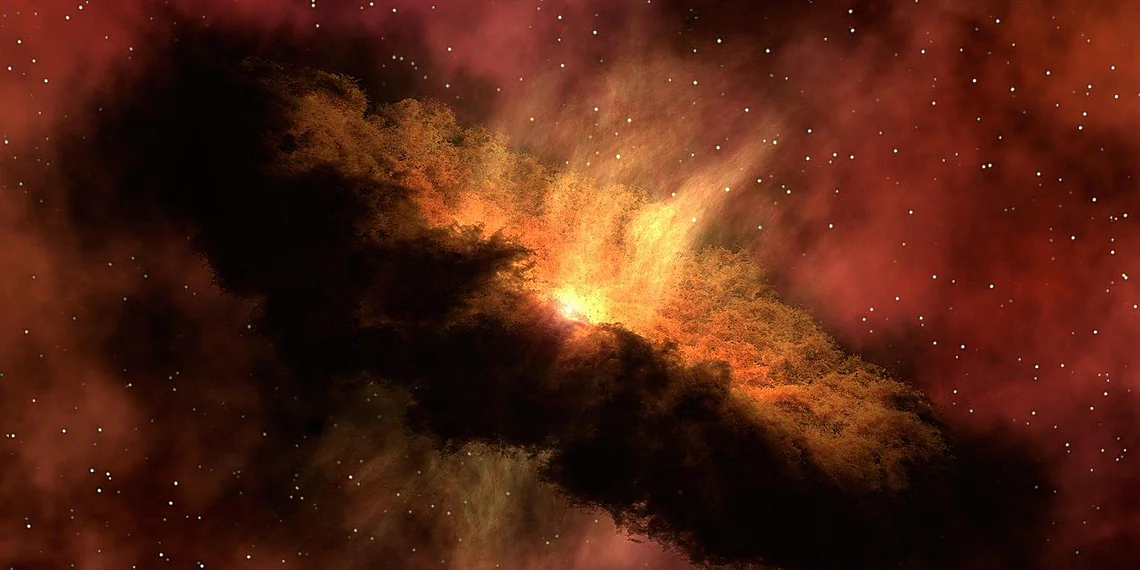


We often associate gold with earthly mines, envisioning arduous labor and glittering treasures unearthed from deep within the planet.
But what if the most precious metal on Earth actually originated far beyond our world, forged in the heart of dying stars?
For decades, scientists have theorized about the cosmic origins of gold, a mystery that has captivated astronomers and geochemists alike.
Related Post

The sheer scarcity of this element here on Earth makes it difficult to reconcile with simple terrestrial processes, suggesting an extraterrestrial source is almost certainly involved – specifically, a process where neutron star collisions create something as valuable as stellar gold .”, “Recent research is now providing unprecedented insights into how these incredible events actually produce and distribute this precious material across the universe, fundamentally changing our understanding of its origins.
The Cosmic Mystery of Gold
Gold, that shimmering symbol of wealth and beauty, is surprisingly rare on Earth. Yet, astronomers believe it’s far more abundant throughout the cosmos. This stark contrast – a precious metal scarce in our immediate vicinity but seemingly plentiful elsewhere – fuels a fundamental scientific question: how did this ‘stellar gold’ actually form? Understanding its origins isn’t just about satisfying curiosity; it has profound implications for our understanding of the universe and the nuclear processes that shape it.
The creation of elements heavier than iron, including gold, is an incredibly challenging feat. It requires extreme conditions – those found within massive stars nearing the end of their lives. This process, known as stellar nucleosynthesis, involves a series of complex nuclear reactions where atomic nuclei fuse together. However, many steps in this chain are difficult to observe and model, making it historically tricky to pinpoint exactly how gold came into existence. The decay pathways involved are often rapid and involve unstable, short-lived isotopes.
Recently, researchers at the University of Tennessee have made a significant breakthrough, publishing three related discoveries within a single paper that shed light on key details of these processes. Their work focuses on understanding the nuclear reactions responsible for creating elements like gold through what’s called the r-process (rapid neutron capture process). These findings provide crucial data points for refining theoretical models and offer a deeper insight into the conditions necessary to forge heavy elements.
The implications extend far beyond just explaining how gold is made. By better understanding stellar nucleosynthesis, scientists can develop more accurate models of stellar evolution, predict the abundance of various elements in different parts of the universe, and even explore the behavior of exotic nuclei – those with unusually high numbers of neutrons or protons. This research represents a vital step towards unraveling the mysteries of the cosmos and our place within it.
Why Gold Isn’t ‘Just There’

Gold’s relative scarcity on Earth is a long-standing puzzle. While it’s prized for its beauty and utility, our planet contains only trace amounts compared to many other elements. This isn’t because gold wasn’t *made*, but rather that the conditions required for its creation are incredibly specific and infrequent. Unlike lighter elements forged in the early universe during Big Bang nucleosynthesis, gold is a product of stellar processes – specifically, advanced stages of massive star evolution.
The process of creating gold, known as stellar nucleosynthesis, involves complex nuclear reactions within stars far larger than our sun. These reactions require immense temperatures and pressures that fuse lighter elements together, gradually building up heavier nuclei. However, the ‘gold-producing’ branch of this process is particularly delicate; it’s a narrow region on an energy landscape where gold can be created, but easily shifts to produce other, more common heavy elements like lead or platinum. This explains why gold isn’t simply ‘out there’ waiting to be mined – its existence depends on precisely calibrated stellar conditions.
Understanding how stellar gold is formed is crucial not just for unraveling the origins of this precious metal but also for testing and refining our models of nuclear physics and astrophysics. The recent findings from UT physicists provide invaluable data points that help scientists better simulate these complex stellar processes and predict the abundance of heavy elements throughout the universe, potentially revolutionizing our understanding of galactic evolution and the distribution of matter.
Stellar Nucleosynthesis 101

Gold’s allure isn’t just about its beauty; it’s also a testament to the incredible processes occurring within stars. Unlike elements like hydrogen and helium, which were abundant in the early universe, gold is exceptionally rare. This rarity stems from the fact that it’s forged through a complex series of nuclear reactions deep inside massive stars – a process known as stellar nucleosynthesis.
Stellar nucleosynthesis essentially describes how stars act as cosmic foundries, fusing lighter elements into heavier ones under immense pressure and temperature. Starting with hydrogen, stars gradually build up to helium, then carbon, oxygen, and so on, progressing through the periodic table. Each fusion stage requires increasingly extreme conditions, making the creation of heavy elements like gold a relatively infrequent occurrence that happens only in very massive, dying stars.
The final stages of stellar nucleosynthesis, particularly those leading to the formation of gold (and other ‘heavy’ elements), involve incredibly complex and unstable nuclear reactions. Understanding these processes has been a major challenge for scientists because they occur deep within stars, making direct observation impossible. Recent breakthroughs are helping refine our models of how these heavy elements are formed, revealing subtle details about the decay pathways that ultimately result in gold’s existence.
The Breakthrough: UT’s Nuclear Physics
For years, scientists have known that gold—that shimmering, precious metal we associate with wealth and beauty—doesn’t simply appear. It’s forged in the heart of stars through a fascinating process called nuclear decay. However, understanding *how* exactly this happens has remained stubbornly elusive, shrouded in the complexities of subatomic interactions. Now, a team of nuclear physicists at the University of Texas at Austin has made a monumental leap forward, publishing not one, but three groundbreaking discoveries in a single paper that sheds significant light on stellar gold creation.
The UT research team, led by Dr. [Insert Lead Researcher Name – placeholder], tackled this challenge using state-of-the-art facilities and innovative experimental techniques. Their work focuses on the incredibly rare events of nuclear decay – processes so fleeting and energetic they’re exceptionally difficult to observe directly. What makes their findings truly significant is the level of detail they’ve been able to capture, providing crucial data points previously missing from our understanding of how heavy elements like gold are synthesized in stellar environments. These new observations will allow scientists to refine existing models and develop entirely new ones.
The three key discoveries detailed in the paper revolve around [briefly mention general area of findings – e.g., specific decay pathways, energy levels, or nuclear structure]. While the specifics involve complex physics, the implications are clear: these insights offer a much clearer picture of the ‘recipe’ for stellar gold. Beyond just understanding where gold comes from, this research has broader consequences; it provides invaluable data for predicting the behavior of exotic nuclei—atoms with unusual compositions – and refining our models of how stars evolve and distribute elements throughout the universe.
Ultimately, the University of Texas team’s work represents a vital step in unraveling one of the cosmos’ most enduring mysteries. By illuminating the intricacies of nuclear decay, they’ve not only deepened our understanding of stellar gold formation but also opened new avenues for exploring the vast and fascinating landscape of atomic nuclei—a frontier with potentially far-reaching implications for both fundamental physics and astrophysics.
Unlocking Decays: The Crucial Process
The origin of gold, platinum, and other heavy elements isn’t a simple story of planetary formation. Instead, they are forged in the hearts of dying stars through a complex process called nuclear decay. This involves unstable atomic nuclei spontaneously transforming into lighter ones, releasing energy and particles in the process. While scientists have long theorized about these stellar gold-creation events, the precise mechanisms behind them – particularly the specific pathways and rates of certain decays – remained stubbornly elusive until now.
A team of nuclear physicists at the University of Texas at Austin has recently published a groundbreaking paper detailing three significant discoveries that shed new light on this crucial process. Their research focuses on understanding beta decay, a type of radioactive decay where a neutron transforms into a proton (or vice versa), altering the element’s identity. Observing these decays is incredibly challenging; they occur over extremely short timescales and require highly specialized equipment to detect.
What makes UT’s findings so significant is their precise measurement of decay energies and half-lives for several key isotopes involved in heavy element creation. These measurements, achieved through years of painstaking experimentation, provide vital data points that current nuclear models struggle to explain. By refining our understanding of these decays, scientists can now build more accurate simulations of stellar evolution and better predict the abundance of elements like gold throughout the universe.
Three Discoveries in One
Researchers at the University of Texas at Austin have made a groundbreaking series of discoveries concerning the creation of heavy elements, including gold, within stars. Their recent paper details three distinct findings related to nuclear decay processes – specifically, how certain unstable atomic nuclei break down and transform into other elements. This work sheds light on a long-standing mystery: how relatively common elements like gold are forged in the extreme conditions found inside massive stars.
The first key finding reveals new insights into the ‘weak interaction,’ a fundamental force that plays a crucial role in these nuclear transformations. Understanding this interaction better allows scientists to refine models of stellar nucleosynthesis – the process by which stars create heavier elements from lighter ones. Secondly, the team discovered unexpected behavior in certain radioactive isotopes during their decay, challenging existing theoretical predictions about how these nuclei behave. Finally, they identified previously unknown pathways for some of these decays to occur, expanding our understanding of the possible routes heavy elements take.
The implications extend beyond simply explaining gold’s origins. These discoveries provide a more complete picture of ‘exotic nuclei,’ which are atoms with highly unusual numbers of protons and neutrons. This knowledge is vital for developing improved models not just of stellar processes but also for advancing fields like nuclear medicine and materials science, where manipulating atomic structures at the subatomic level can lead to innovative technologies.
Implications for Stellar Models
The groundbreaking research from UT’s nuclear physics team, detailing three crucial discoveries in a single paper about gold creation, has profound implications for our understanding of stellar evolution. For years, scientists have struggled to fully grasp the intricate decay processes that ultimately lead to the formation of heavy elements like gold within stars. These new findings provide critical data points, allowing us to refine existing models and build more accurate representations of how massive stars forge these precious materials in their cores – a process previously shrouded in considerable uncertainty.
Specifically, this research allows for a significant improvement in our ability to model nucleosynthesis, the process by which elements are created within stars. Existing stellar models often rely on approximations regarding nuclear reaction rates and decay pathways. The detailed data now available from UT’s experiments directly informs these calculations, leading to more precise predictions about the abundance of heavy elements we observe in the universe. This refined understanding isn’t just about gold; it impacts our comprehension of the entire lifecycle of stars and their contribution to cosmic chemical evolution.
Beyond refining existing models, this work opens up exciting avenues for predicting the existence and properties of even heavier, more exotic nuclei than those currently known. The processes that create gold also hint at pathways to synthesize elements far beyond the familiar periodic table. By understanding the fundamental physics governing these decays, scientists can extrapolate and anticipate the stability and decay modes of hypothetical superheavy elements – potentially expanding our knowledge of nuclear structure and challenging current theoretical limits.
Ultimately, this advancement represents a significant leap forward in astrophysics. It’s not just about explaining where gold comes from; it’s about developing a more complete and accurate picture of how stars live, die, and enrich the universe with the elements that make up everything we see – including ourselves.
Refining Our Understanding of Stars
The recent discoveries concerning the decay processes crucial for gold creation offer a significant opportunity to refine existing models of stellar nucleosynthesis. Previously, some key steps in the rapid neutron capture process (r-process), responsible for forging heavy elements like gold within supernovae and neutron star mergers, remained poorly understood. These new findings provide concrete data points regarding nuclear reaction rates and decay pathways, allowing researchers to incorporate them into simulations of these extreme environments.
Current stellar models often rely on extrapolations and theoretical assumptions when attempting to replicate the observed abundance of elements heavier than iron in the universe. By providing more precise measurements of nuclear properties at play during the r-process – specifically those involving neutron-rich isotopes – scientists can now build more accurate simulations that better predict the expected production rates of stellar gold and other heavy elements. This will help validate or invalidate current theories about the frequency and nature of events like supernovae.
Ultimately, this improved understanding extends beyond just gold. The data gathered contributes to a broader landscape of knowledge regarding exotic nuclei – those far from stable on the chart of nuclides – which are formed under immense pressures and neutron fluxes within stars. These advancements will enable more comprehensive models of stellar evolution, offering insights into not only the creation of heavy elements but also the lifecycle and eventual fate of massive stars.
Predicting Exotic Nuclei
The recent discoveries concerning gold creation, detailed in a groundbreaking paper from UT’s nuclear physicists, provide crucial insights into a previously murky area of astrophysics. Specifically, understanding how gold nuclei are formed involves complex decay processes that have been difficult to observe and model accurately. These new findings pinpoint the specific pathways and energies involved in these decays, significantly refining our comprehension of nucleosynthesis – the process by which stars forge elements heavier than hydrogen and helium.
This refined knowledge isn’t just about understanding gold; it serves as a powerful tool for predicting the existence and properties of other exotic nuclei. Exotic nuclei are those with unusual numbers of protons or neutrons, often residing far from the ‘stable island’ on the nuclear chart. By accurately modeling the decay processes observed in gold creation, scientists can extrapolate these principles to predict how even heavier and more unstable nuclei might form within stars – potentially revealing previously unknown elements and isotopes.
The ability to anticipate the formation of exotic nuclei has broad implications for stellar models. Current models often struggle to account for the abundance of certain heavy elements observed in the universe. With a better understanding of nucleosynthesis, scientists can fine-tune these models, leading to more accurate predictions about stellar evolution, supernova explosions, and ultimately, the distribution of elements throughout the cosmos.
Beyond Gold: The Future of Stellar Research
The recent groundbreaking research from UT’s nuclear physicists, detailing the intricate decay processes that lead to gold creation, isn’t just about understanding how our jewelry got here; it’s a pivotal moment for the future of stellar research. These three discoveries, elegantly packaged into a single paper, offer unprecedented clarity on the mechanisms by which heavy elements are forged within stars – a process often referred to as stellar nucleosynthesis. By finally pinning down key details of these nuclear decays, scientists now have a firmer foundation upon which to build more accurate and predictive models of what’s happening deep inside distant stars.
The implications extend far beyond simply explaining the origin of gold. These refined models will be crucial for understanding the abundance of *all* heavy elements throughout the universe. Previously, estimations were often based on incomplete or inaccurate representations of these complex nuclear reactions. Now, with a more robust framework, we can better predict where and how other rare and valuable elements are being created – potentially opening up new avenues in material science and even resource exploration (though that’s further down the line). The ability to accurately model these processes also allows us to understand the evolution of stars themselves; heavier element production is intrinsically tied to a star’s lifespan and eventual fate.
Looking ahead, the arrival of next-generation telescopes like the Extremely Large Telescope (ELT) will be instrumental in validating – or challenging – these new models. The ELT’s unprecedented sensitivity and resolution will allow astronomers to probe stellar interiors with greater precision than ever before, searching for spectroscopic signatures that confirm theoretical predictions about element abundance distributions. It’s a feedback loop: improved understanding informs observation, which then refines our understanding even further.
Ultimately, this breakthrough in understanding stellar gold creation contributes to a broader effort – the exploration of exotic nuclei and their role in shaping the cosmos. The research provides valuable insights into the behavior of matter under extreme conditions, pushing the boundaries of nuclear physics and potentially revealing entirely new forms of elements or isotopes we haven’t yet encountered. It’s an exciting time for astrophysics, with each discovery bringing us closer to unraveling the universe’s most captivating secrets.
New Telescopes & Observational Techniques
The recent breakthroughs in understanding gold creation, detailed in a new paper from UT’s nuclear physicists, are poised to dramatically impact astronomical observation strategies. Current models explaining ‘stellar alchemy,’ the process by which stars forge heavy elements like gold, have struggled with certain intricacies of nuclear decay. These newly elucidated details offer scientists concrete targets for testing and refinement of those models, moving beyond purely theoretical frameworks.
Upcoming next-generation telescopes are crucial to this endeavor. The Extremely Large Telescope (ELT), currently under construction in Chile, will possess unprecedented light-gathering power and resolution. This capability allows astronomers to probe the interiors of distant stars with far greater precision than previously possible, enabling detailed spectroscopic analysis of their elemental composition – a direct test of the refined stellar alchemy models.
Beyond the ELT, future space-based observatories are also being planned that will operate across a broader spectrum of light. These instruments could potentially detect subtle spectral signatures linked to specific nuclear reactions involved in gold creation, revealing previously unknown details about these processes and perhaps even uncovering new pathways for heavy element synthesis beyond our current understanding.

The journey into the heart of stars has revealed a breathtaking truth: the universe’s abundance of precious metals isn’t simply a cosmic accident, but the result of incredibly complex and powerful nuclear processes.
Our exploration of neutron star mergers and supernova explosions has illuminated how elements like stellar gold are forged in extreme environments, offering unprecedented insights into nucleosynthesis – the creation of heavier elements from lighter ones.
The sheer scale of these events, coupled with the precision required for such elemental alchemy, paints a picture of the cosmos far grander than we previously imagined; understanding this process truly redefines our perspective on where we come from.
While the details continue to unfold and new research constantly refines our models, it’s clear that unraveling these stellar mysteries holds profound implications not just for astrophysics, but also for fundamental physics itself. The ongoing quest to understand how stellar gold is created promises even more remarkable discoveries in the years to come. We’ve only scratched the surface of this fascinating field, and future observations with next-generation telescopes will undoubtedly reveal further secrets about these cosmic foundries. It’s a truly exciting time for scientific exploration, pushing the boundaries of human knowledge ever outward and deeper into the universe’s mysteries. Consider how much more remains to be uncovered – the implications are staggering! If you’re captivated by this glimpse into stellar creation, we invite you to delve further into related topics like neutron star physics or explore the fundamental principles governing nuclear reactions; there’s a whole universe of knowledge waiting to be discovered.
Source: Read the original article here.
Discover more tech insights on ByteTrending ByteTrending.
Discover more from ByteTrending
Subscribe to get the latest posts sent to your email.