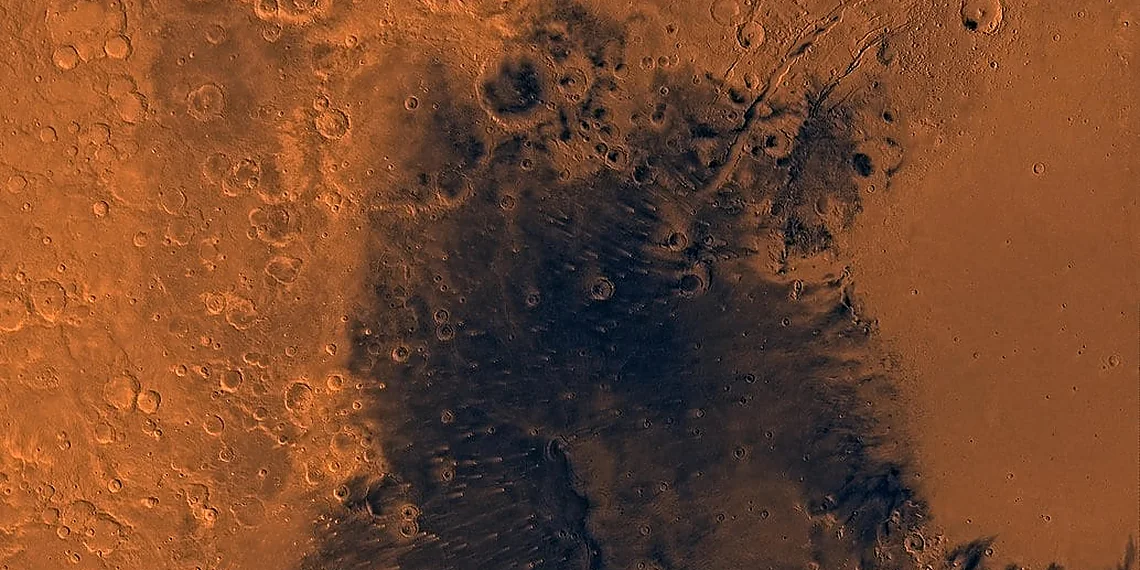

Forget rusty dunes and desolate landscapes – Mars is hiding a secret, one that challenges everything we thought we knew about the Red Planet’s present-day climate. Recent radar data reveals vast quantities of water ice lurking surprisingly close to the equator, an area previously considered far too warm for such frozen reserves to exist.
This equatorial ice isn’t just a geological oddity; it presents a compelling puzzle for planetary scientists trying to piece together Mars’s dynamic history. Where did this massive ice deposit come from, and why has it persisted in such an unexpected location?
The leading explanation involves a fascinating interplay of ancient volcanic activity and the planet’s shifting axial tilt, suggesting the possibility of what some researchers are calling ‘Mars ice volcanoes’ – colossal formations where ice was erupted alongside volcanic materials, creating these substantial frozen deposits. We’ll dive deep into this revolutionary theory and explore how it rewrites our understanding of Mars’s past and potentially its future.


The Paradox: Ice Where It Shouldn’t Be
Mars, the Red Planet, presents a stark and challenging environment. For decades, our understanding of its climate has centered on a frigid landscape dominated by massive polar ice caps – primarily composed of water ice and carbon dioxide ice (dry ice). These vast reservoirs represent the majority of Mars’ known water resources. Beyond the poles, the Martian surface is characterized by extremely low temperatures, averaging around -62° Celsius (-80° Fahrenheit), with significant seasonal variations. The thin atmosphere provides minimal insulation, leading to dramatic temperature swings between day and night. This combination of factors results in a generally arid world; while evidence suggests past liquid water existed on Mars, today’s surface conditions preclude stable bodies of liquid water due to the low atmospheric pressure which causes it to rapidly evaporate or freeze.
However, recent data from orbiting spacecraft has revealed a surprising anomaly: the detection of significant quantities of buried water ice in equatorial regions. These regions, situated closer to the Martian equator, receive considerably more solar radiation than the poles and are therefore far too warm for surface ice to persist under current conditions. The discovery challenges our established models of Martian climate history and raises fundamental questions about how this ice formed, has managed to remain preserved, and what implications it holds for understanding past habitability on Mars.
Mars Today: A Frozen Desert
The contemporary Martian environment is undeniably harsh. Surface temperatures routinely plummet well below freezing, even during the summer months in equatorial regions. The atmospheric pressure is less than 1% of Earth’s, making it exceedingly difficult for liquid water to exist stably on the surface; any liquid would either quickly evaporate or freeze.
Currently, the most substantial ice deposits are found at Mars’ north and south poles, forming thick layered structures that represent millennia of accumulated snowfall. These polar caps contain vast quantities of both water ice and frozen carbon dioxide. While subsurface ice has been suspected for some time based on radar data and geological features, direct observation and confirmation have remained challenging due to the planet’s dusty surface.
The overall appearance of Mars is one of a frozen desert – a landscape sculpted by wind and dust storms, with limited evidence of active surface water processes. While seasonal changes occur (e.g., carbon dioxide ice sublimates at the poles during summer), these are primarily driven by temperature fluctuations affecting volatile ices rather than widespread liquid water activity.
The Equatorial Anomaly
In recent years, data from missions like NASA’s Mars Reconnaissance Orbiter (MRO) and the European Space Agency’s ExoMars Trace Gas Orbiter have provided compelling evidence for buried water ice in equatorial latitudes. These findings aren’t based on direct visual observation of surface ice but rather on detecting elevated levels of hydrogen – a key component of water – using neutron spectroscopy. This technique measures the abundance of subsurface hydrogen, effectively mapping potential water ice deposits.
The detected hydrogen signals indicate the presence of significant volumes of water ice located just beneath the Martian regolith (loose surface material) in areas like Arcadia Planitia and Deuteronilus Mensae, both situated within relatively low-latitude regions. These locations receive significantly more solar energy than the poles, making the persistence of ice there deeply puzzling.
Several hypotheses attempt to explain this equatorial anomaly. These include cyclical variations in Mars’ axial tilt (obliquity) over long timescales, which could have resulted in past periods where these regions were colder and capable of accumulating ice; the possibility that the ice is shielded by a layer of dust or sediment protecting it from sublimation; and potentially even localized geological processes creating microclimates conducive to ice preservation. Further investigation utilizing future missions will be crucial to unraveling this mystery and refining our understanding of Mars’ climate history.
Volcanic Activity: A Climate Shifter
Mars is often portrayed as a desolate, arid world, but beneath its rusty surface lies a surprising abundance of water ice. While significant quantities are locked within the polar ice caps, recent discoveries reveal widespread subsurface ice deposits extending far beyond these regions, even reaching lower latitudes. This distribution isn’t readily explained by current climate models alone; a critical piece of the puzzle involves Mars’s volcanic past and its profound influence on the planet’s atmospheric dynamics and water cycle. Evidence suggests that massive volcanic eruptions played a pivotal role in transporting this ice from the poles to more temperate zones, fundamentally shaping the Martian landscape and potentially influencing conditions suitable for past habitability.
The presence of vast subsurface ice deposits at mid-latitudes challenges traditional understandings of Mars’s climate history. If these ice reserves were always present but inaccessible, why haven’t they significantly impacted the surface environment? The answer likely lies in a complex interplay between volcanic activity, atmospheric processes, and cyclical shifts in Martian obliquity (axial tilt). Understanding this process requires delving into the geological record and reconstructing how ancient eruptions fundamentally altered Mars’s atmosphere, triggering events that redistributed water ice across the planet’s surface.
Dust & The Greenhouse Effect
Ancient Martian volcanism wasn’t a sporadic event; it was characterized by periods of intense activity, including colossal eruptions that dwarfed anything seen on Earth in recent history. These eruptions released not only lava but also enormous quantities of volcanic ash and dust particles into the atmosphere. While initially contributing to a global dimming effect – blocking sunlight and causing temporary cooling – these fine particulate materials quickly began to exert a different influence: the greenhouse effect. Unlike greenhouse gases like carbon dioxide, which are relatively transparent to infrared radiation, volcanic dust is highly effective at trapping heat because of its composition and size.
The increased concentration of dust in the atmosphere created a temporary ‘dust-rich’ greenhouse effect. This warming, although likely short-lived (perhaps lasting centuries or millennia), was sufficient to raise global temperatures above freezing point in some polar regions. Critically, this warming caused significant sublimation – the direct transition of ice from solid state to water vapor – at the poles. The magnitude of these eruptions and their frequency would have dictated the intensity and duration of this greenhouse effect, creating transient periods where substantial quantities of water ice were released into the atmosphere.
Ice Transport via Atmospheric Currents
The water vapor liberated from the polar regions didn’t simply remain concentrated at high latitudes. The warmed, water-rich air became buoyant and was driven by powerful atmospheric currents – primarily Hadley cells and potentially other large-scale circulation patterns – towards lower latitudes. These currents act like giant conveyor belts, capable of transporting vast quantities of material across planetary distances. The precise mechanisms driving these ancient Martian winds are still being investigated, but models suggest they were likely stronger and more organized than those observed today.
As the water vapor traveled towards the equator, it would have cooled due to adiabatic expansion (cooling as air rises and expands) and radiative cooling (loss of heat through infrared radiation). This cooling led to condensation – forming tiny ice particles suspended in the atmosphere. These ice particles were then deposited across the Martian surface, primarily at mid-latitudes, via snowfall or possibly even through deposition by powerful winds carrying icy dust aggregates. The distribution patterns of these deposits, evidenced by radar data and spectral signatures, strongly correlate with predicted atmospheric circulation pathways, providing compelling evidence for this ice transport mechanism.
Evidence & Ongoing Research
The possibility that Mars harbors vast, buried reserves of water ice, potentially linked to ancient volcanic activity forming unique ‘ice volcanoes,’ is rapidly shifting our understanding of the planet’s geological history and habitability potential. While initial detections of subsurface ice were based on radar soundings, increasingly sophisticated analysis of spectral data and direct rover investigations are painting a detailed picture of these frozen reservoirs and their formation mechanisms. The theory suggests that cryovolcanism – volcanic activity involving water or other volatile substances instead of molten rock – may have played a significant role in shaping the Martian landscape, distributing ice across the planet’s surface and potentially creating conditions conducive to past life.
The presence of water ice isn’t just about finding frozen water; it’s about understanding its distribution, purity, and connection to geological processes. The discovery that much of this ice is mixed with regolith (Martian soil) rather than existing as pure ice sheets presents a challenge for resource utilization but also provides valuable clues regarding how the ice was deposited and preserved over billions of years. Furthermore, the detection of hydrated minerals – minerals containing water molecules within their crystal structure – further strengthens the evidence for past aqueous environments and supports the hypothesis that volcanic activity may have facilitated these processes.
Spectroscopic Data Analysis
Orbital probes like NASA’s Mars Reconnaissance Orbiter (MRO) and the European Space Agency’s ExoMars Trace Gas Orbiter have been instrumental in mapping subsurface water ice through spectroscopic data analysis. These instruments utilize various techniques, including near-infrared spectroscopy, to analyze the reflected sunlight from the Martian surface. The presence of hydrogen atoms associated with water molecules leaves a characteristic spectral signature that can be detected even when the ice is buried beneath layers of dust and regolith. For example, MRO’s SHARAD (Shallow Radar) instrument initially provided evidence for extensive subsurface ice deposits at high latitudes, while CRISM (Compact Reconnaissance Imaging Spectrometer for Mars) has identified hydrated minerals linked to past water activity in numerous locations.
ExoMars’ Trace Gas Orbiter (TGO), with its NOMAD (Nadir and Occultation for MArs Discovery) instrument suite, contributes by providing high-resolution spectral mapping. NOMAD’s observations are particularly valuable because they can differentiate between various forms of hydrogen – not all of which is bound in water ice; some may be associated with methane or other compounds. This allows scientists to more accurately pinpoint the location and abundance of water ice and understand its chemical context within the Martian environment. The combined data from MRO, ExoMars, and other orbiting assets are creating increasingly detailed maps of subsurface ice distribution and composition.
Rover Investigations
While orbital surveys provide a broad overview of water ice deposits, rovers on the Martian surface offer unparalleled opportunities for in-situ analysis. The Curiosity rover, exploring Gale Crater, has detected evidence of past aqueous environments and hydrated minerals within sedimentary rocks, confirming that liquid water once existed on Mars and providing context for potential ice deposition events. The data collected by Curiosity’s ChemCam instrument – a laser-induced breakdown spectrometer – allows scientists to analyze the elemental composition of rocks from a distance, revealing the presence of hydrogen and other elements indicative of past water activity.
Currently, NASA’s Perseverance rover, along with its accompanying Ingenuity helicopter, is actively exploring Jezero Crater, believed to be an ancient lakebed. Perseverance’s SuperCam instrument, similar in function to ChemCam but with enhanced capabilities, is analyzing rock compositions and searching for biosignatures – indicators of past life. The SHERLOC (Scanning Habitable Environments with Raman & Luminescence for Organics & Chemicals) instrument on Perseverance uses a Raman spectrometer to identify minerals and organic molecules within rocks and soil, providing further insights into the history of water and potential habitable environments. Samples collected by Perseverance are being cached for future return to Earth, where they will undergo even more detailed analysis in terrestrial laboratories, potentially revealing definitive evidence of past Martian ice deposits or microbial life.
Implications for Future Exploration
The recent discovery of vast, previously unknown deposits of water ice near the Martian equator, intimately linked to ancient volcanic activity, represents a paradigm shift in our understanding of the Red Planet. Using data from the Mars Reconnaissance Orbiter’s Shallow Radar (SHARAD) instrument, scientists have identified extensive layers of nearly pure water ice interspersed with volcanic ash and dust, buried just meters beneath the surface in regions like Arcadia Planitia and Deuteronilus Mensae. This isn’t merely frozen water; it’s a record—a geological time capsule holding clues to Mars’ volatile history and presenting unprecedented opportunities for future exploration and potential colonization.
The significance lies not only in the sheer volume of ice detected – estimated to be significantly greater than previously known polar reserves – but also in its location. Equatorial regions are notoriously harsh environments on modern Mars, characterized by intense solar radiation and thin atmospheres. The presence of readily accessible water ice at these latitudes fundamentally alters our perception of Martian habitability potential and dramatically simplifies the logistical challenges associated with establishing a sustained human presence.
The prevailing theory posits that this equatorial ice was transported from the poles during periods of past climatic shifts, likely facilitated by massive volcanic eruptions. Explosive volcanism would have ejected ash plumes high into the atmosphere, which then acted as a conveyor belt, carrying water vapor and ice crystals towards the equator where they subsequently settled and accumulated over millennia. This mechanism provides a tangible link between Mars’ geological activity and its climate evolution, offering invaluable data points for refining our models of planetary change.
Resource Availability
The accessibility of equatorial ice is arguably the most immediately impactful consequence of this discovery. Water ice represents a critical resource for any long-term Martian settlement, serving as both a propellant source and a vital ingredient for life support systems. Utilizing in-situ resource utilization (ISRU) techniques, specifically electrolysis, water can be split into hydrogen and oxygen – the primary components of rocket fuel. This dramatically reduces the need to transport these resources from Earth, significantly lowering mission costs and increasing self-sufficiency for Martian colonies. The equatorial location minimizes travel distances for robotic ice mining operations, further enhancing efficiency.
Currently, extracting water from polar ice caps presents logistical challenges due to their remote locations and often difficult terrain. Equatorial deposits offer a much more favorable environment for resource extraction, with relatively flat landscapes and proximity to potential landing sites. Furthermore, the volcanic ash intermixed within the ice layers may contain valuable minerals that could also be exploited for construction materials or other industrial processes, creating a potentially self-sustaining ecosystem on Mars. The presence of these near-surface deposits represents a game-changer in mission planning, allowing for smaller and more flexible lander designs focused primarily on resource extraction rather than extensive exploration.
Understanding Martian Climate History
The volcanic ice transport mechanism provides a crucial window into Mars’ past climate. The fact that water ice has been found so far from the poles strongly suggests periods when the Martian climate was significantly warmer and wetter than it is today, allowing for atmospheric circulation patterns capable of transporting substantial amounts of moisture across vast distances. Reconstructing these ancient climates is essential to understanding how Mars lost its habitability – a critical question in astrobiology.
Detailed analysis of the volcanic ash layers interspersed within the ice deposits will provide invaluable data on the timing and intensity of past eruptions, allowing scientists to correlate volcanic activity with periods of climatic change. Isotopic analysis of the water ice itself can further reveal information about its origin and age, offering insights into the processes that shaped Mars’ volatile inventory over billions of years. The discovery underscores the importance of considering volcanism as a key driver in Martian climate evolution – a factor often underestimated in previous models. This refined understanding can also inform our search for evidence of past life on Mars; if habitable conditions existed during these warmer periods, they may have been localized near volcanic vents or within subsurface ice deposits.
The recent confirmation of these intriguing formations, now understood as evidence of ancient Mars ice volcanoes, fundamentally shifts our understanding of the planet’s geological history and potential for past habitability.
This discovery underscores the dynamic processes that once shaped Mars, suggesting a far more complex interplay between volcanic activity and icy environments than previously imagined; it’s a testament to the power of ongoing robotic exploration and advanced data analysis.
Future missions equipped with even more sophisticated radar and subsurface imaging capabilities will undoubtedly reveal further details about these structures, allowing us to map their distribution across the Martian landscape and analyze the composition of the ice itself.
The implications extend beyond just geological understanding; uncovering more about past water availability is crucial in assessing whether life ever existed on Mars, and the presence of such expansive ice deposits offers a tantalizing window into that possibility. Further investigation might even reveal pockets of trapped gases or organic molecules preserved within these frozen layers, potentially providing unprecedented insights into Martian history. Imagine what we’ll uncover as we continue to refine our models and target new areas for study – perhaps uncovering more examples of Mars ice volcanoes in unexpected locations. The next decade promises a surge of exciting discoveries, expanding our knowledge of the Red Planet exponentially. Don’t miss out on this incredible journey of scientific discovery; explore our related articles below to dive deeper into Martian geology and astrobiology, and be sure to follow ByteTrending for all the latest updates from Mars exploration.
Source: Read the original article here.
Discover more tech insights on ByteTrending ByteTrending.
Discover more from ByteTrending
Subscribe to get the latest posts sent to your email.