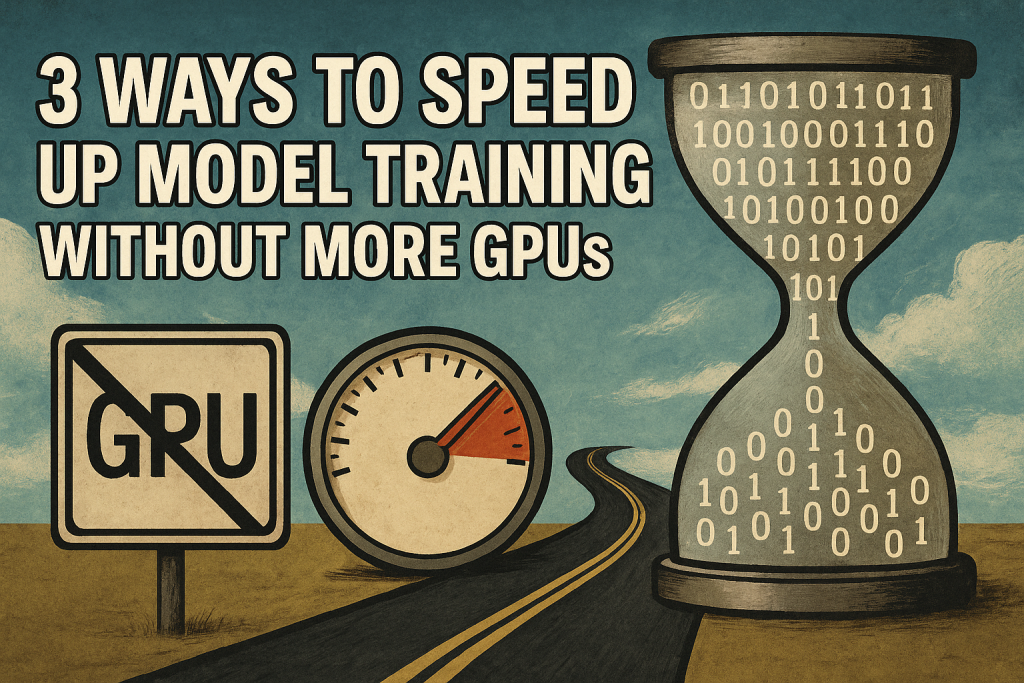

We’ve all been there: staring at a progress bar that seems to crawl, watching precious hours evaporate as your machine learning model stubbornly refuses to train. It’s frustrating, it’s time-consuming, and frankly, it can feel like a roadblock to innovation. The excitement of developing cutting-edge AI solutions often gets bogged down by the sheer length of training cycles, especially for teams without access to massive computing resources. But what if you could significantly reduce that wait time without breaking the bank on new GPUs or cloud infrastructure? This article dives into practical strategies and emerging techniques designed to dramatically improve your workflow. We’ll explore how optimizing existing processes and leveraging clever software solutions can unlock substantial gains in Model Training Speed, allowing you to iterate faster and deploy smarter models more quickly. Forget lengthy training times – it’s time to reclaim your productivity and accelerate your AI journey.
Many believe that achieving rapid model development requires a constant upgrade cycle of powerful hardware, but this isn’t always the case. While dedicated infrastructure certainly has its place, there’s a growing body of research and readily available tools focused on optimizing algorithms and data handling to boost efficiency. We will unpack these approaches in detail, providing actionable insights you can apply immediately to your current projects. The goal is to empower every developer, regardless of their hardware budget, with the knowledge to achieve significantly faster results. Let’s move beyond the bottleneck and unlock the true potential of your machine learning models.
Precision Optimization
Model training, especially for large neural networks, can be incredibly time-consuming. A significant lever to pull in accelerating this process lies in optimizing numerical precision – specifically reducing it. Many deep learning frameworks default to 32-bit floating point numbers (FP32), offering a wide range of values and high accuracy. Think of FP32 like using a ruler with millimeter markings; you can measure very precisely. However, these higher precision calculations demand more computational power and memory bandwidth. Switching to 16-bit floating point numbers (FP16) is akin to using a ruler with centimeter markings – slightly less precise, but much faster to use.
The beauty of FP16 lies in its potential for dramatic speedups. Because each number takes up half the storage space and requires fewer calculations, you can fit larger models or batches into memory, leading to increased throughput on compatible hardware (like NVIDIA’s Tensor Cores). This reduction in data size also significantly reduces communication overhead between GPUs during distributed training. While FP16 offers substantial gains, naively switching from FP32 to FP16 isn’t always straightforward. Some operations can suffer from underflow or overflow issues due to the reduced dynamic range of FP16, potentially degrading accuracy.


This is where mixed precision training comes into play – a technique that allows you to harness the benefits of both worlds. Mixed precision involves using FP16 for most computations while retaining FP32 for critical parts like accumulating gradients or certain loss functions where higher precision is vital for stability. Automatic Mixed Precision (AMP), now widely supported in frameworks like PyTorch and TensorFlow, automates this process, intelligently identifying which operations can safely use FP16 and which require FP32, simplifying the implementation considerably and minimizing any potential accuracy impact.
Ultimately, precision optimization offers a powerful pathway to accelerate model training without sacrificing essential accuracy. By understanding the trade-offs between FP32 and FP16, and utilizing techniques like mixed precision training, developers can significantly reduce training times, enabling faster iteration cycles and unlocking new possibilities in AI/ML development.
Understanding Floating-Point Precision (FP32 vs. FP16)
Floating-point numbers are the standard way computers represent real numbers, crucial for machine learning model calculations. FP32 (single-precision) uses 32 bits to store a number, allowing for a wide range and high accuracy. Think of it like measuring something with millimeter precision – you can get very detailed results. However, this level of detail requires more computational resources – processing power and memory – slowing down training times.
FP16 (half-precision) uses only 16 bits to represent the same numbers. This effectively halves the memory footprint and allows for faster calculations because operations can be performed in parallel more efficiently on modern hardware like NVIDIA’s Tensor Cores. Using our measurement analogy, FP16 is like measuring with centimeter precision – it’s less detailed but much quicker. While there’s a loss of accuracy, carefully designed techniques often minimize the impact on model performance.
The trade-off between FP32 and FP16 boils down to speed versus precision. By switching to FP16, you can potentially see 2x faster training speeds with minimal or no degradation in accuracy, especially when combined with techniques like mixed-precision training (using both FP16 and FP32 strategically). It’s a common optimization strategy for large models where training time is a significant bottleneck.
Mixed Precision Training: The Sweet Spot
Model training speed is a critical bottleneck in modern deep learning workflows. One of the most effective techniques to address this is mixed precision training, which leverages the benefits of lower-precision floating-point formats like FP16 (half-precision) while mitigating potential accuracy issues. FP16 offers significant performance advantages on hardware optimized for it – often 2x or greater speedups compared to traditional FP32 (single-precision). This is because FP16 operations require less memory bandwidth and computational resources.
However, simply switching a model entirely to FP16 can sometimes lead to instability during training due to the reduced dynamic range. Mixed precision training solves this by intelligently using FP32 where needed – typically for accumulation steps or layers sensitive to underflow – while utilizing FP16 for the majority of calculations. This approach retains accuracy while capitalizing on the speed gains.
Fortunately, implementing mixed precision doesn’t require extensive manual adjustments thanks to Automatic Mixed Precision (AMP). AMP frameworks like those available in PyTorch and TensorFlow automatically handle the conversion between FP16 and FP32 formats, identifying which operations are safe for FP16 execution and managing the necessary scaling factors to prevent overflow. This significantly simplifies the process of adopting mixed precision training.
Memory Optimization Techniques
Model training speed is often bottlenecked not by computational power alone, but by the constraints of GPU memory. Larger batch sizes generally lead to more stable gradients and faster convergence, but pushing beyond a certain point can trigger out-of-memory errors. Fortunately, several effective techniques exist to significantly reduce your model’s memory footprint, allowing you to leverage those larger batches and accelerate training without upgrading hardware. These strategies primarily involve clever manipulation of how data and intermediate calculations are stored during the forward and backward passes.
One powerful approach is gradient accumulation. Imagine wanting a batch size that’s too large for your GPU; with gradient accumulation, you effectively simulate it by performing several smaller forward and backward passes. Each pass calculates gradients based on a mini-batch, but these gradients aren’t applied immediately to update the model weights. Instead, they are accumulated over multiple iterations. Only after accumulating gradients from a pre-determined number of mini-batches (e.g., 4 mini-batches simulating a batch size four times larger) do you apply them for a single weight update. This trick allows you to experience the benefits of large batches without actually needing that much memory at once.
Another critical technique is gradient checkpointing, which represents a deliberate trade-off between compute and memory. During the forward pass, activations (the outputs of each layer) are typically stored in memory for use during backpropagation. Gradient checkpointing avoids this by strategically discarding some activation tensors and recomputing them on demand during the backward pass. While this introduces extra computation time because you’re recalculating those activations, it dramatically reduces peak GPU memory usage – often by as much as 70-80% in extreme cases. The key is to carefully select which layers to checkpoint based on their impact on memory and computational overhead.
Ultimately, combining these memory optimization techniques—gradient accumulation for simulating larger batches and gradient checkpointing for reducing activation storage—offers a potent combination for accelerating model training. By understanding the underlying principles and experimenting with different configurations, you can unlock significant performance gains and push your models to train faster and more efficiently.
Gradient Accumulation: Simulating Larger Batches
Gradient accumulation is a technique that allows you to effectively increase your batch size without requiring more GPU memory. It works by accumulating gradients over multiple mini-batches before performing a single weight update. This mimics the behavior of training with a larger batch size, which often leads to improved model stability and potentially better generalization performance.
Here’s how it functions: Imagine you want to use an effective batch size of 32, but your GPU can only handle a batch size of 8. With gradient accumulation, you would process 8 samples, calculate the gradients, *not* apply them yet, and store them. Then, you repeat this process for another mini-batch of 8 samples, accumulating those gradients as well. After processing four mini-batches (totaling 32 samples), you finally average the accumulated gradients and use that averaged value to update your model’s weights. This single weight update is equivalent to training with a batch size of 32.
The key parameter in gradient accumulation is ‘accumulation steps’. In our example, an accumulation step of 4 would simulate a batch size of 32 (8 * 4 = 32). While it doesn’t fundamentally change the memory usage per iteration, it allows you to leverage larger effective batch sizes and benefit from their advantages without hitting GPU memory limits. Most deep learning frameworks offer built-in support for gradient accumulation, making implementation relatively straightforward.
Gradient Checkpointing
Gradient checkpointing, also known as activation recomputation, is a technique used to significantly reduce the memory footprint required during model training. Deep neural networks often require vast amounts of memory to store activations – the outputs of each layer – which are needed for backpropagation (calculating gradients). Gradient checkpointing addresses this by selectively discarding these activations after the forward pass.
Instead of storing all activations, gradient checkpointing only saves a subset. During the backward pass, when those discarded activations are needed to compute gradients, they are recomputed on-the-fly using the forward pass operations again. This effectively trades memory for computation; you’re saving memory by not storing data but increasing training time because certain calculations are repeated.
The impact of gradient checkpointing depends heavily on the model architecture and hardware. While it can dramatically reduce memory usage (often by 50-80%), it also introduces an overhead due to the recomputation, potentially slowing down overall training speed. Careful consideration should be given to which layers to checkpoint to balance memory savings with performance impact.
Data Flow & Preprocessing
The journey from raw dataset to a trained machine learning model is rarely as straightforward as it appears. Often, what seems like a slow training process isn’t solely due to complex algorithms or inadequate hardware; instead, it’s frequently hampered by inefficiencies in how data is fed into the model. This ‘data pipeline’ – encompassing loading, preprocessing, and augmentation – can easily become a significant bottleneck, especially when dealing with large datasets and intricate transformations. Ignoring this critical area means potentially wasting valuable time and resources while your GPU sits idle waiting for data.
A common culprit is serial data processing. Imagine the CPU painstakingly preparing each batch of images before sending them to the GPU. This sequential approach creates a significant delay, preventing the GPU from operating at its full potential. Fortunately, solutions exist! Techniques like parallel data loading and prefetching can dramatically improve throughput. Using multiple worker processes to load and preprocess data concurrently allows the GPU to receive batches more frequently, keeping it consistently engaged in computation. Libraries like PyTorch’s `DataLoader` offer built-in support for these optimizations – ensuring your data is ready when needed.
Beyond simply loading data faster, shifting preprocessing operations from the CPU to the GPU can yield substantial performance gains. Many preprocessing steps, such as resizing, normalization, and augmentation, are inherently parallelizable. By performing these operations directly on the GPU using libraries like NVIDIA’s RAPIDS or even leveraging PyTorch’s built-in transforms, you eliminate the overhead of transferring data between devices. This reduces CPU utilization, freeing it up for other tasks and significantly accelerating the overall training loop.
Ultimately, optimizing your data flow and preprocessing isn’t about complex code changes; it’s about understanding how data moves through your pipeline and identifying potential bottlenecks. By implementing techniques like parallel loading, prefetching, and GPU-accelerated preprocessing, you can unlock significant performance improvements in your model training process, leading to faster iteration cycles and ultimately, better results.
Optimizing Data Loaders (Shuffling, Batching)
The efficiency of your model training pipeline is often heavily influenced by how quickly you can feed data to the model. Data loaders, responsible for fetching and preparing batches of data, frequently become a bottleneck if not optimized properly. Simple shuffling ensures that each epoch presents the data in a randomized order, preventing biases introduced by inherent dataset ordering (e.g., sorted by class). Batching combines multiple samples into a single forward pass, increasing throughput and utilizing hardware resources more effectively – larger batch sizes generally lead to faster training but require careful consideration of memory constraints.
To overcome limitations imposed by sequential data loading, parallelization is crucial. Modern deep learning frameworks like PyTorch and TensorFlow offer utilities for multi-process data loading (`DataLoader` in PyTorch with `num_workers > 0`, or `tf.data.Dataset.interleave` in TensorFlow). These techniques distribute the workload of data preparation across multiple CPU cores, significantly reducing the time spent waiting for data. Prefetching complements parallelization by proactively loading the next batch of data while the model is processing the current one; this hides latency and keeps the GPU or TPU consistently fed with data.
Beyond simple parallelism, consider asynchronous prefetching strategies and optimized data formats (e.g., TFRecords for TensorFlow). For very large datasets that don’t fit in memory, techniques like memory mapping can provide a performance boost by avoiding repeated disk reads. Profiling your data loading pipeline using tools provided by your deep learning framework is essential to pinpoint specific bottlenecks and tailor optimizations accordingly; often, the gains from optimizing data loaders are substantial compared to other training improvements.
Data Preprocessing on the GPU
Data preprocessing is often a significant, yet overlooked, contributor to slow model training times. Traditionally, many preprocessing steps – like image resizing, normalization, or feature engineering – are performed on the CPU before being fed into the GPU for training. This creates a bottleneck as data must be transferred between the CPU and GPU repeatedly, consuming valuable time and resources. The CPU becomes overloaded with these tasks, hindering its ability to prepare data quickly enough for the GPU’s processing needs.
Moving preprocessing operations directly onto the GPU can drastically reduce this overhead. Libraries like PyTorch’s `torchvision` and TensorFlow offer GPU-accelerated image transformations and other preprocessing tools. By performing these operations on the GPU, you eliminate the constant CPU-GPU data transfers, allowing the GPU to remain consistently utilized and reducing overall training time. This also frees up the CPU to handle other tasks, further improving system efficiency.
The performance gains from GPU preprocessing are particularly noticeable with large datasets or complex transformations. While simpler pipelines might see smaller improvements, more intricate preprocessing workflows benefit substantially from this shift. Profiling your data loading pipeline is crucial to identify bottlenecks and determine if moving preprocessing to the GPU would provide a significant speed boost for your specific model and dataset.
Beyond the Basics
While we’ve covered foundational optimization strategies, truly accelerating model training often requires venturing beyond the basics. Techniques like mixed precision training (FP16 or BF16) and optimized data loaders are fantastic starting points, but experienced practitioners frequently explore even more sophisticated methods to shave off precious minutes – or even hours – from their training cycles. One powerful approach involves leveraging compiler optimizations that go beyond standard framework settings.
XLA (Accelerated Linear Algebra) compilation, for example, is a technique increasingly used with TensorFlow and JAX. It essentially translates your model’s computational graph into highly optimized machine code tailored to the underlying hardware (GPUs or TPUs). This process can significantly reduce overhead associated with kernel launches and memory transfers, leading to substantial speedups. Similarly, PyTorch’s TorchScript offers comparable benefits for its users. Beyond XLA and TorchScript, consider exploring techniques like gradient accumulation strategies, custom kernels written in CUDA/HIP, and even specialized hardware architectures designed specifically for deep learning workloads.
It’s important to note that these advanced optimizations often come with increased complexity. Implementing XLA correctly, for instance, can require a deeper understanding of the framework’s internals and careful consideration of potential compatibility issues. Similarly, custom kernels demand significant expertise in low-level programming. The best approach depends heavily on your specific model architecture, dataset size, and hardware resources.
For those eager to delve further into these advanced topics, we’ve compiled a list of helpful resources at the end of this article. From detailed documentation on XLA compilation to tutorials on writing custom CUDA kernels, these links will help you push the boundaries of your model training speed. Remember that experimentation and benchmarking are key – what works wonders for one project might be less effective for another.
XLA Compilation & Other Framework Optimizations
While reducing precision and optimizing data pipelines offer significant speedups, frameworks themselves are constantly evolving with optimization techniques. One powerful example is XLA (Accelerated Linear Algebra) compilation, particularly relevant for TensorFlow and JAX users. XLA essentially rewrites your model’s computational graph to be more efficient for the underlying hardware (GPUs or TPUs), fusing operations together and minimizing overhead. This can result in substantial training speed improvements, often exceeding those achievable through simpler methods alone.
Beyond XLA, other framework-specific optimizations exist. PyTorch’s `torch.compile` is a similar effort to accelerate model execution by leveraging ahead-of-time compilation. Framework developers are continually refining these tools and introducing new features aimed at maximizing hardware utilization and minimizing latency during training loops. The specifics of how to leverage these optimizations will vary depending on the chosen framework and hardware.
For those seeking even more advanced performance gains, techniques like kernel fusion, custom CUDA kernels (for NVIDIA GPUs), and leveraging specialized libraries for linear algebra are possibilities. However, these approaches often require a deeper understanding of both the model architecture and the underlying hardware. We encourage readers to explore the official documentation of their chosen framework and consult community resources for further exploration of these advanced optimization strategies.
We’ve covered a lot of ground, from optimized data pipelines and efficient batching strategies to leveraging mixed precision training and exploring gradient accumulation techniques.
The overarching theme should be clear: dramatically accelerating your model training isn’t solely about throwing more hardware at the problem; it’s about smart optimization.
By focusing on these practical approaches—careful dataset preparation, strategic memory management, and intelligent algorithm selection—you can unlock substantial improvements in Model Training Speed without necessarily expanding your GPU resources.
Remember that each project presents unique challenges, so finding the optimal combination of techniques will require some experimentation and fine-tuning based on your specific data and architecture. The gains are often surprisingly significant even with relatively modest adjustments to existing workflows, making this a worthwhile investment of time and effort for any machine learning practitioner looking to boost productivity and reduce costs..”, “These methods offer tangible pathways towards quicker iteration cycles and faster deployment timelines, ultimately empowering you to build and refine more impactful AI solutions.”,
Source: Read the original article here.
Discover more tech insights on ByteTrending ByteTrending.
Discover more from ByteTrending
Subscribe to get the latest posts sent to your email.