

Uncover how Amazon Bedrock AgentCore Memory transforms raw conversational data into persistent, actionable knowledge. Building AI agents that remember user interactions requires more than just storing conversations; it demands a system capable of retaining context and learning from experience. While Amazon Bedrock AgentCore’s short-term memory captures immediate context, the true power lies in transforming those interactions into lasting insights that span across sessions, ultimately enabling truly context-aware experiences with your AI agent.
If you’re new to AgentCore Memory, we recommend reviewing our introductory blog post first: Amazon Bedrock AgentCore Memory: Building context-aware agents. In brief, AgentCore Memory is a fully managed service designed to empower developers to build sophisticated AI agents by providing both short-term working memory and long-term intelligent memory capabilities.
Addressing the Challenge of Persistent Memory
Humans don’t simply remember conversations verbatim; we extract meaning, identify patterns, and construct understanding over time. Consequently, teaching AI to replicate this process presents significant challenges. Distinguishing meaningful insights from routine chatter is crucial – an agent should retain information like “I’m vegetarian,” for example, while disregarding filler phrases such as “hmm, let me think.” Furthermore, related information across different interactions must be recognized and merged to prevent duplicates or contradictions; a January mention of a shellfish allergy and a March statement about avoiding shrimp should be consolidated. Similarly, temporal context is vital: evolving preferences, such as changing tastes in spicy chicken, necessitate careful handling to respect the most recent preference while maintaining historical context.
The Complexity of Knowledge Retention
Beyond simply storing data, AgentCore Memory’s design strives for a more nuanced understanding of user interactions. For instance, consider a scenario where an agent initially records a user’s preference for decaf coffee but later learns they now prefer regular. Efficiently managing this change – ensuring the agent accurately reflects the current preference without losing valuable historical context – is key to creating a truly helpful and personalized experience.
The Importance of Efficient Retrieval
As memory stores grow, efficient retrieval becomes paramount. Balancing comprehensive retention with speed demands sophisticated indexing and search capabilities. AgentCore Memory addresses this by leveraging vector search techniques that prioritize semantic similarity over exact keyword matches, allowing the agent to quickly access relevant memories even when phrasing differs slightly.
Understanding How AgentCore Long-Term Memory Functions
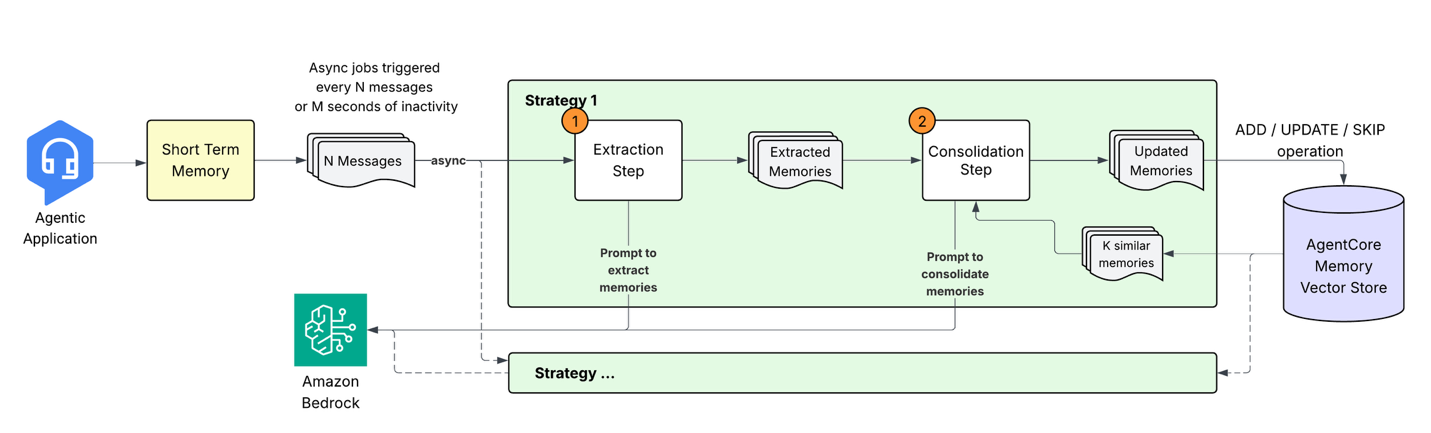
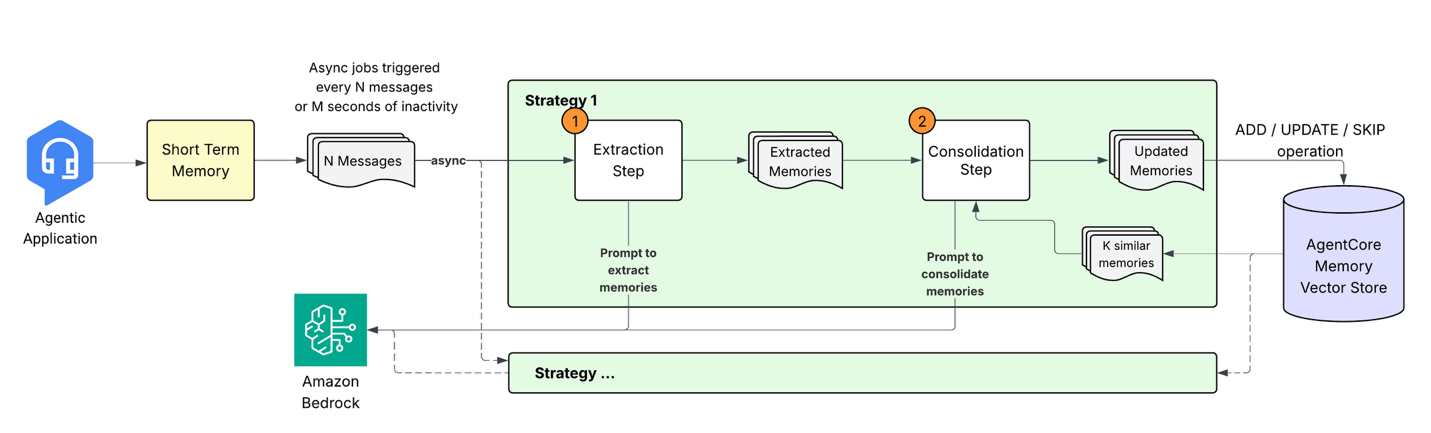
When an agentic application sends conversational events to AgentCore Memory, it initiates a pipeline designed to transform raw data into structured knowledge. Let’s examine each component of this system.
Memory Extraction: Transforming Conversations into Insights
As new events are stored in short-term memory, an asynchronous extraction process analyzes content to identify meaningful information. This leverages large language models (LLMs) to understand context and extract details suitable for long-term storage. The extraction engine processes incoming messages alongside prior interactions, identifying key entities and relationships.
Memory Consolidation: Structuring Knowledge into a Cohesive Graph
Extracted insights aren’t immediately stored; instead, they undergo consolidation. This phase groups related memories, resolves conflicts, and structures information into a cohesive knowledge graph. AgentCore Memory leverages techniques like entity linking to connect mentions of the same concept (e.g., “shrimp” and “shellfish”) under a single entry, creating a unified representation of user preferences and information.
Memory Retrieval: Facilitating Contextually Relevant Recall
When an agent needs to recall information, AgentCore Memory utilizes vector search to quickly find relevant memories based on semantic similarity. This means the system doesn’t just look for exact keyword matches; it identifies memories that are conceptually related to the current context, ensuring a more nuanced and accurate response.
The Advantages of AgentCore Beyond Basic Storage
Source: Read the original article here.
Discover more tech insights on ByteTrending.
Discover more from ByteTrending
Subscribe to get the latest posts sent to your email.