
The world of robotics and autonomous systems stands on the precipice of a significant shift, and it’s largely thanks to advancements in computer vision. If you’ve ever wished your Raspberry Pi projects could see faster, smarter, and with far less power, we’ve found something that might be exactly what you need. Prophesee has launched the GenX320 Starter Kit for Raspberry Pi 5, bringing their neuromorphic sensing technology to the Raspberry Pi developer community for the first time. This represents a leap forward in how machines perceive their surroundings, and ultimately, how they operate.
Understanding Event-Based Vision: A New Paradigm
Traditional cameras capture full frames at fixed intervals, which is inherently inefficient. However, event-based vision systems operate differently. They continuously detect changes in brightness—known as ‘events’—with each pixel activating independently and asynchronously. Consequently, sensors become significantly faster, more energy-efficient, and require less data and processing power than traditional counterparts. For example, response times can reach microseconds, a dramatic improvement over conventional camera frame rates.
How Does Event-Based Sensing Work?
This neuromorphic approach mirrors how humans capture and process visual information. Just as the human eye processes changes in a scene – an event – event-based sensors only report activity when a change occurs. If nothing changes, no data is transmitted. Therefore, both humans and these sensors can collect necessary information without wasting time and energy reprocessing static images.
Benefits of Event-Based Vision
The advantages extend beyond mere speed and efficiency. Event-based vision excels in low-light conditions and rapidly changing environments where traditional cameras struggle. Furthermore, the reduced data volume translates to lower bandwidth requirements and decreased latency, crucial for real-time applications like autonomous navigation. As a result, this technology is finding its place in industrial automation, robotics, security systems, and other edge computing scenarios.
Exploring the GenX320 Starter Kit
The GenX320 Starter Kit centers around Prophesee’s GenX320 sensor—the smallest and most power-efficient event-based vision sensor currently available. It boasts a resolution of 320×320, an impressive dynamic range exceeding 140 dB, and an equivalent event rate reaching approximately 10,000 FPS while consuming less than 50 mW of power. The kit itself consists of the GenX320 sensor and a compact camera module featuring a MIPI CSI-2 interface for seamless integration with Raspberry Pi 5 (board sold separately). Notably, it includes a mini tripod for convenient setup.
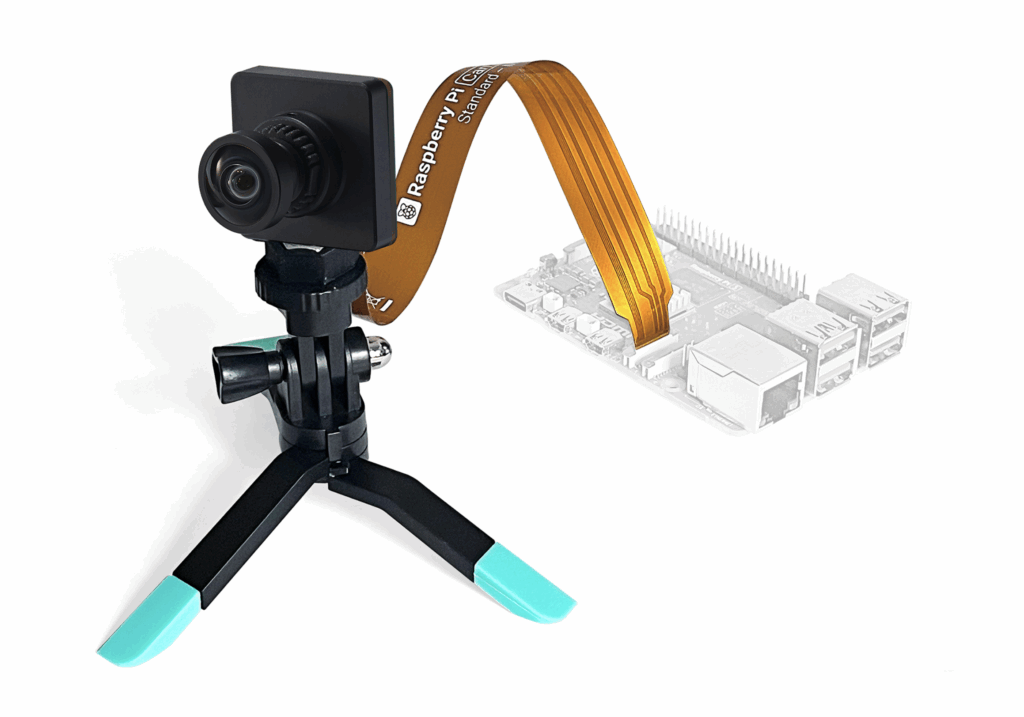
Users can choose between two lens options: an M12 mount with a 76° field of view or an M6 mount offering a wider 104° field of view. This flexibility allows developers to tailor the sensor’s perspective to their specific project needs.
Developer Resources and Applications
Prophesee provides comprehensive developer resources, including software development kits (SDKs), tutorials, and example code, designed to facilitate integration with Raspberry Pi projects. The SDK supports popular programming languages like Python and C++, giving developers substantial customization options. For those new to the concept of event-based vision, Prophesee offers introductory materials explaining the technology’s underlying principles and advantages over traditional camera systems.
Potential Applications
The combination of the Raspberry Pi 5’s processing power and the GenX320 sensor’s unique sensing capabilities opens doors to a wide range of applications. Early adopters are already exploring uses such as gesture recognition, high-speed object tracking, low-light scene analysis, and autonomous navigation. The starter kit’s documentation provides detailed setup instructions and initial code snippets for basic image acquisition and event processing.
Conclusion: A New Era in Reactive Computer Vision
The availability of the GenX320 Starter Kit represents a significant milestone—democratizing access to advanced neuromorphic vision technology. By integrating event-based sensors with the Raspberry Pi, Prophesee is empowering developers to explore and innovate within this rapidly evolving field. Ultimately, this advancement promises to unlock new possibilities in robotics and beyond, paving the way for more responsive, efficient, and intelligent machines.
Source: Read the original article here.
Discover more tech insights on ByteTrending.
Discover more from ByteTrending
Subscribe to get the latest posts sent to your email.