ByteTrending
  • Home
    • About ByteTrending
    • Contact us
    • Privacy Policy
    • Terms of Service
  • Tech
  • Science
  • Review
  • Popular
  • Curiosity
Donate
No Result
View All Result
ByteTrending
No Result
View All Result
Home Tech
Related image for cagent

Build & Distribute AI Agents with cagent

ByteTrending by ByteTrending
October 5, 2025
in Tech
Reading Time: 2 mins read
0
Share on FacebookShare on ThreadsShare on BlueskyShare on Twitter

Related Post

socially assistive robotics supporting coverage of socially assistive robotics

Socially Assistive Robotics: Integrating Cognition for Human Support

May 24, 2026
ai quantum computing supporting coverage of ai quantum computing

ai quantum computing How Artificial Intelligence is Shaping

May 5, 2026

Construction Robots: How Automation is Building Our Homes

May 5, 2026

Why Reinforcement Learning Needs to Rethink Its Foundations

May 5, 2026

cagent is a new open-source project from Docker that makes it simple to build, run, and share AI agents, without writing a single line of code. Instead of writing code and wrangling Python versions and dependencies when creating AI agents, you define your agent’s behavior, tools, and persona in a single YAML file, making it incredibly straightforward to create and share personalized AI assistants.
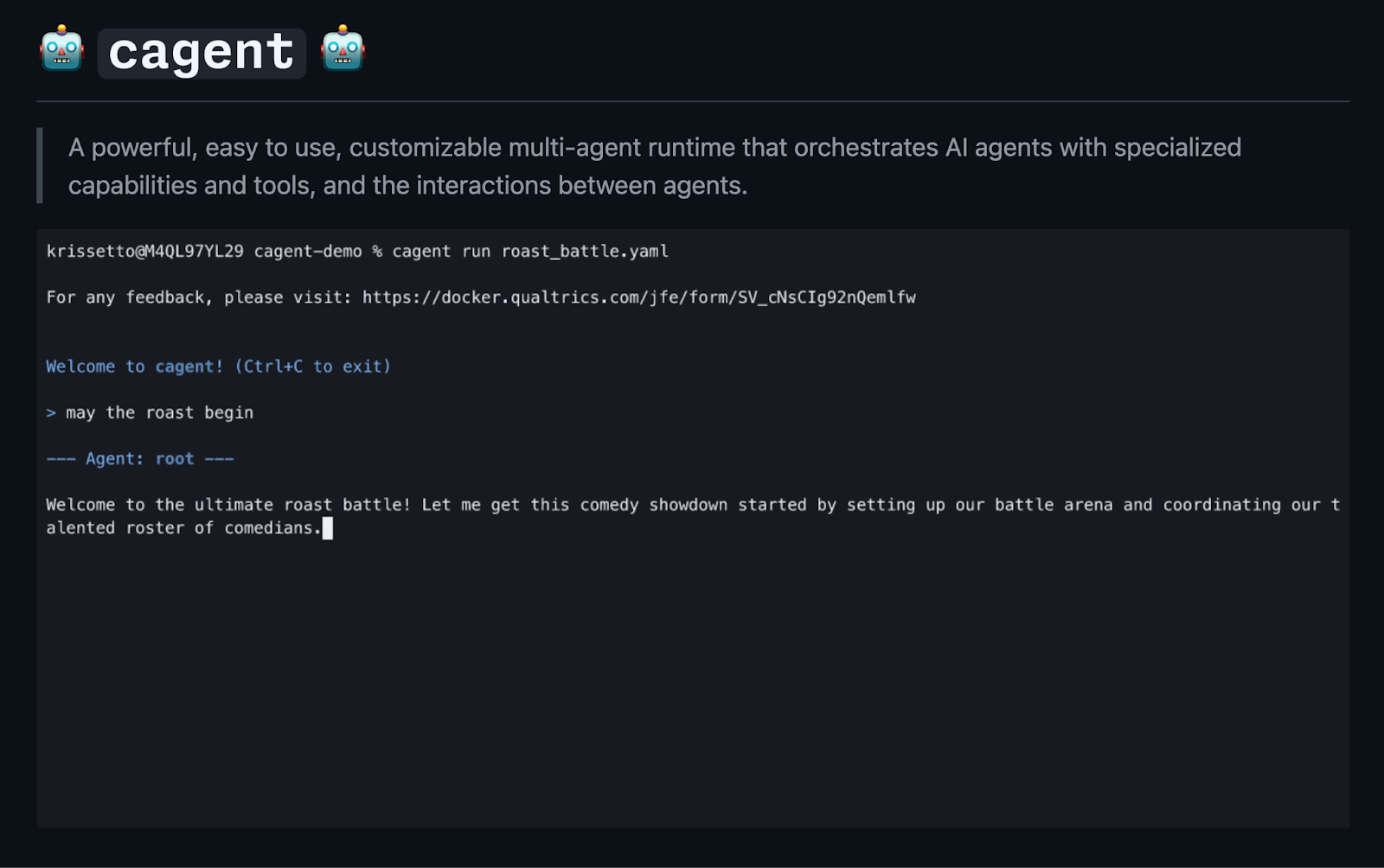
Cagent 1

Figure 1: cagent is a powerful, easy to use, customizable multi-agent runtime that orchestrates AI agents with specialized capabilities and tools, and the interactions between agents.

cagent can use OCI registries to share and pull agents created by the community, so not only can you elegantly solve the agent creation problem, but also the agent distribution problem. Let’s explore what makes cagent special and examine some real-world use cases.

What is cagent?

At its core, cagent is a command-line utility that runs AI agents defined in cagent.yaml files. The philosophy is simple: declare what you want your agent to do, and cagent handles the rest. Several features contribute to its ease of use.

Declarative Simplicity

Defining models, instructions, and agent behavior within a single YAML file provides a declarative and simple approach. This “single artifact” methodology makes agents portable, easy to version, and readily shareable.

Flexible Model Support

cagent offers flexibility by avoiding vendor lock-in; you’re not tied to a specific provider. You can run remote models or even local ones using Docker Model Runner, which is particularly beneficial for maintaining privacy and control.

Practical Use Cases for cagent

Having used cagent for several weeks, I’d like to share two practically useful agents that have streamlined my workflow.

A GitHub Task Tracker

While integrating AI with task tracking solutions isn’t revolutionary, it’s surprisingly useful and demonstrates cagent’s capabilities in a real-world scenario. For developers, GitHub issues provide a convenient to-do list. Although the user experience might not be perfect, it becomes less important as we leverage AI to create and manage those issues.

I have a GitHub repository (github.com/shelajev/todo) with enabled issues, allowing an agent to create, list, and close issues directly.

cagent session creating a to-do agent;

Conclusion

cagent represents a significant advancement in simplifying AI agent development and distribution. By abstracting away the complexities of coding, dependency management, and deployment, it empowers users to concentrate on defining agent behavior and integrating them into their workflows. The declarative approach, combined with flexible model support, powerful tool integration, and multi-agent capabilities, opens up numerous possibilities for automating tasks, enhancing productivity, and building intelligent systems. As the community continues to grow and contribute, we can expect even more exciting innovations and use cases related to cagent.


Source: Read the original article here.

Discover more tech insights on ByteTrending.

Share this:

  • Share on Facebook (Opens in new window) Facebook
  • Share on Threads (Opens in new window) Threads
  • Share on WhatsApp (Opens in new window) WhatsApp
  • Share on X (Opens in new window) X
  • Share on Bluesky (Opens in new window) Bluesky

Like this:

Like Loading…

Discover more from ByteTrending

Subscribe to get the latest posts sent to your email.
Tags: AgentAIDocker

Related Posts

socially assistive robotics supporting coverage of socially assistive robotics
AI

Socially Assistive Robotics: Integrating Cognition for Human Support

by Sofia Navarro
May 24, 2026
ai quantum computing supporting coverage of ai quantum computing
AI

ai quantum computing How Artificial Intelligence is Shaping

by Sofia Navarro
May 5, 2026
construction robots supporting coverage of construction robots
Popular

Construction Robots: How Automation is Building Our Homes

by Sofia Navarro
May 5, 2026
Next Post
Related image for BAIR graduates

BAIR Graduates: Your Guide to Success Stories & Opportunities

Leave a ReplyCancel reply

Recommended

Related image for Ray-Ban hack

Ray-Ban Hack: Disabling the Recording Light

October 24, 2025
Generative Video AI supporting coverage of generative video AI

Generative Video AI Sora’s Debut: Bridging Generative AI Promises

May 5, 2026
Related image for Ray-Ban hack

Ray-Ban Hack: Disabling the Recording Light

October 28, 2025
Diagram comparing Amazon Bedrock and OpenSearch for hybrid RAG search implementation.

Hybrid RAG search Amazon Bedrock vs OpenSearch: Which Search

May 5, 2026
Generative AI inference deployment supporting coverage of Generative AI inference deployment

SageMaker vs Bare Metal for Generative AI Inference Deployment

May 24, 2026
AI agent performance loop supporting coverage of AI agent performance loop

AI Agent Performance Loop: How to Keep AI Agents Reliable After

May 24, 2026
AI sparsity hardware supporting coverage of AI sparsity hardware

AI Sparsity Hardware: How Hardware Sparsity Can Make Massive AI

May 15, 2026
Cybersecurity consultant skills supporting coverage of Cybersecurity consultant skills

Cybersecurity Consultant Skills: What Changes for Enterprise AI

May 15, 2026
ByteTrending

ByteTrending is your hub for technology, gaming, science, and digital culture, bringing readers the latest news, insights, and stories that matter. Our goal is to deliver engaging, accessible, and trustworthy content that keeps you informed and inspired. From groundbreaking innovations to everyday trends, we connect curious minds with the ideas shaping the future, ensuring you stay ahead in a fast-moving digital world.
Read more »

Pages

  • Contact us
  • Privacy Policy
  • Terms of Service
  • About ByteTrending
  • Home
  • Authors
  • AI Models and Releases
  • Consumer Tech and Devices
  • Space and Science Breakthroughs
  • Cybersecurity and Developer Tools
  • Engineering and How Things Work

Categories

  • AI
  • Curiosity
  • Popular
  • Review
  • Science
  • Tech

Follow us

Advertise

Reach a tech-savvy audience passionate about technology, gaming, science, and digital culture.
Promote your brand with us and connect directly with readers looking for the latest trends and innovations.

Get in touch today to discuss advertising opportunities: Click Here

© 2025 ByteTrending. All rights reserved.

No Result
View All Result
  • Home
    • About ByteTrending
    • Contact us
    • Privacy Policy
    • Terms of Service
  • Tech
  • Science
  • Review
  • Popular
  • Curiosity

© 2025 ByteTrending. All rights reserved.

%d