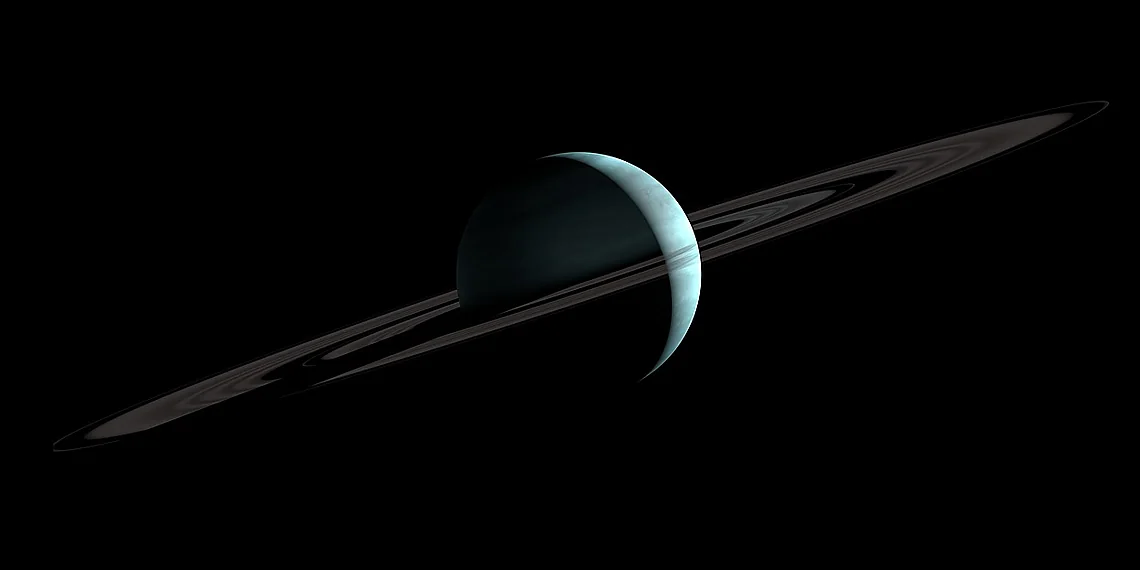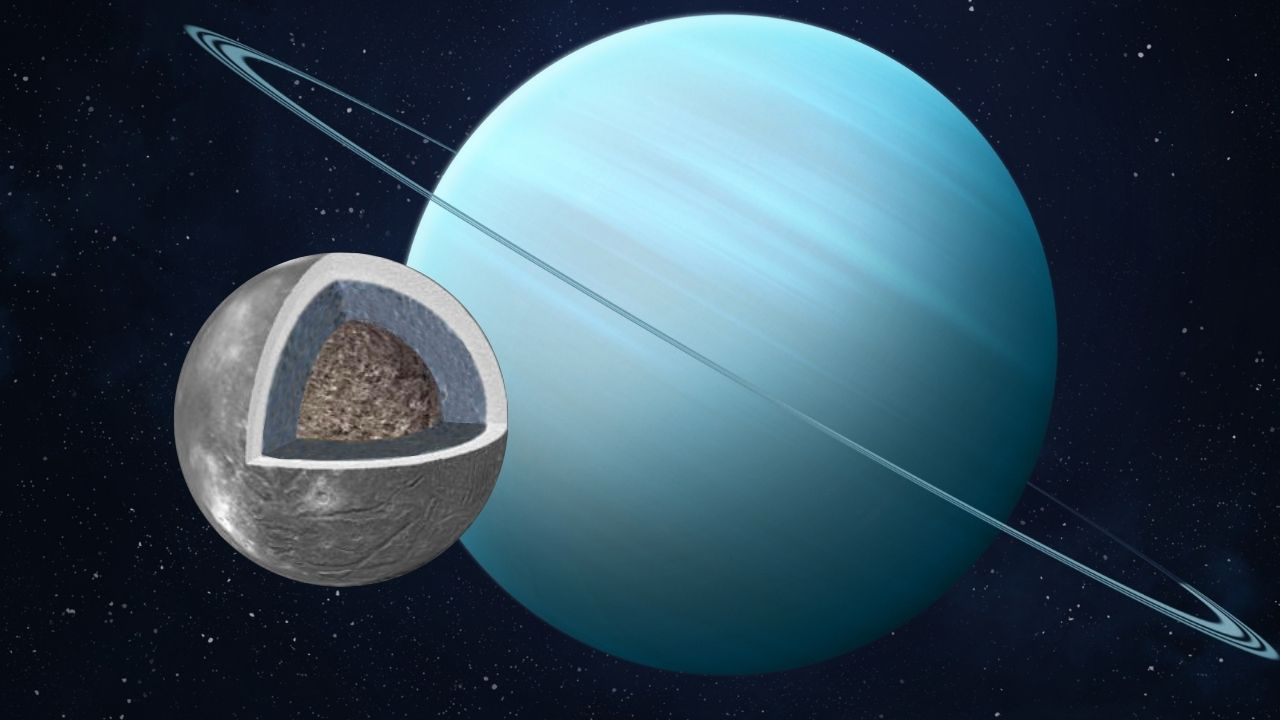

Interest in icy moons has been growing steadily as they become more and more interesting to astrobiologists. Some take the majority of the attention, like Enceladus with its spectacular geysers. But there are interesting ones that might be hiding amongst even thicker ice shells in the Uranian system. A new paper published in Icarus from researchers at the Planetary Science Institute, Johns Hopkins University, and the University of North Dakota, looks at what Ariel, the fourth biggest moon in the Uranian system, might look like under its icy surface.
Ariel: Unveiling a Hidden Ocean
Ariel is a captivating world orbiting Uranus, boasting a surprisingly bright and geologically diverse surface. While initially appearing as a relatively unremarkable icy satellite, recent investigations using data from the Voyager 2 flyby have hinted at a more complex interior than previously thought. These hints suggest that Ariel might harbor a subsurface ocean – a possibility now bolstered by detailed modeling efforts. Indeed, research into Ariel’s internal structure is revealing exciting new details about its potential habitability.
Modeling Ariel’s Interior: A Deep Dive
The research team employed advanced geophysical models to explore potential internal structures for Ariel, considering factors like tidal heating and the moon’s composition. Furthermore, their simulations reveal a plausible scenario where a global water ocean exists beneath an ice shell approximately 170 kilometers (roughly 106 miles) thick. This immense depth places it among the deepest known subsurface oceans in our solar system. Consequently, understanding how Ariel formed and evolved is key to unlocking its secrets.
The Origin of Ariel’s Ocean: Multiple Theories
The origin of this vast ocean remains a subject of ongoing research, but several hypotheses exist. One possibility involves the accumulation of water ice during the early formation of the Uranian system, followed by differentiation and subsequent melting due to tidal forces or radioactive decay within the moon’s core. On the other hand, another intriguing idea proposes that Ariel captured water-rich materials from the outer solar nebula. Therefore, determining the most likely scenario requires further investigation into the composition of Ariel’s surface and interior.
Tidal Heating: A Potential Energy Source
Tidal heating, caused by gravitational interactions with Uranus and other moons, could have played a significant role in melting ice and creating the subsurface ocean. In addition, this process generates heat within a planet’s or moon’s interior, potentially providing energy for geological activity and maintaining liquid water. Consequently, understanding the tidal forces acting on Ariel is crucial for assessing its habitability potential.
Implications for Habitability: A Potential Oasis
The discovery – or even the possibility – of a substantial subsurface ocean on Ariel significantly expands its potential for harboring life. While the immense ice shell presents a considerable barrier, liquid water is considered essential for life as we know it. For example, similar oceans have been found in other moons, suggesting that Ariel could be another place where life might exist. The presence of an ocean could also facilitate chemical reactions and energy sources that might sustain microbial ecosystems.
Future Exploration: Probing the Depths
Further observations and dedicated missions will be crucial to confirm the existence and characteristics of Ariel’s subsurface ocean. Future spacecraft equipped with advanced radar sounding instruments or gravity mapping capabilities could penetrate the icy shell and provide more detailed insights into its structure and composition, potentially revealing clues about the moon’s past and present habitability. Notably, future missions would need to be designed specifically to study Ariel’s interior.
Source: Read the original article here.
Discover more tech insights on ByteTrending.
Discover more from ByteTrending
Subscribe to get the latest posts sent to your email.