
The recent release of OpenAI’s open-weight models, gpt-oss-120b and gpt-oss-20b (both leveraging a Mixture of Experts design and boasting a generous 128K context window), marks a significant advancement in accessible AI. These leading open source models, as demonstrated by Artificial Analysis benchmarks, excel particularly in reasoning and powering innovative agentic workflows. Furthermore, Amazon SageMaker AI provides a robust platform for fine-tuning or customizing these models and deploying them with your preferred framework via a fully managed service, offering substantial flexibility.
While large language models (LLMs) are exceptionally adept at understanding and generating text, realizing real-world applications involving agentic workflows demands intricate workflow management, tool utilization, and context preservation. Complex systems often benefit from multi-agent architectures that break down tasks into specialized components; however, this introduces complexities in agent coordination and memory handling. Consequently, a structured approach to orchestration becomes crucial.
This article demonstrates how to deploy gpt-oss-20b on SageMaker managed endpoints and showcases a practical stock analyzer agent assistant example using LangGraph, a powerful graph-based framework designed for state management and coordinated workflows. In addition, we’ll explore deploying these agents to Amazon Bedrock AgentCore, providing a unified orchestration layer that simplifies deployment and scaling of AI agents.
Solution Architecture: Building an Agentic Stock Analyzer
Our solution centers around constructing an agentic stock analyzer. The core components include deploying the GPT OSS 20B model to a SageMaker endpoint using vLLM, utilizing LangGraph for multi-agent orchestration, and leveraging Amazon Bedrock AgentCore for deployment.
Understanding the Workflow
The diagram below illustrates the architecture of this solution. The process begins with a user query; subsequently, specialized agents—a Data Gathering Agent, a Stock Performance Analyzer Agent, and a Stock Report Generation Agent—collaborate within Amazon Bedrock AgentCore Runtime to address the request.
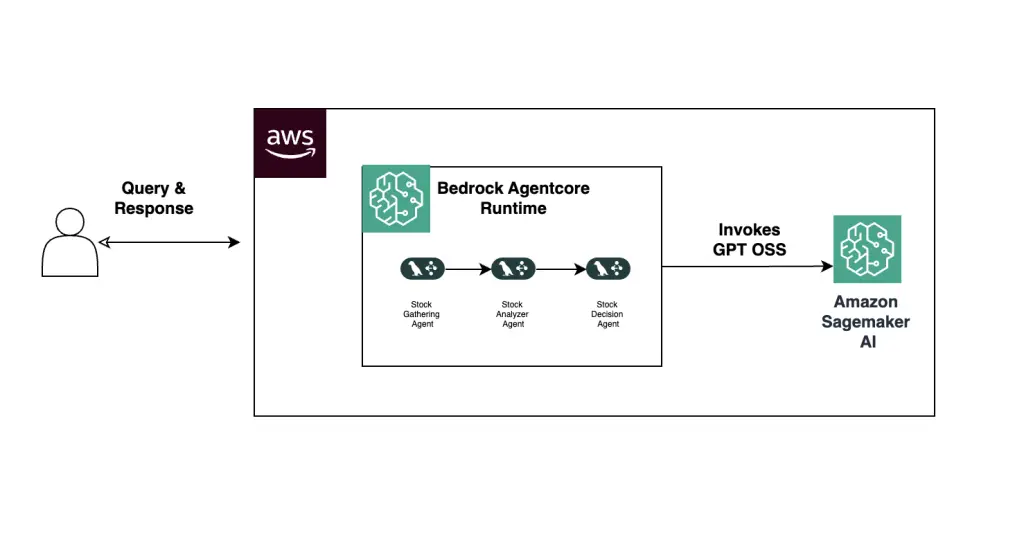
Notably, these agents invoke a GPT OSS model hosted on SageMaker AI when language understanding or generation is needed. The structured outputs received from the model guide agent actions, facilitating a fully serverless, modular, and scalable system powered by open-source technology. Consequently, this approach minimizes infrastructure overhead while maximizing efficiency in agentic workflows.
Prerequisites & Deployment Considerations
Before proceeding with deployment, ensure you possess the necessary G6e instance quotas for model deployment. You can request these quota adjustments directly from AWS. Furthermore, familiarizing yourself with the detailed instructions outlined in the original blog post is highly recommended to ensure a smooth and successful implementation process.
Implementing Agentic Workflows with LangGraph
LangGraph plays a pivotal role in orchestrating the multi-agent system. It handles complex task dependencies, manages state transitions between agents, and provides persistent memory capabilities. For example, the Data Gathering Agent might first retrieve stock data from an external API, then pass this data to the Stock Performance Analyzer Agent for evaluation. Meanwhile, LangGraph maintains a record of each agent’s actions and intermediate results, enabling seamless workflow execution.
LangGraph Benefits
Employing LangGraph offers several advantages: it simplifies complex orchestration logic, enhances code readability and maintainability, and facilitates debugging by providing clear visibility into the flow of data and control between agents. Additionally, its persistent memory feature enables agents to retain context across multiple interactions, leading to more personalized and effective experiences.
Benefits of Utilizing Agentic Workflows
This integrated approach offers a range of compelling advantages. Firstly, Amazon Bedrock AgentCore provides effortless scalability for your agentic workflows. Secondly, the modular design allows you to create specialized agents tailored for specific tasks, boosting flexibility and maintainability. Finally, utilizing open-source models like GPT OSS significantly contributes to cost-effectiveness.
Conclusion: The Future of AI Automation
By strategically combining OpenAI’s powerful open-weight language models with Amazon SageMaker AI and Bedrock AgentCore, developers are empowered to construct sophisticated agentic workflows capable of tackling complex challenges efficiently and economically. This innovative approach unlocks new avenues for process automation, improved decision-making, and the creation of groundbreaking AI-powered applications. Ultimately, this marks a significant step toward more intelligent and automated systems.
Source: Read the original article here.
Discover more tech insights on ByteTrending.
Discover more from ByteTrending
Subscribe to get the latest posts sent to your email.