
Revolutionizing Research: AI Meets Empirical Software
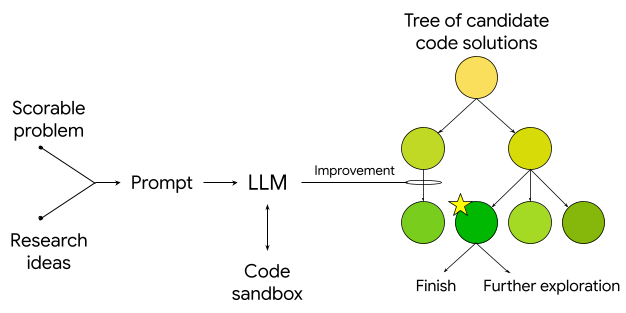
The landscape of scientific discovery is undergoing a dramatic shift, fueled by the convergence of artificial intelligence (AI) and empirically-driven software. Google’s recent research blog post highlights an innovative approach to accelerating breakthroughs – a system that learns from experimental data to guide new experiments and ultimately unlock deeper understanding across various scientific domains. This isn’t just about automating existing processes; it’s about fundamentally changing how science is done, leveraging the power of AI to accelerate innovation.

Understanding Empirical Software and Its Potential
Traditionally, scientific progress relies heavily on human intuition, hypothesis generation, and painstaking experimentation. Empirical software aims to augment this process by systematically exploring the experimental space based on observed data. It’s a closed-loop system: experiments are run, data is collected, the AI analyzes that data, and then suggests new experiments – all with the goal of efficiently navigating complex scientific problems. Consequently, it can significantly reduce time spent in research.
How it Works
At its core, this AI-powered empirical software utilizes machine learning models to build a representation of the underlying scientific phenomena. These models are trained on existing experimental data, allowing them to predict outcomes and identify promising avenues for further investigation. The system then intelligently designs new experiments, optimizing for factors like information gain and resource utilization. For instance, in drug discovery, it could suggest combinations of compounds to test based on predicted efficacy.
- Data-Driven Insights: AI analyzes vast datasets to uncover hidden patterns and correlations.
- Experiment Design: The software suggests the most informative experiments to run next.
- Closed-Loop Learning: Results from new experiments feed back into the model, constantly refining its understanding of empirical software’s insights.
Consider materials science, where discovering new compounds with specific properties is crucial for advancements in electronics and energy storage. Traditional methods can take years or even decades; empirical software could drastically reduce this timeline by intelligently exploring the chemical space, ultimately driving innovation.

Beyond Simulations
Unlike purely simulation-based approaches (which rely on theoretical models), empirical software thrives on real experimental data, even if that data is noisy or incomplete. This makes it particularly valuable in fields where accurate simulations are difficult to develop – a common challenge across many scientific disciplines. Therefore, it provides a crucial advantage when dealing with complex systems.
Real-World Applications and Future Directions
Google’s research highlights several potential applications for this technology, ranging from drug discovery to materials science and fundamental physics. The system isn’t intended to replace scientists; rather, it serves as a powerful assistant, freeing researchers from tedious tasks and allowing them to focus on higher-level analysis and interpretation. This contributes significantly to the efficiency of scientific workflows through empirical software.

Challenges and Opportunities
While promising, the development of effective empirical software faces several challenges. These include ensuring data quality, developing robust machine learning models that can handle complex scientific phenomena, and integrating these tools seamlessly into existing research workflows. However, overcoming these hurdles unlocks tremendous opportunities to accelerate scientific discovery and address some of humanity’s most pressing challenges; notably, it streamlines the application of empirical software.
- Data Scarcity: Initial data sets may be limited, requiring techniques like transfer learning.
- Explainability: Understanding why the AI suggests certain experiments is crucial for building trust and ensuring scientific rigor.
- Integration: Seamlessly integrating empirical software into existing lab infrastructure is vital for adoption.
Looking ahead, we can expect to see even more sophisticated forms of empirical software emerge, incorporating techniques like reinforcement learning and generative models to further optimize the experimental process. The future of science may very well be shaped by this powerful combination of AI and empirical experimentation.
Source: Read the original article here.
Discover more tech insights on ByteTrending.
Discover more from ByteTrending
Subscribe to get the latest posts sent to your email.