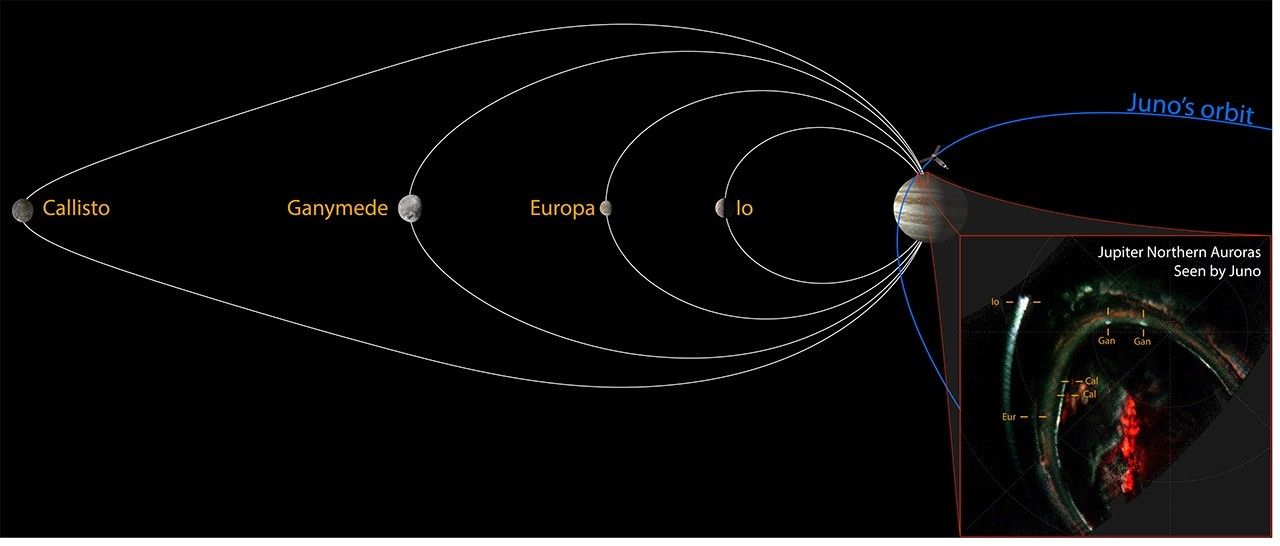

Discover a groundbreaking advancement! NASA’s Juno spacecraft has successfully detected the final missing auroral signature originating from Io, Europa, Ganymede, and Callisto – Jupiter’s four largest moons. This achievement marks a significant step forward in understanding the intricate interplay between Jupiter’s magnetic field, solar wind, and its icy satellites; specifically, it completes our picture of Jovian aurora generation.
What are Jovian Auroras?
While auroras are commonly associated with Earth, manifesting as the mesmerizing Northern and Southern Lights, Jupiter’s aurorae dwarf those on our planet. They create a dazzling light display near its poles. These phenomena occur when charged particles from the solar wind interact with Jupiter’s powerful magnetic field. Consequently, Jupiter’s immense magnetic field traps these particles, accelerating them toward the polar regions where they collide with atmospheric gases and cause them to glow; therefore, understanding their characteristics is crucial.
How do Auroras Differ on Jupiter?
Jupiter’s aurorae are considerably more powerful than Earth’s. Furthermore, unlike Earth’s auroras which fluctuate with solar activity, Jupiter’s aurorae are continuous and incredibly bright. In addition to their intensity, the scale of these displays is immense, stretching hundreds of thousands of kilometers into space; this makes them a key area for scientific study.
The Missing Piece: Moon-Generated Auroras
For several years, scientists have recognized that Jupiter’s moons influence its auroral activity. Io, Europa, Ganymede, and Callisto orbit within Jupiter’s magnetosphere, effectively acting as sources of plasma – charged particles – which contribute to the aurora. Previously, Juno observations revealed auroral signatures linked to three of these moons (Io, Europa, and Ganymede). However, detecting the signature from Callisto proved elusive due to its weaker influence and location further out in the magnetosphere; as a result, completing this picture was paramount.


Challenges in Detecting Callisto’s Signature
Callisto’s greater distance from Jupiter means it emits a fainter auroral signature. Moreover, the signal is easily obscured by background noise and other sources of emissions within Jupiter’s magnetosphere. Consequently, detecting this subtle signal required exceptional sensitivity and sophisticated data processing techniques.
Why This Discovery Matters
This complete set of moon-generated aurora detections provides valuable insights into several key areas. For instance, understanding how each moon contributes to the overall auroral system helps scientists refine models of Jupiter’s magnetosphere – a region far larger than the planet itself. Furthermore, these observations shed light on how plasma is generated and transported within Jupiter’s magnetosphere, revealing details about the interactions between moons, magnetic fields, and charged particles. Notably, auroral activity can also influence the geological processes occurring on these icy moons; thus, studying these connections can provide clues about subsurface oceans and potential habitability.
- Magnetospheric Dynamics: Understanding how each moon contributes to the overall auroral system helps scientists refine models of Jupiter’s magnetosphere – a region far larger than the planet itself.
- Plasma Interactions: The observations shed light on how plasma is generated and transported within Jupiter’s magnetosphere, revealing details about the interactions between moons, magnetic fields, and charged particles.
- Moons’ Geological Activity: Auroral activity can influence the geological processes occurring on these icy moons. Studying these connections can provide clues about subsurface oceans and potential habitability.
The Juno mission continues to push the boundaries of our understanding of Jupiter and its complex system, offering unprecedented views of this giant planet and its fascinating moons; therefore, future observations promise even more discoveries.
Learn more about the Juno mission and its findings on the NASA’s Juno Mission page.
Source: Read the original article here.
Discover more tech insights on ByteTrending.
Discover more from ByteTrending
Subscribe to get the latest posts sent to your email.