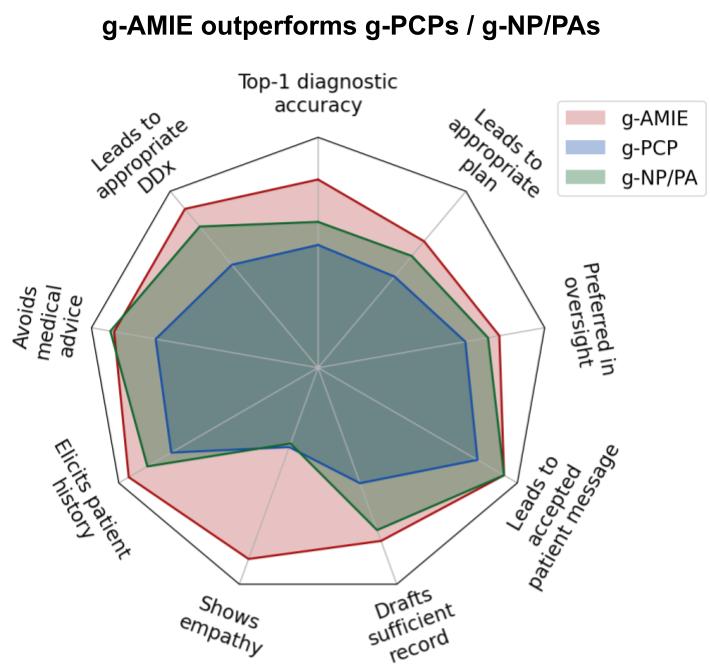

Introducing AMIE: Generative AI with a Human Touch
Google Research recently unveiled AMIE (AI for Medical Image Enhancement), a generative AI model designed to assist radiologists and other medical professionals. What distinguishes AMIE is the deliberate integration of physician oversight into its workflow, representing a crucial step towards responsible adoption of artificial intelligence in healthcare. This approach directly addresses concerns surrounding accuracy, bias, and trust that often hinder AI deployments in critical fields like medicine; therefore, incorporating human feedback becomes essential.
The Significance of Physician Oversight in AMIE‘s Design
Traditionally, generative AI models operate autonomously, producing results with limited interaction. However, the healthcare domain demands a higher level of scrutiny and validation due to its inherent risks. Consequently, Google’s approach with AMIE prioritizes collaboration between artificial intelligence and medical professionals. Furthermore, this iterative process aims to build trust among clinicians who are often hesitant to fully embrace AI in diagnostics.
Addressing Limitations of Traditional Generative AI
Many existing generative AI systems lack the ability to learn from nuanced feedback; as a result, their outputs can sometimes be inaccurate or clinically irrelevant. For example, an AI might enhance an image in a way that obscures subtle but important features. With AMIE, this issue is mitigated because physicians can directly guide the model towards producing more useful and accurate results through their targeted feedback.
The Role of Clinical Expertise
Physicians possess invaluable domain knowledge that AI models often struggle to replicate. Consequently, integrating physician oversight into AMIE’s workflow allows it to tap into this expertise, enabling a higher quality of image enhancement. In addition, the ongoing interaction between AMIE and medical professionals fosters a continuous learning environment where both benefit from the process—the AI learns from clinical experience, and clinicians gain insights into how AI can augment their capabilities.

Understanding AMIE’s Technical Architecture
AMIE’s architecture is built around a diffusion model, which is known for its ability to generate high-quality images. However, the key differentiator lies in how feedback from physicians is incorporated into the training loop. Initially, the model generates an enhanced image; subsequently, clinicians review and provide feedback using several methods.
The Feedback Mechanism: A Detailed Look
Physician feedback can manifest as acceptance of the generated image, minor edits to refine specific areas, or requests for regeneration with altered parameters. For instance, a radiologist might request that AMIE enhance contrast in a particular region of an X-ray. These actions are then fed back into the model’s training process, allowing it to learn from each interaction and improve its performance over time. Notably, this continuous learning loop is crucial for adapting the AI to diverse clinical scenarios and preferences.
Technical Specifications & Comparisons
| Feature | AMIE (with Oversight) | Traditional Generative AI |
|---|---|---|
| Physician Feedback Integration | Yes – Continuous Learning Loop | No – Limited Interaction |
| Accuracy in Medical Imaging | Potentially Higher due to Human Guidance | Variable, Dependent on Training Data |
| Trust & Acceptance by Clinicians | Higher due to Collaboration | Lower due to Lack of Transparency |
The Future of AI-Assisted Medical Imaging
Google’s AMIE represents a significant shift towards more human-centered AI solutions in healthcare. As generative AI models become increasingly prevalent, incorporating physician oversight becomes paramount for ensuring accuracy, safety, and trust. Furthermore, the success of AMIE could pave the way for similar collaborative approaches in other medical specialties.
In conclusion, AMIE demonstrates that combining artificial intelligence with human expertise can lead to powerful advancements in medical image enhancement. As a result, this model highlights a promising path toward responsible AI adoption within healthcare and offers a compelling vision for the future of diagnostics and patient care; on the other hand, further research is needed to assess long-term impacts and refine feedback mechanisms.
Source: Read the original article here.
Discover more tech insights on ByteTrending.
Discover more from ByteTrending
Subscribe to get the latest posts sent to your email.