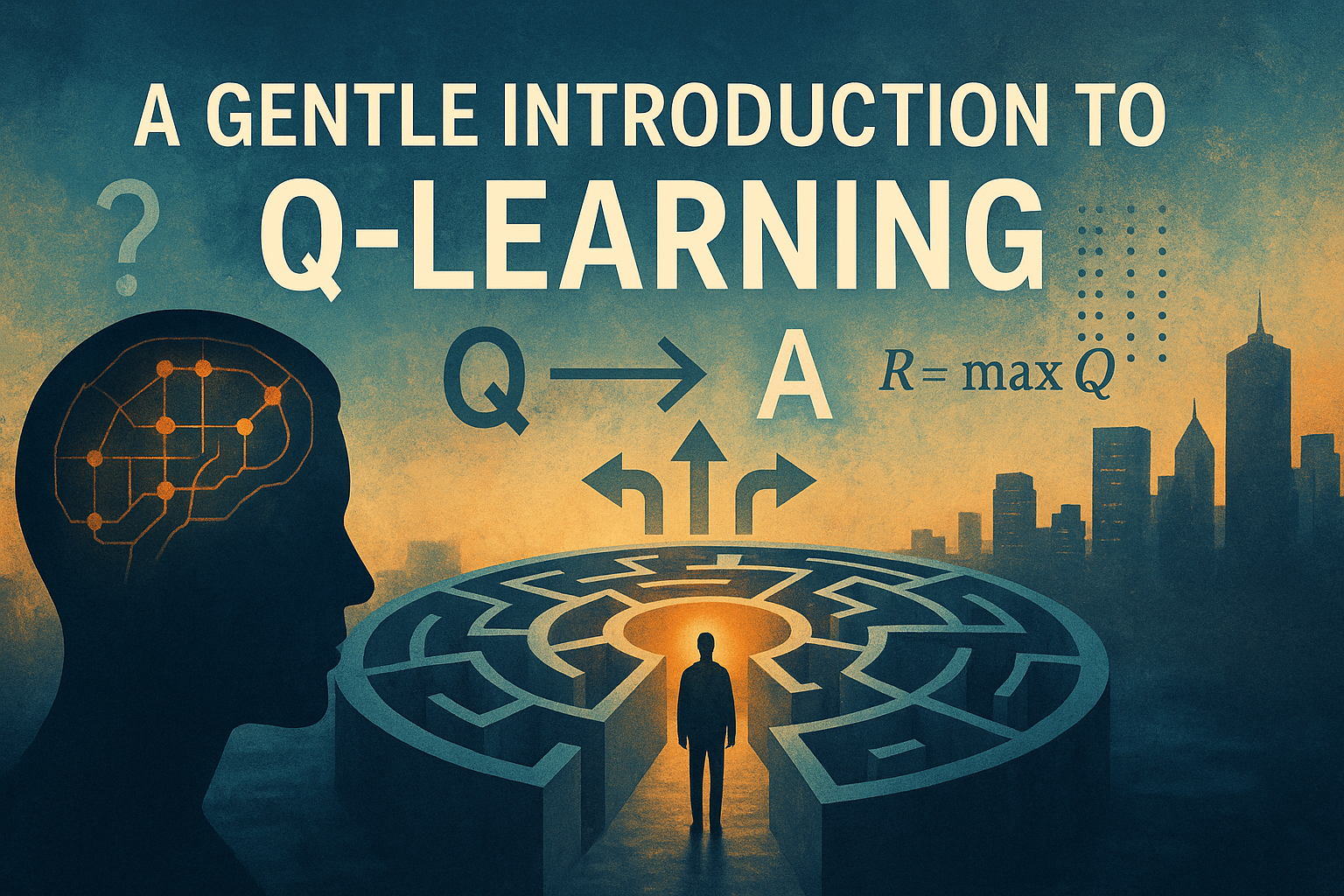

What is Reinforcement Learning? – A Quick Overview
Reinforcement learning (RL) represents a fascinating branch of artificial intelligence where an agent learns to make decisions within an environment to maximize a cumulative reward. Unlike supervised learning, which relies on labeled data, reinforcement learning agents learn through trial and error, receiving feedback in the form of rewards or penalties for their actions.
Imagine training a dog – you give it treats (rewards) when it performs desired behaviors and discourage it with a firm ‘no’ (penalty) when it misbehaves. Reinforcement learning operates on a similar principle, but within a complex mathematical framework. The agent explores the environment, takes actions, observes the results, and adjusts its strategy to improve its performance over time.
The core idea is that the agent isn’t explicitly told what to do; instead, it learns how to achieve a specific goal through interaction with the environment and the feedback it receives. This makes RL particularly well-suited for scenarios where defining explicit rules or providing labeled data is difficult or impossible.
Introducing Q-Learning: A Key Algorithm
Q-learning is a specific type of reinforcement learning algorithm that’s often considered a cornerstone in the field. It’s named after its creator, Richard S. Sutton and Andrew Barto, and it’s particularly known for its simplicity and effectiveness.

The Q-value represents the expected cumulative reward an agent will receive if it takes a specific action in a given state. The algorithm aims to learn these Q-values – essentially, it learns which actions are most likely to lead to success. This is often visualized as a Q-table, where rows represent states and columns represent actions.
How Q-Learning Works: A Step-by-Step Explanation
Let’s break down the core mechanics of Q-learning:
- State: The agent perceives its environment and identifies the current state (e.g., position on a grid, health level in a game).
- Action: Based on the current state, the agent selects an action to take (e.g., move left, jump, attack).
- Reward: The environment provides a reward or penalty based on the outcome of the chosen action.
Update Q-value: This is the heart of Q-learning. The algorithm updates the estimated Q-value for the state-action pair using the following formula:
Q(s, a) = Q(s, a) + α * [R(s, a) + γ * maxₛ Q(s’, a’) – Q(s, a)]Where:
* Q(s, a) is the current Q-value for state ‘s’ and action ‘a’.
* α (alpha) is the learning rate (controls how much the new information influences the existing Q-value). A higher alpha means faster learning.
* R(s, a) is the reward received after taking action ‘a’ in state ‘s’.
* γ (gamma) is the discount factor (determines the importance of future rewards compared to immediate rewards). A value closer to 1 prioritizes long-term gains.
* s’ is the next state reached after taking action ‘a’ in state ‘s’.
* a’ is the best action possible in the next state, s’.
Essentially, the algorithm balances the immediate reward with the potential future rewards, learning to prioritize actions that lead to long-term success. The agent continually updates its Q-table based on these interactions, gradually refining its understanding of the environment and optimizing its decision-making strategy.
Q-learning is frequently used in robotics (controlling robot movements), game AI (teaching agents how to play games like chess or Go), and resource management. Its strength lies in its ability to learn optimal policies without requiring explicit programming for every possible scenario – it learns through experience, just like a human would.
Source: Read the original article here.
Discover more tech insights on ByteTrending.
Discover more from ByteTrending
Subscribe to get the latest posts sent to your email.