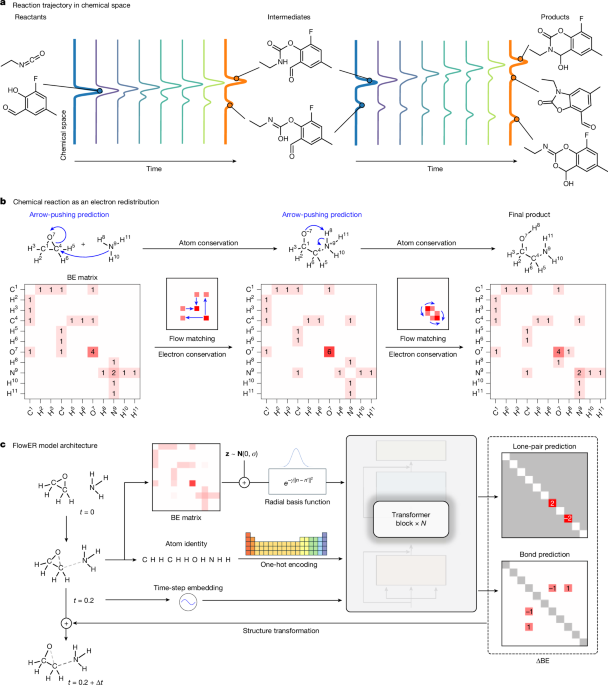

FlowER – a groundbreaking tool leveraging generative machine learning – offers a novel approach to predicting chemical reaction mechanisms. Published online August 20, 2025, in *Nature*, this research tackles the longstanding challenge of accurately forecasting how molecules transform, fundamentally impacting areas reliant on understanding reaction processes – a critical aspect for anyone involved with chemical development. Traditionally, computational chemistry has struggled with mass conservation, often producing mechanisms that violate fundamental laws of nature. This new method directly addresses this issue by employing ‘flow matching’, a technique designed to enforce electron redistribution within reaction pathways. The core goal is accurate **reaction mechanism prediction**, and FlowER represents a significant advancement in this field.
Understanding Flow Matching and its Significance
At its core, FlowER models chemical reactions as the systematic redistribution of electrons between reactants and products. Unlike previous methods that relied solely on predicting bond formation and breakage, FlowER actively seeks out mechanisms where mass is conserved. The team used generative machine learning to create a vast library of potential reaction pathways, then ‘flow matched’ these pathways against the observed stoichiometry – the ratio of reactants consumed to products formed. This process essentially filters out any mechanism that violates mass conservation. This approach isn’t just about accuracy; it’s fundamentally changing how we think about reaction prediction. By explicitly incorporating mass conservation, FlowER generates more realistic and reliable mechanisms. The researchers demonstrated this by applying FlowER to a range of reactions, including complex transformations in organic chemistry, showcasing its ability to predict mechanisms that were previously intractable with conventional methods. Furthermore, the improvement of approximately 30% compared to existing prediction algorithms when evaluating mass conservation highlights the value of this new approach – solidifying **reaction mechanism prediction** as a viable strategy.
Flow Matching: The Key Innovation
The ‘flow matching’ algorithm operates by iteratively adjusting the electron distribution within reaction pathways until mass is perfectly conserved. This iterative process ensures that only valid, physically plausible mechanisms are retained. This core innovation dramatically reduces the scope of potential mechanisms considered, making the search for accurate reactions far more efficient.
How FlowER Works: A Technical Deep Dive
The underlying technology behind FlowER is a generative neural network trained on a massive dataset of known chemical reactions and their corresponding mechanisms. The network learns the statistical relationships between reactants, products, and reaction conditions. Crucially, the flow matching algorithm operates as a post-processing step. After the neural network generates a potential mechanism, the flow matching algorithm iteratively adjusts the electron distribution within the pathway until mass is perfectly conserved. This process ensures that only valid, physically plausible mechanisms are retained. The team utilized a novel loss function specifically designed for flow matching, penalizing deviations from mass conservation more heavily than traditional energy-based losses. This fine-tuning of the optimization criteria proved critical to the system’s success. Furthermore, FlowER incorporates constraints on bond formation and breakage probabilities derived from quantum chemical calculations, adding another layer of realism to its predictions. The use of generative machine learning for **reaction mechanism prediction** is truly transformative.


Technical Specifications & Algorithm Details
Source: Read the original article here.
Discover more tech insights on ByteTrending.
Discover more from ByteTrending
Subscribe to get the latest posts sent to your email.