
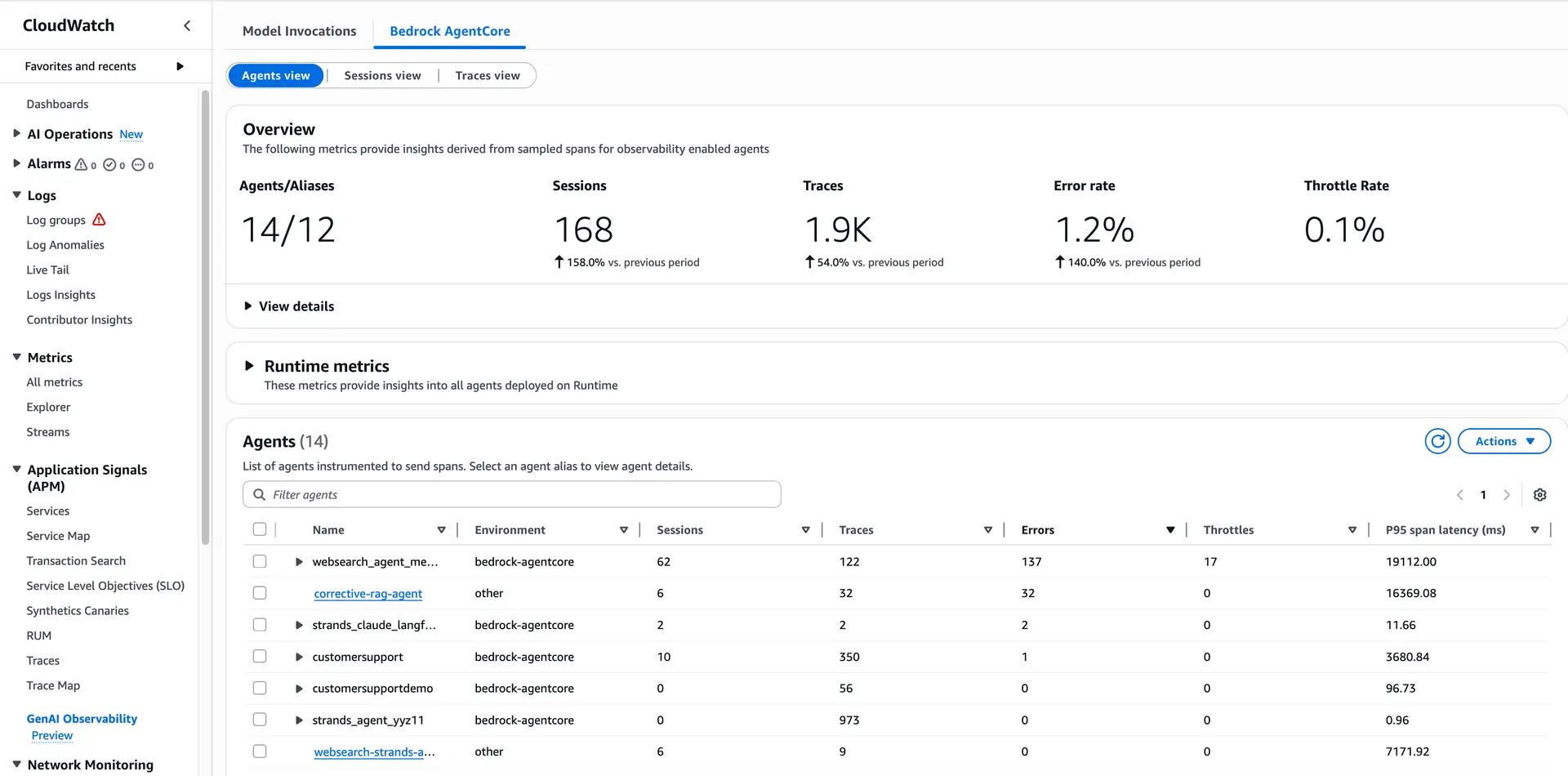


AI agents are rapidly transforming enterprise applications across various industries, from streamlining customer service to automating complex workflows. As organizations increasingly deploy these sophisticated systems, a critical question arises: how can you build trust in an AI application? The core challenge lies in transparency; AI agents often make decisions on behalf of users, dynamically invoke tools, and follow reasoning paths that can create an accountability gap. Having visibility into the factors influencing user interactions and outcomes is essential for building reliable agents. Too frequently, observability is treated as an afterthought—a detrimental approach with AI agents. Early implementation fosters transparency, reliability, and exceptional user experiences.
At the AWS Summit New York City 2025, we introduced Amazon Bedrock AgentCore Observability, a comprehensive monitoring solution designed to work across diverse agent frameworks and foundation models (FMs). Amazon Bedrock AgentCore Observability simplifies the process of monitoring, analyzing, and auditing AI agent interactions by minimizing complex observability infrastructure setup while providing full visibility into agent operations. It offers powerful capabilities for tracking agent interactions, analyzing performance metrics, and debugging issues across different deployment environments, enabling developers to build trustworthy AI systems from the outset.
This article explores implementation options for agents hosted on Amazon Bedrock AgentCore Runtime and those deployed on other services like Amazon Elastic Compute Cloud (Amazon EC2), Amazon Elastic Kubernetes Service (Amazon EKS), AWS Lambda, or alternative cloud providers. We will also share best practices for integrating observability throughout the development lifecycle.
Understanding AgentCore Observability: A Solution Overview
Amazon Bedrock AgentCore observability is designed as a development accelerator, delivering immediate value with several key benefits. It simplifies setup and usage, provides full end-to-end traceability through readily available dashboards, and adheres to OpenTelemetry standards for generative AI semantic conventions. Furthermore, it’s compatible with all AI agent frameworks and large language models (LLMs).
Key Advantages of AgentCore Observability
This unified monitoring approach streamlines debugging, performance optimization, and auditing processes, ensuring accountability and trust in your AI agents. For instance, consider an e-commerce agent recommending products to customers; with AgentCore observability, you can trace the entire decision path—from initial query to final recommendation—identifying potential biases or unexpected behavior that might negatively impact user experience or business outcomes. This capability is invaluable for maintaining a consistent and reliable service.
OpenTelemetry Integration
AgentCore’s adherence to OpenTelemetry standards is particularly important. OpenTelemetry provides a vendor-agnostic approach to instrumentation, meaning you can easily switch between different observability backends without modifying your agent’s code. This flexibility ensures that your observability strategy remains adaptable as your technology stack evolves.
Implementation Options: Flexibility for Every Deployment
AgentCore Observability offers flexible deployment options catering to various infrastructure preferences, providing adaptability regardless of where you choose to host your agents. Here’s a breakdown of the available methods:
Amazon Bedrock AgentCore Runtime
The simplest setup involves leveraging the built-in observability features of the runtime. This eliminates much of the configuration overhead and allows developers to quickly gain insights into their agent’s behavior.
Self-Hosted Deployments (EC2, EKS, Lambda)
For greater control and customization, you can deploy your agents on your preferred infrastructure—whether that’s Amazon EC2, Amazon EKS, or AWS Lambda. In these scenarios, you’ll integrate AgentCore Observability using OpenTelemetry SDKs. The solution provides detailed guidance and code samples for seamless integration.
Cross-Cloud Compatibility
The OpenTelemetry-based design ensures compatibility with most cloud environments—allowing portability across different platforms. Therefore, your observability investment isn’t tied to a single vendor; you have the freedom to move your agents between cloud providers as needed.
Best Practices for Maximizing Observability
To maximize the benefits of AgentCore observability, consider these best practices. Integrating observability from the initial development stages is crucial to catch issues early on and proactively address potential problems. Defining clear metrics related to your agent’s functionality—such as response time, error rate, and user satisfaction—will also facilitate ongoing performance optimization.
Furthermore, adhering to OpenTelemetry conventions ensures consistent data collection and analysis across all components of your system. Automating monitoring through CI/CD pipelines enables continuous improvement and helps maintain a high level of reliability for your AI agents. In addition, it’s important to remember that observability is not just about collecting data; it’s about using that data to drive informed decisions and ultimately build better AI systems.
In conclusion, Amazon Bedrock AgentCore Observability provides a powerful solution for gaining insights into the behavior of your AI agents. By following these implementation options and best practices, you can enhance trust, improve performance, and unlock the full potential of your AI-powered applications.
Source: Read the original article here.
Discover more tech insights on ByteTrending.
Discover more from ByteTrending
Subscribe to get the latest posts sent to your email.








