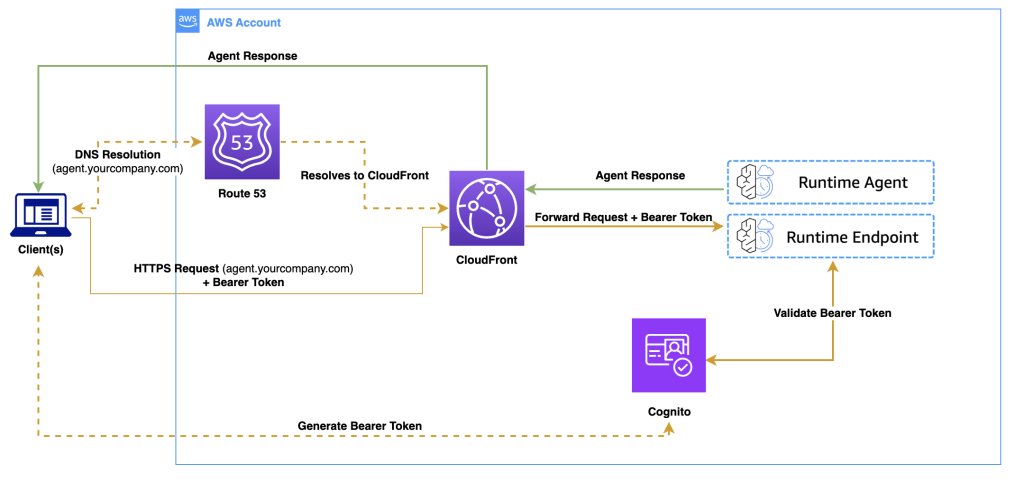



Uncover how to create custom domain names for your Amazon Bedrock AgentCore Runtime agent endpoints, streamlining integration and enhancing branding. When deploying AI agents to Amazon Bedrock AgentCore Runtime (currently in preview), customers frequently desire to use custom domain names for a more professional and seamless user experience.
By default, AgentCore Runtime agents utilize endpoints resembling https://bedrock-agentcore.{region}.amazonaws.com/runtimes/{EncodedAgentARN}/invocations. Consequently, transforming these into memorable custom domains (like https://agent.yourcompany.com) significantly improves usability. This post will guide you through the process of achieving this using Amazon CloudFront as a reverse proxy.
Understanding Amazon Bedrock AgentCore Runtime
Deploying and managing AI agents can often be complex, but Amazon Bedrock AgentCore Runtime simplifies this process by handling underlying infrastructure concerns such as scaling, security, and authentication. It boasts framework agnosticism, supporting tools like LangGraph, CrewAI, and Strands Agents.
Key Advantages of AgentCore Runtime
Furthermore, AgentCore Runtime offers several key benefits. These include extended execution times (up to 8 hours), isolated microVMs for enhanced security, a consumption-based pricing model designed specifically for AI agents, and built-in observability features. As a result, developers can concentrate on building intelligent applications without being burdened by operational overhead.
Why Opt for Custom Domains?
While direct HTTPS requests to the default AgentCore Runtime endpoint are functional, custom domain names provide considerable advantages that extend beyond mere convenience. They significantly improve branding and maintainability for both users and developers alike. For example, a branded domain provides a much more professional feel compared to an AWS-generated URL.
The Benefits in Detail
- Enhanced Branding: Applications display your company’s branded domain name, cultivating a polished user experience and reinforcing brand identity.
- Simplified Development Workflow: Developers can employ consistent and memorable endpoints across projects, eliminating the need to manage lengthy and intricate AWS URLs. This practice reduces potential errors and fosters improved collaboration within teams.
- Streamlined Maintenance Processes: Updates and configuration changes are significantly simplified when utilizing custom domains, particularly in environments managing numerous agents. Consequently, this minimizes deployment risks and streamlines troubleshooting efforts.
Implementing Custom Domains with CloudFront
The process of setting up a custom domain involves several straightforward steps. Initially, you’ll need to obtain an SSL/TLS certificate using AWS Certificate Manager (ACM) for your desired domain name. Subsequently, create a CloudFront distribution configured to forward requests to your AgentCore Runtime endpoint and utilize the ACM certificate. Finally, configure DNS records in Amazon Route 53 to point your custom domain towards the CloudFront distribution’s assigned domain name.
For detailed instructions and illustrative code examples covering each component of this setup process, please refer to the official AWS blog post. This resource offers a comprehensive guide to implementing custom domain names successfully.
Conclusion
Ultimately, integrating custom domains with your Amazon Bedrock AgentCore Runtime agents is a simple yet impactful process that significantly elevates branding, improves the developer experience, and streamlines maintenance procedures. By effectively leveraging CloudFront, Route 53, and ACM, you can establish a robust and scalable solution precisely tailored to meet your organization’s specific requirements. Therefore, embracing custom domain names represents a valuable investment in the long-term usability and professionalism of your AI agent deployments.
Source: Read the original article here.
Discover more tech insights on ByteTrending.
Discover more from ByteTrending
Subscribe to get the latest posts sent to your email.