


Unraveling the Mystery of JWST’s “Little Red Dots”
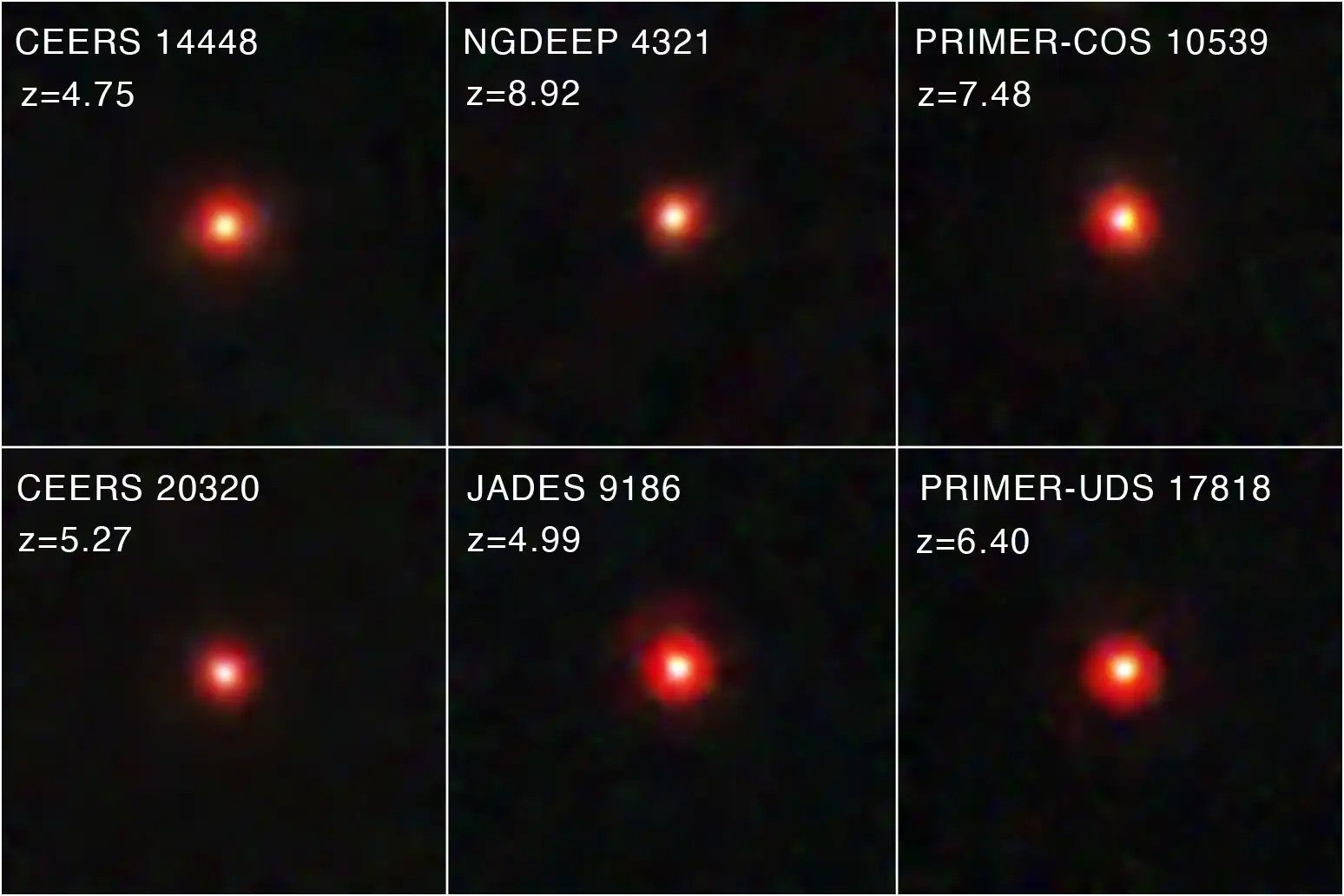
For months, astronomers have been captivated by a peculiar phenomenon detected in early James Webb Space Telescope (JWST) observations: tiny, bright red dots appearing across deep-sky surveys. These intriguing anomalies, initially dubbed “little red dots” (LRDs), presented an astronomical puzzle, sparking considerable debate and speculation within the scientific community. Understanding these black hole stars represents a significant leap forward in our understanding of early universe formation. Now, an international team of researchers believes they’ve made substantial progress toward solving this cosmic mystery – and the answer is surprisingly massive.
The “Black Hole Star” Hypothesis
The prevailing theory now suggests that these LRDs aren’t galaxies or stars in the traditional sense, but rather what scientists are calling “black hole stars.” These objects represent extremely compact entities – essentially seeds of supermassive black holes (SMBHs) – formed during the very early universe. Importantly, these primordial SMBH seeds would have been considerably smaller than the black holes we observe today at the centers of galaxies; their masses were likely only a hundred times that of our Sun. Consequently, they offer a unique window into the conditions prevalent in the nascent cosmos.
The team’s findings, published recently, detail how these objects could have formed through the direct collapse of massive gas clouds in the early universe. Instead of undergoing stellar evolution and forming stars similar to our Sun, these immense gas clouds collapsed directly into black holes, thereby creating these initial seeds. The characteristic red color observed is attributed to the intense radiation emitted as material accretes onto the surface of these nascent black holes – a process known as accretion.
Evidence Supporting the Theory
- JWST’s Sensitivity: JWST’s unparalleled infrared sensitivity allows astronomers to detect extremely faint and distant objects, including these tiny seeds. This ability is crucial for observing phenomena from an era when the universe was in its infancy.
- Redshift Measurements: Preliminary redshift measurements suggest that many of these LRDs are incredibly distant, aligning with their existence within the first billion years after the Big Bang. Consequently, they represent some of the earliest objects ever observed.
- Lack of Stellar Characteristics: Unlike typical stars which display predictable patterns during stellar evolution, these objects don’t exhibit those expected characteristics. Their brightness and color profile simply don’t align with known star types, further solidifying their unusual nature.

Implications for Cosmic Evolution
The discovery, if confirmed by further observations, carries significant implications for our understanding of how supermassive black holes formed. Current models often struggle to adequately explain the rapid growth of SMBHs in the early universe; these little red dots may hold a crucial piece of that puzzle. Furthermore, they provide valuable insights into the conditions and processes that shaped the cosmos shortly after its birth.
Future Research Directions
While this discovery is groundbreaking, further research is essential to solidify our understanding of these little red dots. Scientists are planning follow-up observations with JWST, utilizing different filters and observing techniques to gather more data about their composition, mass distribution, and environment. Additionally, theoretical models will need refinement to accurately account for the existence and formation mechanisms of these objects. Notably, spectroscopic analysis will be key to determining the chemical abundances present in the material falling onto the little red dots.
The Significance of Early Universe Studies
Studying these early black hole seeds allows astronomers to peer back in time and witness the universe during a pivotal epoch. For example, understanding how SMBHs formed so quickly helps constrain models of dark matter distribution and galaxy formation. As a result, continued investigation into little red dots promises not only to illuminate their origins but also to refine our broader cosmological narrative. Finally, researchers are exploring whether these early black hole seeds contributed significantly to the reionization epoch – when the universe transitioned from a neutral state to an ionized one.
Conclusion
The identification of “little red dots” as potential primordial black holes marks a significant advancement in our comprehension of the early universe and the formation of supermassive black holes. While ongoing research is necessary to confirm these findings definitively, this discovery offers an exciting glimpse into the cosmic landscape shortly after the Big Bang; it’s clear that JWST continues to revolutionize our view of the cosmos. Ultimately, uncovering the secrets held within these faint red glows will undoubtedly reshape our understanding of the universe’s evolution.
Source: Read the original article here.
Discover more tech insights on ByteTrending.
Discover more from ByteTrending
Subscribe to get the latest posts sent to your email.