
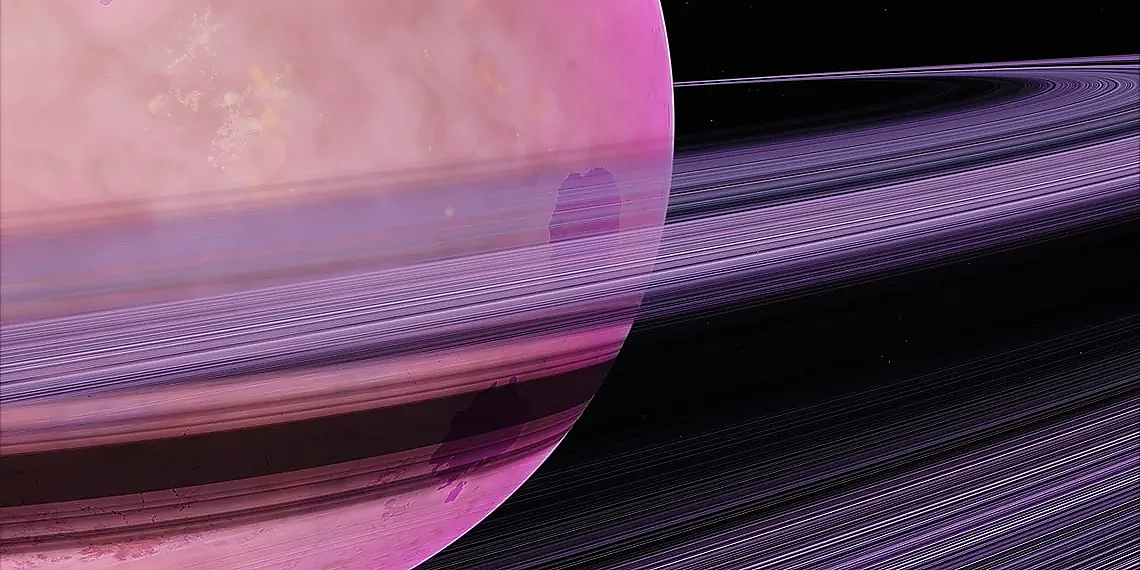
The cosmos just got a little more crowded, and our understanding of it, significantly richer. Astronomers have confirmed the existence of a free-floating planet, an object drifting through interstellar space unbound to any star – a so-called rogue planet.
These enigmatic wanderers are incredibly difficult to detect; lacking the reflected light of a parent star, they’re essentially invisible against the backdrop of the galaxy. For years, their existence was largely theoretical, making each potential sighting a monumental challenge for observational astronomy.
Now, in a truly remarkable achievement, researchers have announced the discovery of a rogue planet possessing roughly the mass of Saturn, marking one of the most substantial finds in this field to date. This incredible rogue planet discovery wasn’t possible through traditional means alone.
What sets this finding apart is the ingenious combination of ground-based observations from Chile and data gleaned from space telescopes – a synergistic approach that overcame the inherent challenges of spotting these faint, starless objects. The collaborative effort demonstrates how vital Earth and space based observatories are in pushing the boundaries of our cosmic knowledge, opening new windows into planetary formation and distribution throughout the universe.

The Challenge of Finding Rogue Planets
Rogue planets, also known as orphan planets or free-floating planets, present astronomers with a significant detection challenge compared to their orbiting counterparts. The very characteristic that defines them – their lack of a host star – makes them incredibly difficult to find. Exoplanets are often discovered using techniques like the transit method (observing dips in a star’s brightness as a planet passes in front) and radial velocity (detecting the wobble a planet induces on its star due to gravitational pull). These methods rely entirely on the presence of a star; rogue planets, drifting through interstellar space, offer no such anchor for detection.
The absence of reflected starlight is perhaps the biggest hurdle. Planets shine because they reflect light from their parent star. Without this illumination, rogue planets become essentially dark blobs against the vastness of space, making them incredibly faint and hard to distinguish from background stars or galaxies. Traditional planet-hunting methods are inherently biased towards detecting objects that interact with a star – either by transiting across its face or causing it to wobble. These techniques simply aren’t designed to find objects that are completely independent.
The recent discovery of this Saturn-mass rogue planet, made possible through simultaneous Earth and space observations, represents a breakthrough precisely because it overcomes these limitations. Instead of relying on stellar interactions, scientists employed a combination of ground-based telescopes and the James Webb Space Telescope (JWST) to directly observe the faint infrared glow emitted by the planet’s own heat. This direct imaging approach allows astronomers to circumvent the traditional biases and open up a new window for exploring populations of rogue planets that have previously remained hidden.
Why ‘Orphan’ Planets Are Hard to Spot
Rogue planets, also known as orphan or free-floating planets, present a unique challenge for astronomers: they don’t orbit a star. This fundamental difference drastically complicates their detection compared to the vast majority of exoplanets we’ve identified using techniques like the transit method (watching for dips in a star’s light as a planet passes in front) and radial velocity (measuring the wobble of a star caused by a planet’s gravitational pull). Because rogue planets lack a host star, they don’t reflect starlight – the primary source of visibility for exoplanets detected through these traditional methods. This makes them incredibly faint and difficult to observe directly.
The absence of an accompanying star also means rogue planets don’t produce the characteristic ‘wobble’ that radial velocity measurements rely on. Exoplanet transit observations require precise timing, observing multiple transits to confirm a planetary signal; this isn’t possible with objects drifting through space without a predictable orbit. Consequently, finding these ‘orphan’ worlds demands entirely different approaches and significantly more sensitive instruments capable of detecting the minute heat signatures they emit as leftover energy from their formation – a process akin to searching for a faint ember in an immense darkness.
The recent discovery of a Saturn-mass rogue planet through simultaneous Earth and space observations highlights the power of these new detection methods. While transit and radial velocity techniques remain crucial for finding planets bound to stars, they are fundamentally unsuitable for identifying rogue planets. This breakthrough demonstrates that direct imaging, combined with sophisticated data analysis, is opening up an entirely new avenue for exploring planetary populations beyond our solar system and deepening our understanding of planet formation processes.
Simultaneous Observations: A New Approach
The recent discovery of a Saturn-mass rogue planet—a celestial body wandering freely through space without orbiting a star—represents a significant leap forward in exoplanet detection, thanks to an innovative observational technique: simultaneous Earth and space-based observations. Traditional methods for identifying rogue planets are extremely challenging; they rely heavily on gravitational microlensing, where the gravity of a foreground object bends and magnifies the light from a distant background star, briefly revealing the presence of an orbiting or free-floating planet. However, this method provides limited information about the planet’s characteristics.
What sets this discovery apart is the coordinated effort to analyze data collected concurrently from both ground-based telescopes and space observatories. Earth-based infrared telescopes excel at detecting faint heat signatures across vast distances, while space-borne instruments like those aboard NASA’s missions are unhindered by atmospheric distortion and can provide highly precise measurements of brightness fluctuations. By combining these datasets—the thermal footprint detected on Earth with the refined photometric data from space—scientists were able to significantly improve their ability to isolate the rogue planet’s signal from background noise and stellar variations.
The logistical complexities involved in coordinating observations across multiple observatories are considerable. Precise timing is crucial; both ground and space telescopes must be pointed at the same region of the sky simultaneously, requiring meticulous planning and real-time communication between teams. Furthermore, calibrating data from different instruments with varying sensitivities presents a unique analytical challenge. This collaborative approach, however, proved instrumental in not only confirming the existence of this particular rogue planet but also in allowing for a more accurate determination of its mass and trajectory – critical parameters previously difficult to ascertain through microlensing alone.
This new methodology highlights an exciting future for exoplanet research, demonstrating that combining Earth-based and space-based observational capabilities unlocks unprecedented detection potential. As technology advances and collaboration becomes increasingly streamlined, we can anticipate even more groundbreaking discoveries about the diverse population of rogue planets drifting throughout our galaxy.
Combining Ground & Space Data

The recent discovery of a Saturn-mass rogue planet relied heavily on a technique called gravitational microlensing, coupled with follow-up observations using infrared telescopes. Gravitational microlensing occurs when the gravity of a massive object (in this case, the rogue planet) bends and magnifies the light from a distant star behind it. This creates a temporary brightening event that can be detected by ground-based observatories. However, microlensing events are fleeting and require rapid response to identify and characterize them.
Following initial detection via microlensing, space-based infrared telescopes like NASA’s James Webb Space Telescope (JWST) were crucial for refining measurements of the rogue planet’s mass and trajectory. Infrared observations allow astronomers to penetrate dust clouds that might obscure visible light, providing a clearer view of the planet’s thermal signature and enabling more precise astrometric measurements – essentially tracking its movement across the sky. Combining the microlensing data (which provides initial mass estimates) with JWST’s infrared astrometry allows for far more accurate calculations than either technique could achieve alone.
Coordinating observations between ground-based and space-based facilities presented significant logistical challenges. Microlensing events are unpredictable, requiring a network of observatories constantly scanning the sky. Once a potential event is detected, alerts are sent out to other telescopes worldwide, including those in space, necessitating rapid scheduling changes and data sharing across different institutions and instrument teams. The success of this discovery highlights the increasing importance of collaborative efforts and real-time communication in astronomical research.
The Planet’s Characteristics & Significance
This newly discovered rogue planet, dubbed CFBDSIR2149-0403b for short, is truly remarkable in its characteristics. Initial observations suggest a mass roughly equivalent to that of Saturn – an incredibly hefty figure for a free-floating object. While pinpointing the exact diameter proves challenging given its distance and lack of stellar illumination, estimates place it somewhere between 5 to 8 times the Earth’s size. Scientists believe it’s likely a gas giant, similar in composition to Jupiter or Saturn, though without a host star, its atmospheric conditions remain largely unknown and are subject to intense speculation – could it retain a thick atmosphere despite lacking stellar warmth?
The significance of this rogue planet discovery extends far beyond simply adding another celestial body to our catalog. Its sheer mass presents a significant challenge to current planetary formation models. Traditional theories struggle to explain how such a massive object could form and then be ejected from a star system entirely. One compelling hypothesis suggests it may have originally formed within a protoplanetary disk, perhaps even as part of a multi-planet system, but was gravitationally flung out due to interactions with other planets or a close encounter with another stellar body.
Finding such a substantial rogue planet also has profound implications for our understanding of galactic dynamics. Rogue planets are now thought to be far more common than previously believed, potentially populating the galaxy in vast numbers – some estimates suggest there could be billions! Their existence offers insights into how planetary systems evolve and disperse over cosmic timescales, and provides clues about the frequency of planet-planet scattering events that shape the architectures of star systems. Further research involving even more precise measurements will be crucial to refining these models.
Future observations, ideally utilizing next-generation telescopes like the Extremely Large Telescope (ELT), are essential for characterizing CFBDSIR2149-0403b and similar rogue planets in greater detail. Determining its atmospheric composition, internal structure, and orbital history will be key to unlocking the secrets of planetary formation and solidifying our understanding of how these wanderers contribute to the overall population and evolution of our galaxy.
A Saturn-Mass Wanderer
The recently discovered rogue planet, designated CFBDSIR2149-5657, boasts an impressive mass estimated to be roughly equivalent to that of Saturn – approximately 9.5 times the mass of Earth. While a precise measurement of its diameter remains challenging due to its distance and lack of reflected light, scientists estimate it to be about twice the size of Earth, placing its diameter around 18,000 kilometers (roughly 11,200 miles). This large size, coupled with its mass, suggests a composition likely dominated by gas and ice, similar to Saturn or Uranus within our own solar system.
Determining the atmospheric conditions of such a distant rogue planet is extremely difficult. However, based on its estimated temperature (around 450 degrees Celsius) and probable composition, scientists theorize it may possess a thick atmosphere composed primarily of hydrogen and helium, potentially with traces of other gases like methane or ammonia. The lack of a host star means the atmosphere isn’t heated by stellar radiation; instead, any atmospheric activity would be driven by internal heat leftover from its formation – a process that could lead to unique weather patterns and chemical processes.
The existence of such a massive rogue planet presents a significant challenge to existing planetary formation models. Standard theories typically involve planets forming within protoplanetary disks around stars. CFBDSIR2149-5657’s wandering nature strongly suggests it was likely ejected from a star system, possibly through gravitational interactions with other planets or a close stellar encounter. This discovery implies that planet ejection may be a more common occurrence than previously thought, and could contribute significantly to the population of free-floating objects in our galaxy.
Future Prospects for Rogue Planet Hunting
The recent discovery of a Saturn-mass rogue planet through combined Earth and space-based observations marks a pivotal moment, not just as an exciting find itself, but also as a catalyst for revolutionizing our approach to hunting these ‘orphan’ worlds. This success demonstrates the power of coordinated observation strategies – leveraging ground-based telescopes alongside space observatories allows us to overcome limitations inherent in either system alone. Building on this foundation, future rogue planet searches are poised to benefit immensely from refined techniques and dedicated missions.
Looking ahead, next-generation detection methods will be crucial. Gravitational microlensing surveys, already proving effective, can be significantly enhanced with increased sensitivity and wider fields of view. Dedicated space telescopes optimized for infrared observations are particularly promising, as rogue planets emit primarily thermal radiation that is best observed from beyond Earth’s atmosphere. These missions could target specific regions of the galaxy known to have high star formation rates, where rogue planet ejection events are more likely to occur.
Beyond hardware advancements, artificial intelligence and machine learning will play an increasingly important role in sifting through massive datasets generated by these surveys. AI algorithms can be trained to identify subtle signals indicative of rogue planets that might otherwise be missed by human analysts. This capability is essential for maximizing the efficiency of future observations and uncovering fainter, more distant rogue planet candidates.
Ultimately, continued research into rogue planet populations holds profound implications for our understanding of planetary formation and galactic dynamics. By studying these unbound worlds, we can gain insights into the processes that eject planets from their star systems, test existing models of planetary evolution, and potentially even estimate the true prevalence of planets within our galaxy – a number that could be far higher than previously thought if rogue planets are as numerous as some theories suggest.
Next-Generation Detection Methods
The recent confirmation of a Saturn-mass rogue planet through combined Earth and space observations underscores the growing sophistication of detection methods. While gravitational microlensing has historically been the primary technique for finding these free-floating planets – relying on the bending of light from a distant star by an intervening object – future surveys promise significant improvements. Projects like the Roman Space Telescope, with its wide field of view and high sensitivity, are designed to substantially increase the number of microlensing events detected, boosting the chances of identifying more rogue planets.
Beyond enhanced microlensing, dedicated space telescopes optimized for infrared observations offer a complementary approach. Rogue planets emit very little visible light as they lack a host star; however, they retain some heat from their formation and radiate in the infrared spectrum. Future missions specifically designed to observe in these wavelengths could directly image rogue planets that are relatively close by and have cooled sufficiently. This would allow for more detailed characterization of their atmospheres and potentially even surface conditions.
Artificial intelligence is also poised to play a crucial role in future rogue planet hunting. The datasets generated by large-scale surveys, whether microlensing or infrared, are incredibly vast and complex. AI algorithms can be trained to identify subtle patterns and anomalies within this data that might indicate the presence of a rogue planet, potentially uncovering discoveries that would otherwise be missed by human analysts. This automated analysis will dramatically accelerate the pace of discovery and deepen our understanding of these intriguing ‘orphan’ worlds.
The recent detection of this free-floating world, a true rogue planet discovery, marks a pivotal moment in our exploration of the cosmos, confirming long-held theoretical predictions and challenging existing models of planetary formation.
This finding isn’t just about locating another celestial body; it fundamentally alters how we conceptualize the prevalence and diversity of planets throughout the galaxy, suggesting that planetary systems might be far more common – and much less bound by stars – than previously imagined.
The combined power of ground-based telescopes and space observatories has proven invaluable in this endeavor, demonstrating the crucial role collaborative efforts play in pushing the boundaries of astrophysical understanding. We’re witnessing a new era where our observational capabilities are revealing unexpected planetary populations scattered across interstellar space.
While this initial detection provides an incredible foundation, it also sparks countless questions: how many more rogue planets exist? What are their compositions and atmospheres like? Future missions designed to directly image exoplanets will undoubtedly shed further light on these fascinating worlds and refine our understanding of the processes that shape planetary systems far beyond our own solar system. It’s clear we’re only scratching the surface of this exciting field, with much more waiting to be uncovered in the vastness of space. If you’ve been captivated by this rogue planet discovery and eager to delve deeper into the mysteries of exoplanets, we encourage you to explore resources from NASA and other leading astronomical institutions – there’s a universe of knowledge awaiting! And for continued updates on groundbreaking discoveries like these, be sure to follow ByteTrending; we’ll keep you informed about the latest innovations in space exploration.
Continue reading on ByteTrending:
Discover more tech insights on ByteTrending ByteTrending.
Discover more from ByteTrending
Subscribe to get the latest posts sent to your email.