

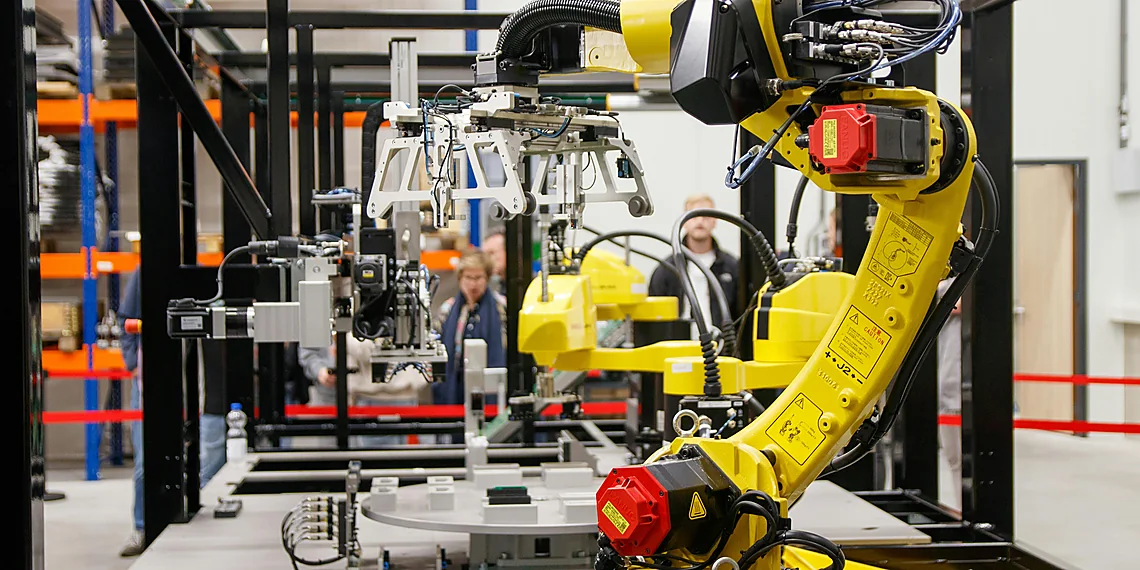

Imagine a robot that folds itself flat for easy transport, then blossoms into a complex machine ready to tackle intricate tasks – it’s not science fiction anymore. The convergence of ancient art and cutting-edge engineering is giving rise to an exciting new field: origami robotics. We’re witnessing a revolution where the principles of paper folding are being harnessed to create robots with unprecedented capabilities in terms of size, strength, and adaptability.
For years, engineers have sought ways to overcome the limitations of traditional robotic design – bulky frames, complex assembly processes, and restricted maneuverability. Now, inspired by the elegant simplicity of origami, researchers are developing innovative mechanisms that allow for compact storage and rapid deployment. This approach promises a future where robots can be easily integrated into diverse environments, from disaster relief zones to minimally invasive medical procedures.
At the forefront of this innovation is the FoRoGated-Structure, a particularly clever design that utilizes interlocking origami folds to achieve both structural rigidity and flexible motion. These structures are proving remarkably effective in creating deployable robotic systems capable of transforming from a flat, easily storable configuration into a robust, functional form – offering a glimpse into what’s possible when we combine the ingenuity of traditional craftsmanship with modern robotics.
The Genius of Interlaced Origami
Traditional origami, while mesmerizing in its artistry, often presents a challenge when it comes to practical applications beyond decorative forms. Many origami structures are fragile or difficult to integrate into functional devices. The breakthrough behind the ‘Foldable-and-Rollable corruGated Structure’ (FoRoGated-Structure) lies in a clever departure from these limitations – specifically, the application of interlacing techniques.
Interlacing, in this context, isn’t about weaving threads; it refers to how layers within the structure are connected. Think of it like braiding hair—each strand interlocks with others, creating a much stronger and more flexible overall form than simply stacking them. In traditional origami, panels might be rigidly attached or rely on delicate creases for support. The FoRoGated-Structure uses this interlacing to allow for smooth, continuous folding *and* rolling without compromising structural integrity.
This ingenious design allows the structure to be incredibly compact when stored – imagine a robust platform that can shrink down to the size of a small roll – yet unfold and expand into a surprisingly strong and stable form. The interlacing distributes stress evenly across the layers, preventing weak points and enabling the FoRoGated-Structure to handle significant loads. It’s this combination of extreme foldability and impressive strength that truly sets it apart from standard origami approaches.
The Seoul National University team’s work demonstrates how a relatively simple concept – interlacing – can dramatically elevate the potential of origami-inspired designs for real-world applications, opening doors for advancements in robotics, deployable structures, and even innovative storage solutions.
Beyond Simple Folds: Introducing FoRoGated-Structure

Traditional origami structures, while clever for their ability to fold flat, often face a trade-off: extreme compactness comes at the expense of structural integrity. Imagine trying to build a strong bridge out of paper airplanes – it wouldn’t hold much weight! Researchers at Seoul National University tackled this challenge by introducing a novel approach called Foldable-and-Rollable corruGated Structure, or FoRoGated-Structure. This isn’t just about clever folds; it involves something far more ingenious.
The key innovation lies in ‘interlacing’ – essentially weaving layers of the corrugated material together. Think of a woven basket: each strand contributes to both flexibility and strength. In the FoRoGated-Structure, this interlacing creates multiple connection points between the folded sections. This allows the structure to fold extremely tightly into a compact form, like a rolled-up scroll, while simultaneously providing significantly higher resistance to bending or breaking when it’s unfolded and deployed.
This interlaced design fundamentally shifts how we think about origami-inspired structures. Instead of relying solely on the geometry of individual folds for strength, the FoRoGated-Structure distributes stress across multiple interwoven layers. This results in a structure that’s not only highly foldable and rollable but also surprisingly robust – opening up possibilities for applications ranging from deployable robots to compact storage solutions where both space-saving and structural stability are crucial.
Why Compactness Matters in Robotics
The relentless drive towards miniaturization touches nearly every field of technology, but its impact on robotics is particularly profound. Why compactness? Because the ability to shrink a robot’s footprint unlocks entirely new applications and dramatically improves existing ones. Imagine deploying complex robotic systems not through bulky shipments or intricate assembly processes, but by simply unrolling them from a compact package – that’s the promise of origami robotics.
Consider disaster relief scenarios. After an earthquake or hurricane, access to affected areas is often severely limited. Traditional robots, requiring significant space for transport and deployment, can be impractical. A compact, rollable robot based on principles like Seoul National University’s new FoRoGated-Structure could be easily transported by first responders and rapidly deployed to search for survivors or assess damage – a game-changer in time-critical situations where every second counts.
The benefits extend far beyond Earth’s surface too. Space exploration presents unique logistical challenges; launching payloads into orbit is incredibly expensive, and maximizing the use of limited space on spacecraft is paramount. Origami robotics allows for complex robotic systems—think multi-jointed arms or deployable sensors—to be folded tightly for launch and then unfurl to their full operational size once in space. This significantly reduces launch costs and increases mission capabilities.
The newly developed FoRoGated-Structure exemplifies this potential, combining the strength of corrugated materials with the elegant folding patterns inspired by origami. Its ability to maintain high strength while being easily folded and rolled offers a compelling solution for robotics applications demanding both robust performance and exceptional portability – paving the way for ‘robotics on demand’ across a wide range of industries.
Robotics on Demand: Applications & Advantages

The newly developed Foldable-and-Rollable corruGated Structure (FoRoGated-Structure) offers a compelling solution to the logistical challenges inherent in deploying robots across diverse environments. Imagine search and rescue operations following an earthquake; current robotic systems often require significant transport resources, hindering rapid response. FoRoGated-Structure allows for these robots to be drastically reduced in size – rolled up like a scroll – making them easily transported via drone or backpack, ready for immediate deployment when needed.
Beyond disaster relief, the advantages of compact robotics extend significantly into space exploration. Sending large robotic probes to other planets is incredibly expensive and complex. FoRoGated-Structure could enable smaller, lightweight robots to be bundled together within a single spacecraft, dramatically reducing launch costs and increasing payload capacity. Once on site, these robots could autonomously unfold and disperse across the planetary surface for comprehensive data collection.
The reduction in size isn’t just about transport; it also minimizes storage space requirements and simplifies logistical planning. Military applications, environmental monitoring, and even industrial inspection all benefit from a robotic system that can be easily stored, transported, and rapidly deployed. The inherent strength of the FoRoGated-Structure ensures these compact robots maintain operational effectiveness upon deployment, making them a versatile solution for a wide range of demanding tasks.
The Science Behind the Strength
The surprising strength of these origami robots isn’t just about clever folding; it’s rooted in ingenious engineering principles. At the heart of this innovation lies what researchers call a Foldable-and-Rollable corruGated Structure (FoRoGated-Structure). It leverages the ancient art of paper folding – origami – but elevates it with modern material science and structural design. The key is understanding how seemingly fragile folds can translate into impressive mechanical resilience when combined strategically.
A crucial element in this design is the interplay between corrugation and interlocking. Think about corrugated cardboard: its strength comes from the alternating ridges and grooves that provide both flexibility and rigidity. The FoRoGated-Structure takes this concept further by incorporating interlocking folds within these corrugated layers. This isn’t just a matter of folding paper; each fold is precisely engineered to engage with its neighbors, effectively distributing stress across the entire structure. When force is applied, instead of concentrating at a single point and causing failure, it’s spread out through a network of interconnected folds.
Imagine a chain – each link contributes to the overall strength. Similarly, in the FoRoGated-Structure, each fold acts as a miniature load-bearing element. The interlocking mechanism ensures that when one fold experiences stress, it transfers that force to adjacent folds, preventing localized deformation and maintaining structural integrity. This clever distribution of forces allows for a remarkably high strength-to-weight ratio – meaning you get exceptional strength from a very compact design. It’s this combination of corrugation and intelligent interlocking that truly unlocks the power within these origami-inspired structures.
Ultimately, the FoRoGated-Structure demonstrates how biomimicry—drawing inspiration from nature and traditional crafts like origami—can lead to breakthroughs in engineering. The ability to fold down into a tiny package while retaining impressive strength opens up exciting possibilities for deployable robots, compact storage solutions, and other applications where space is at a premium.
Corrugation and Interlocking: A Powerful Combination
The exceptional strength of origami robotics, particularly structures like Seoul National University’s FoRoGated-Structure, isn’t solely due to clever folding patterns. A key element lies in the strategic use of corrugation – creating a wave-like or accordion-like pattern within the folded layers. This corrugated design introduces significant structural rigidity; imagine how much stronger a cardboard box is compared to a flat sheet of cardboard. These corrugations resist bending and buckling forces, preventing collapse when subjected to external pressure.
Complementing the strength provided by corrugation is the ingenious implementation of interlocking folds. Instead of simply folding layers on top of each other, researchers often design these origami structures with features that mechanically interlock. These ‘locks’ can be simple tabs or more complex geometric shapes that prevent slippage and ensure that the folded sections remain securely connected under load. This interlocking action distributes stress across multiple points within the structure, preventing localized failure.
The combination of corrugation and interlocking is what truly unlocks the potential for robust yet compact origami robotic systems. The corrugated layers provide a baseline level of stiffness, while the interlocking folds ensure that this stiffness is maintained even when external forces are applied or the structure undergoes deformation. This synergistic effect allows engineers to create lightweight, easily storable devices that can deliver surprisingly high strength and stability when deployed – as demonstrated by the FoRoGated-Structure’s impressive performance.
Future Horizons for Foldable Tech
The breakthrough FoRoGated-Structure developed at Seoul National University highlights just the beginning of what’s possible with interlaced origami principles. While its initial application focuses on creating robust, compact robotic components – imagine miniature surgical tools that fold flat for insertion and then deploy into complex configurations – the implications extend far beyond robotics itself. The core innovation lies in combining folding and rolling motions to achieve both extreme compactness and surprisingly high structural integrity, a combination previously difficult to realize.
Looking further ahead, we can envision a future where this interlaced origami approach revolutionizes how we design and deploy infrastructure. Consider temporary shelters for disaster relief that could be shipped flat-packed and rapidly assembled into sturdy structures upon arrival. Or modular building components that fold away for easy transport and then expand to create entire homes or offices with minimal on-site construction. The ability to pack significant volume and strength into a small footprint opens up entirely new possibilities for rapid deployment and adaptable architecture.
Beyond infrastructure, advanced packaging could also see transformative changes. Current methods often involve bulky protective materials; interlaced origami structures could provide superior cushioning and impact resistance while drastically reducing package size and waste. Think of delicate electronics shipped in self-assembling, custom-shaped containers that offer unparalleled protection and minimize material usage. This shift would not only reduce shipping costs but also contribute to more sustainable practices.
Ultimately, the success of this FoRoGated-Structure is a testament to the power of biomimicry – learning from nature’s ingenious designs. As researchers continue to explore variations on the interlaced origami theme, we can expect even more surprising and impactful applications to emerge across diverse fields, blurring the lines between engineering, design, and materials science.
The journey through interlaced origami’s potential has revealed a landscape ripe for disruption, moving far beyond simple paper folding into sophisticated engineering solutions. We’ve seen how this ancient art form is fueling advancements in everything from medical devices to space exploration, offering unprecedented levels of adaptability and compactness previously unimaginable. The ability to create structures that can self-assemble, morph, and deploy on demand opens doors to entirely new product categories and functionalities across numerous sectors. Consider the possibilities for minimally invasive surgery or the deployment of large solar arrays in orbit – these are just glimpses of what’s achievable with continued innovation. The emergence of origami robotics is particularly exciting, enabling robots that can navigate complex environments and perform intricate tasks within constrained spaces. Future iterations promise even greater complexity and control, blurring the lines between static structures and dynamic machines. The convergence of materials science, computational design, and mechanical engineering will undoubtedly propel this field forward at an accelerating pace, leading to breakthroughs we can scarcely envision today. It’s clear that interlaced origami isn’t just a clever technique; it’s a paradigm shift in how we approach design and manufacturing. We stand on the precipice of a technological renaissance driven by these principles, poised to redefine what is possible. Now, we want to hear from you: how do you see this technology impacting your daily life or reshaping the industries you’re involved in? Share your thoughts and predictions – let’s explore the future together.
What applications of interlaced origami truly excite you?
Continue reading on ByteTrending:
Discover more tech insights on ByteTrending ByteTrending.
Discover more from ByteTrending
Subscribe to get the latest posts sent to your email.