Imagine a cosmic ballet, where colossal islands of stars are locked in an irresistible dance, spiraling towards each other across vast stretches of space – that’s the breathtaking reality of galactic collisions. These aren’t gentle brushes; they’re monumental events reshaping entire galaxies, triggering bursts of star formation and fundamentally altering their structures. The universe is a dynamic place, constantly evolving, and these interactions are key drivers of that evolution. Witnessing them firsthand is like peering into the very machinery of cosmic creation.
Our latest glimpse focuses on a particularly stunning example: the merging pair of NGC 4490 and NGC 4485. Located approximately 230 million light-years away in the constellation Coma Berenices, this duo provides an extraordinary illustration of what happens during galactic mergers. The swirling tails of stars and gas, the intense regions of newborn stars – it’s a visual spectacle that demands attention.
While galaxy collisions are relatively common across cosmic timescales, observing one so clearly defined and actively progressing offers invaluable insights for astronomers. Studying NGC 4490 and NGC 4485 allows us to refine our models of how galaxies grow and change through these dramatic encounters, furthering our understanding of the universe’s grand design.
The Dance Begins: Observing NGC 4490 & NGC 4485
The captivating image recently released by the European Space Agency showcases a remarkable cosmic ballet: the interaction of dwarf galaxies NGC 4490 and NGC 4485. Located roughly 24 million light-years from Earth within the constellation Coma Berenices, this pair presents astronomers with an exceptionally close-up view of galactic mergers – events typically occurring over timescales of billions of years. What makes this interaction particularly intriguing is its relatively gentle nature; unlike many grand collisions that result in dramatic tidal tails and intense bursts of star formation, NGC 4490 and NGC 4485 appear to be engaged in a more protracted, delicate embrace.
The initial recognition of these galaxies as an interacting pair wasn’t immediate. While cataloged previously, the true nature of their relationship remained largely obscured until the advent of powerful telescopes like the James Webb Space Telescope (JWST). Earlier observations provided hints of a connection, but lacked the resolution to fully appreciate the intricate details of their interaction. JWST’s infrared capabilities have been revolutionary in this regard, piercing through dust clouds and revealing previously hidden stellar populations and the extended gas bridge that connects the two galaxies – a clear sign of gravitational influence.
The gas bridge itself is a key feature, acting as a conduit for material exchange between NGC 4490 and NGC 4485. This transfer of gas fuels star formation within both galaxies, although at rates significantly lower than those seen in more violent galactic collisions. The clarity with which JWST has captured this structure, along with the individual stars within each galaxy, provides unprecedented insight into the dynamics of these smaller-scale galactic interactions and allows astronomers to study the early stages of merger processes that likely shaped many larger galaxies we observe today.
The proximity of NGC 4490 and NGC 4485 offers a rare opportunity for detailed study. It’s akin to having a front-row seat to witness the subtle, long-term consequences of gravitational interaction. By analyzing the composition of the gas bridge and tracing the motions of stars within both galaxies, scientists hope to better understand how dwarf galaxies contribute to the evolution of larger galactic structures and ultimately, the universe as we know it. Further observations with JWST are planned to continue unraveling this stellar dance.
A Cosmic Couple: The Discovery

The galactic merger we now know as NGC 4490 and NGC 4485 wasn’t always recognized as a distinct interacting pair. Initially identified individually, astronomers began to suspect a connection based on their close proximity in the sky – they appear just under a degree apart from our perspective on Earth. This relatively small angular separation meant that earlier observations with ground-based telescopes struggled to discern the true nature of their relationship; faint details were often lost against background noise.
What sets NGC 4490 and NGC 4485 apart from many other galactic interactions is their stage of merging. While some interacting galaxies are caught in early, violent collisions or late-stage coalescence, these dwarf galaxies appear to be locked in a prolonged, gentler embrace. A visible bridge of gas connects the two, indicating ongoing gravitational interaction but not necessarily a catastrophic smashup. This slower, more graceful dance provides astronomers with an exceptional opportunity to study the processes that drive star formation and galactic evolution.
The James Webb Space Telescope (JWST) has revolutionized our understanding of this cosmic couple. Its unparalleled infrared capabilities have pierced through dust clouds, revealing previously unseen stellar populations within both galaxies and dramatically clarifying the structure of the gas bridge linking them. The clarity afforded by JWST allows researchers to analyze the chemical composition of the gas, trace the flow of material between the two galaxies, and ultimately, better understand how these mergers shape the galaxies we observe throughout the universe.
Star Formation Frenzy
Galactic mergers, those colossal cosmic collisions between galaxies, aren’t just destructive events; they’re often spectacular engines of star formation. When two galaxies collide, their interstellar gas clouds—vast reservoirs of hydrogen and helium—aren’t neatly separated like billiard balls. Instead, they smash into each other with tremendous force. This collision isn’t a gentle nudge; it’s more akin to a planetary impact on a smaller scale, triggering a cascade of physical processes that dramatically increase the rate at which new stars are born.
The initial gas collisions compress these clouds far beyond their normal densities. Think of squeezing a sponge – as you press down, the water molecules bunch together. Similarly, gravitational forces intensify within the colliding gas, causing pockets to become incredibly dense. These regions then collapse under their own gravity, initiating the formation of new stars. Importantly, the merger doesn’t just create random star clusters; it often generates massive stellar nurseries—regions teeming with newly formed, bright, and hot stars – far more prolific than those found in relatively quiescent galaxies.
Density waves play a crucial role in this starburst frenzy. As the two galaxies interact gravitationally, they generate ripples or waves that propagate through their gas disks. These density waves compress the gas as they pass, creating elongated regions of higher density which then collapse to form stars. It’s like pushing a rope – you create a wave that concentrates energy along its path. These density waves can funnel gas towards the galactic center, further fueling intense star formation and potentially triggering supermassive black hole activity.
The result is often what astronomers call a ‘starburst galaxy’ – a galaxy undergoing an exceptionally high rate of star formation compared to normal galaxies. These starbursts are relatively short-lived on cosmic timescales (tens or hundreds of millions of years), but during that time, they can produce vast numbers of stars and significantly alter the galaxy’s overall structure and composition. The spectacular images from telescopes like JWST are revealing ever more detail about these incredible events, allowing us to witness firsthand this breathtaking cycle of galactic destruction and rebirth.
Gas Collisions & Stellar Nurseries
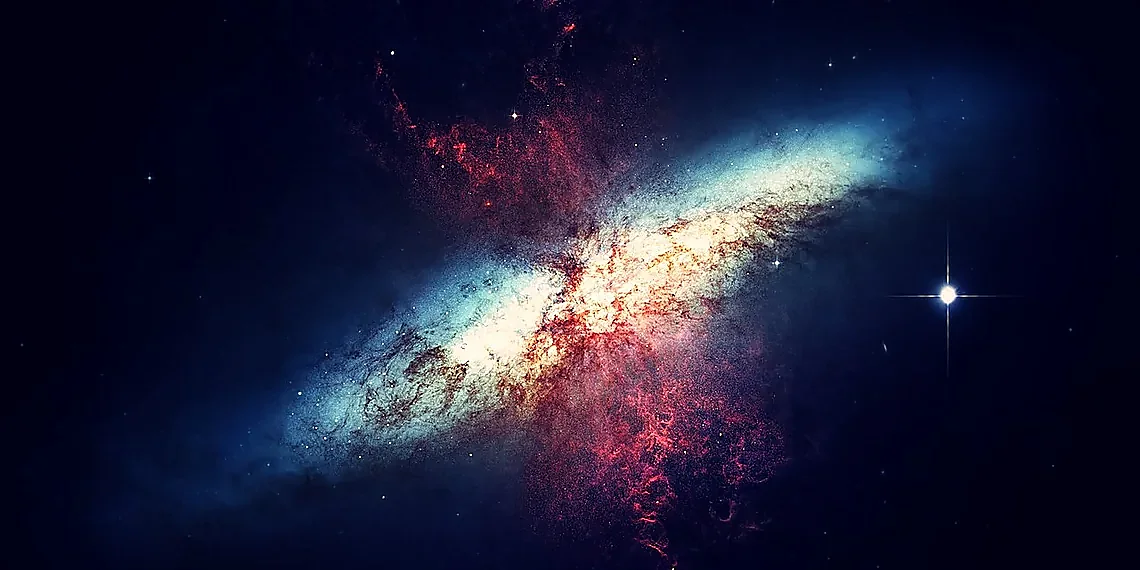
Galactic mergers aren’t just visually stunning events; they are also incredibly efficient engines for star birth. When two galaxies collide, their interstellar gas clouds – vast reservoirs of hydrogen and helium – slam into each other. This isn’t a gentle nudge; it’s a high-speed collision that compresses the gas dramatically. Prior to the merger, this gas might be thinly spread throughout the galaxies. The impact concentrates it into much denser regions, creating prime conditions for star formation.
The compression of gas during a galactic merger is largely driven by gravitational forces. As the galaxies approach and interact, their mutual gravity pulls material inward. This process also generates density waves that ripple through the merging system. These waves are akin to traffic jams in the gas clouds; they further squeeze the material, triggering localized regions of intense collapse. Areas where these density waves converge experience particularly high levels of compression, leading to a surge in star formation.
The resulting increase in star birth rates is often referred to as a ‘starburst.’ These bursts can create hundreds or even thousands of new stars within a relatively short timeframe (astronomically speaking). The newly formed massive stars quickly burn through their fuel and explode as supernovae, enriching the surrounding gas with heavier elements. This cycle of star formation, death, and enrichment is crucial for galactic evolution and the creation of the complex chemical environments where planets – and potentially life – can form.
The Future of NGC 4490 & NGC 4485
The captivating image of NGC 4490 and NGC 4485 currently locked in a gravitational embrace offers a glimpse into the future – not just of these two dwarf galaxies, but potentially of our own Milky Way billions of years from now. While their current interaction appears gentle, it’s only the beginning of a long and complex process that will ultimately result in a single, larger galaxy. Predicting the precise final form is challenging, as galactic mergers are chaotic events influenced by countless factors like orbital dynamics, gas content, and dark matter halos; however, we can paint a plausible picture based on current understanding.
Over the next few billion years, expect to see significant morphological changes. Initially, tidal forces will distort both galaxies, creating long stellar streams and bridges of stars extending far beyond their original boundaries – features already visible in the JWST image. As they draw closer, gravitational interactions will trigger intense bursts of star formation as gas clouds collapse under the increased density. This ‘starburst’ phase will likely be relatively short-lived compared to the overall merger timescale, but it’ll dramatically increase the galaxy’s luminosity and enrich its interstellar medium with heavy elements forged in the hearts of massive, short-lived stars. The galaxies will gradually lose their individual identities as their stellar populations become increasingly intermingled.
The ultimate fate of NGC 4490 & NGC 4485 is likely to be a more elliptical or lenticular galaxy – a shape characterized by its smooth appearance and lack of prominent spiral arms. Unlike the vibrant, actively star-forming galaxies we see today, the resulting galaxy will probably settle into a quieter existence. The gas supply needed for ongoing star formation will gradually deplete, halting the starburst and leaving behind a population primarily composed of older stars. While smaller satellite galaxies may be cannibalized over time, contributing to its mass, the overall structure will likely remain relatively stable.
It’s worth noting that dark matter plays a crucial role in shaping this evolutionary path. The distribution and interaction of their respective dark matter halos will significantly influence the merger’s dynamics and final outcome. While we can observe the visible stars and gas, the unseen gravitational pull of dark matter dictates much of the overarching structure formation. Ultimately, the combined galaxy born from NGC 4490 & NGC 4485 will become a testament to the relentless process of cosmic evolution – a serene monument built upon the violent collision of two smaller worlds.
From Two to One: The Merger’s Timeline
The interaction between NGC 4490 and NGC 4485 didn’t begin spontaneously; it’s a consequence of their gravitational dance within the larger Virgo Cluster. Initial encounters, occurring hundreds of millions of years ago, likely caused tidal distortions and stretched out stellar streams as each galaxy’s gravity pulled on the other. This phase is marked by increasingly close passages, creating a visible bridge of gas and stars connecting them – readily observable in recent JWST imagery. The galaxies are currently experiencing their first major gravitational interaction, setting the stage for a prolonged merger process.
Over the next several billion years, the merging process will intensify. As NGC 4490 and NGC 4485 draw closer, they’ll undergo significant morphological changes. Their spiral structures will become increasingly disrupted as tidal forces tear them apart. Star formation rates are expected to surge dramatically due to the compression of gas clouds within the interacting galaxies, leading to a ‘starburst’ phase – intense bursts of new star birth visible across vast distances. The overall size of the combined galaxy will increase, though much of the mass will be ejected into intergalactic space during this chaotic period.
Eventually, after several billion years of turbulent interaction, NGC 4490 and NGC 4485 are predicted to settle into a single, more relaxed elliptical galaxy. This final product won’t retain any recognizable spiral features; it will likely be an ellipsoidal shape with a smoother distribution of stars. While the starburst activity will gradually subside, the resulting galaxy will have a different chemical composition than its progenitors, enriched by the heavy elements forged within the massive, short-lived stars born during the merger event. Its rotation rate will also slow considerably as it settles into a new equilibrium.
Beyond NGC 4490 & NGC 4485: Galactic Mergers in the Universe
The stunning image of NGC 4490 and NGC 4485, currently locked in a gravitational embrace, represents just one instance of a far more common phenomenon: galactic mergers. While this particular pairing might appear delicate, the reality is that collisions and mergers between galaxies have been – and continue to be – fundamental drivers of galaxy evolution throughout cosmic history. From the early universe’s chaotic formation to the relatively ordered structures we see today, these interactions are responsible for shaping much of what we observe.
Cosmic collisions aren’t rare occurrences; they’re a universal process. In the early universe, when galaxies were smaller and closer together, mergers were far more frequent than they are now. These weren’t always gentle encounters like that seen in NGC 4490 & NGC 4485 either – often they involved violent disruptions and dramatic reshaping of galactic structures. Larger galaxies, especially elliptical galaxies, owe their very existence to numerous smaller galaxy mergers over billions of years. Think of it as a cosmic assembly line; smaller building blocks combine to create larger, more complex structures.
Beyond simply increasing the size of galaxies, these mergers play a critical role in enriching the universe with heavier elements. When galaxies collide, gas clouds within them are compressed and trigger bursts of intense star formation – known as ‘starburst’ events. These newly formed stars forge heavy elements like carbon, oxygen, and iron through nuclear fusion. When these massive stars eventually explode as supernovae, they scatter these elements into the surrounding space, seeding future generations of stars and planets – essentially providing the raw materials for life itself.
The ongoing interaction between NGC 4490 and NGC 4485 is a glimpse into this dynamic process, showcasing how gravitational forces sculpt galaxies over vast timescales. While it will take millions of years for them to fully merge, the resulting galaxy will be significantly different from either progenitor – a testament to the transformative power of galactic mergers in shaping the universe we inhabit.
Cosmic Collisions: A Universal Process
Galactic mergers aren’t rare occurrences; they’ve been a constant feature of cosmic history. While the graceful interaction seen between NGC 4490 and NGC 4485 might seem unusual, it represents just one stage in a much larger process. Simulations and observations suggest that most galaxies, including our own Milky Way, have undergone multiple mergers throughout their lifetimes, particularly during the early universe when galaxies were smaller and closer together. The frequency of these events peaked roughly 10 billion years ago, though they continue to occur today, albeit at a lower rate.
These cosmic collisions play a crucial role in galaxy evolution. Smaller galaxies are often absorbed by larger ones, contributing their stars and gas. This process fuels the growth of massive elliptical galaxies, which frequently form through major mergers – when galaxies of comparable size collide. Mergers also trigger intense bursts of star formation known as ‘starbursts,’ as the gravitational interactions compress gas clouds, leading to a dramatic increase in new star birth rates. The resulting stellar populations can significantly alter a galaxy’s structure and appearance.
Beyond simply growing galaxies, mergers are vital for distributing heavier elements throughout the universe. Supernova explosions from massive stars born during starburst periods scatter these elements – like oxygen, carbon, and iron – into the surrounding interstellar medium. These enriched materials then become incorporated into subsequent generations of stars and planets, essentially providing the building blocks for life as we know it. Without galactic mergers, the chemical composition of the universe would be vastly different.
The images beamed back by the James Webb Space Telescope continue to redefine our understanding of the cosmos, offering unprecedented views into processes previously shrouded in mystery.
We’ve witnessed firsthand how galaxies aren’t static islands floating through space; they’re dynamic entities constantly interacting and evolving, often colliding and merging over vast stretches of time.
The sheer scale and complexity revealed during these galactic mergers – the intense bursts of star formation, the swirling patterns of gas and dust, the gravitational dance between colossal structures – is truly breathtaking.
These observations underscore a fundamental truth: the universe we inhabit has been sculpted by these powerful interactions, shaping the galaxies we see today and influencing our own cosmic origins in ways we are only beginning to comprehend. The raw power on display highlights just how much remains to be discovered about galactic evolution across billions of years of cosmic history .”,
Continue reading on ByteTrending:
Discover more tech insights on ByteTrending ByteTrending.
Discover more from ByteTrending
Subscribe to get the latest posts sent to your email.