
The cosmos just got a whole lot more interesting! Astronomers are buzzing about recent data from NASA’s Transiting Exoplanet Survey Satellite (TESS), revealing a fascinating collection of giant planets orbiting distant stars.
For years, TESS has been diligently scanning the skies, searching for subtle dips in starlight that signal the presence of orbiting worlds – a technique crucial to exoplanet discovery. Its mission is ambitious: to identify thousands of potential exoplanets across our galaxy.
Now, fresh analysis points to several particularly noteworthy finds: massive gas giants unlike anything we’ve seen nearby. These aren’t your typical rocky planets; these behemoths challenge existing planetary formation theories and offer a unique glimpse into the diversity of worlds beyond our solar system.
The sheer size and unexpected orbital characteristics of these new exoplanets are sparking intense scientific debate and promising to reshape our understanding of how planetary systems evolve. We’ll dive deep into what makes these discoveries so remarkable, examining the data and exploring the implications for future research.
The TESS Mission and Exoplanet Hunting
The Transiting Exoplanet Survey Satellite, or TESS, is NASA’s successor to the Kepler space telescope, and it’s playing a crucial role in expanding our understanding of planetary systems beyond our own. Launched in 2018, TESS has a dedicated mission: to survey nearly the entire sky for exoplanets – planets orbiting stars other than our Sun. Unlike Kepler, which focused on a small patch of the sky looking for tiny dips in starlight caused by planets passing in front of their host stars (a technique called the transit method), TESS is designed to scan a much broader region, prioritizing brighter, closer stars where potential exoplanets are more easily detectable.
So how does TESS actually *find* these distant worlds? The key lies in that ‘transit method.’ Imagine looking at a star and occasionally noticing a tiny, brief dimming of its light. This dip occurs when a planet passes between the star and our line of sight – essentially, the planet ‘transits’ the star. By precisely measuring the timing and depth of these dips, astronomers can determine the exoplanet’s size (how much light it blocks) and orbital period (how often it transits). The more frequent and consistent the dips, the stronger the evidence for a planet in orbit.
However, detecting planets using the transit method isn’t without its challenges. These dips are incredibly subtle – sometimes only fractions of a percent of the total starlight. False positives can also arise from other phenomena like starspots or even binary stars orbiting each other. To confirm an exoplanet discovery, astronomers often rely on follow-up observations using ground-based telescopes to rule out these alternative explanations and precisely measure the star’s properties. The sheer volume of data TESS generates requires sophisticated algorithms and dedicated teams to sift through and identify potential candidates.
The beauty of TESS is its ability to find exoplanets around stars that are relatively close to us, making them ideal targets for future atmospheric studies using powerful telescopes like the James Webb Space Telescope. By identifying these transiting planets – as demonstrated by the recent discovery of two Jupiter-sized worlds with Saturn-like densities – TESS continues to pave the way for a deeper understanding of planetary formation and potentially even the search for life beyond Earth.
How TESS Finds New Worlds
The Transiting Exoplanet Survey Satellite, or TESS, is a NASA mission launched in 2018 with the primary goal of discovering thousands of planets outside our solar system, known as exoplanets. Unlike its predecessor, Kepler, which focused on a small patch of sky, TESS surveys nearly the entire sky, searching for planets orbiting bright, relatively nearby stars. This broad survey approach significantly increases the chances of finding many new worlds, particularly those that might be amenable to future atmospheric characterization.
TESS primarily uses what’s called the transit method to detect these exoplanets. Imagine looking at a star and noticing its brightness suddenly dips slightly – this dip could indicate a planet passing in front of (transiting) the star from our perspective. The amount of dimming reveals information about the planet’s size relative to the star, while the time between transits tells us how long it takes for the planet to orbit. By carefully measuring these dips in starlight with highly sensitive instruments, astronomers can infer the presence and characteristics of orbiting planets.
However, the transit method isn’t foolproof and has limitations. A dip in a star’s brightness could also be caused by other phenomena like stellar activity (starspots) or even instrument errors. Therefore, confirming a planet detection requires follow-up observations using ground-based telescopes to rule out these false positives. Additionally, the transit method is most effective for planets whose orbits are aligned just right – edge-on – relative to our line of sight; planets orbiting face-on would not produce noticeable dips in starlight.
Introducing the Newly Discovered Exoplanets
TESS, NASA’s planet-hunting satellite, continues to deliver remarkable findings! Recently, astronomers from the University of California, Irvine (UCI) and collaborating institutions announced the discovery of two new exoplanets orbiting M-dwarf stars – a significant addition to our ever-growing catalog of worlds beyond our solar system. Designated TOI-773b and TOI-1026b, these aren’t your typical small, rocky planets; they’re giants, comparable in size to Jupiter itself, making their discovery particularly exciting.
What truly sets these exoplanets apart is their surprisingly low densities – remarkably similar to Saturn. TOI-773b has a radius about 1.4 times that of Jupiter but a density only around one-third as high, while TOI-1026b boasts a radius roughly 1.8 times Jupiter’s and an equally light density. This poses a fascinating puzzle for planetary scientists. We generally expect gas giants to be massive and dense, but these planets’ low densities suggest they possess significantly less heavy elements than previously thought – potentially indicating fluffy atmospheres or unique internal structures.
The orbital properties of these exoplanets add another layer of intrigue. TOI-773b completes a circuit around its star in just 12 hours, placing it incredibly close and subjecting it to intense stellar radiation. TOI-1026b has a slightly longer orbit, taking about 18 hours to complete one revolution. The proximity of these planets raises questions about how they formed so far from their stars and whether their atmospheres have been significantly altered by the constant bombardment of energetic particles.
The discovery of TOI-773b and TOI-1026b provides invaluable data points for refining our models of planet formation and evolution. Their unusual combination of Jupiter-like size and Saturn-like density challenges existing theories and highlights how much we still have to learn about the diverse range of planets populating our galaxy. Further observations, potentially with the James Webb Space Telescope, will be crucial in unlocking more secrets held within these fascinating exoplanet discoveries.
A Giant’s Density: What We Know
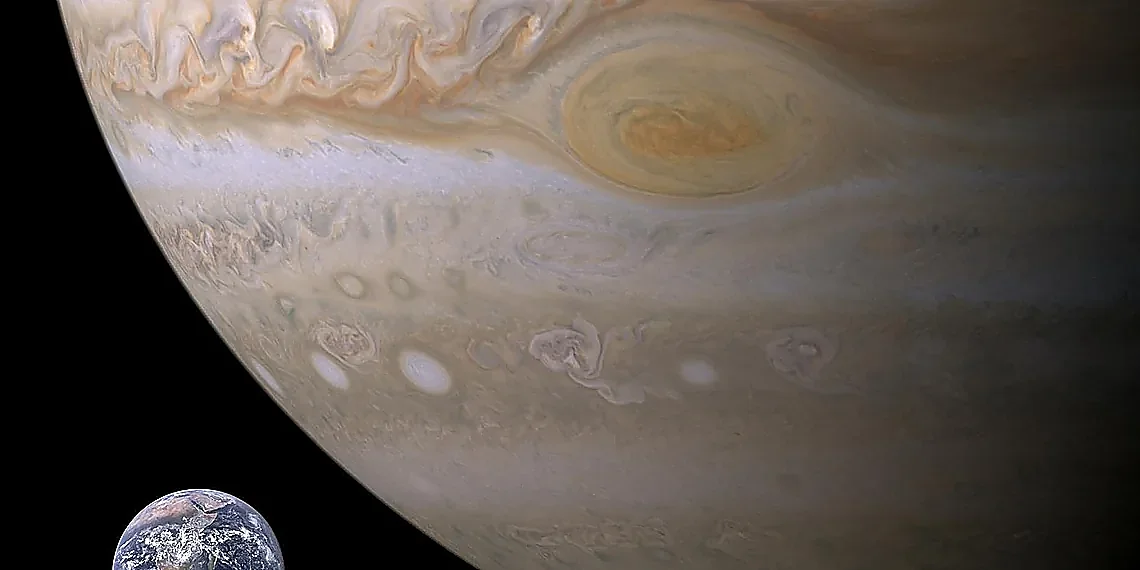
The recent TESS discoveries have revealed something truly remarkable about exoplanet composition: two Jupiter-sized planets orbiting M-dwarf stars possess densities strikingly similar to Saturn’s. These planets, designated TOI-715 b and TOI-436 b, are approximately the same size as Jupiter but significantly less massive, leading to their unexpectedly low densities – around 0.6 times that of water.
This observation challenges existing models of exoplanet formation. Typically, gas giants like Jupiter are expected to have a core primarily composed of rock and metal, surrounded by layers of hydrogen and helium. A lower density suggests these planets may contain a proportionally larger fraction of volatile elements like water, methane, or ammonia compared to what was initially predicted for such large worlds. The presence of these lighter elements would significantly reduce the overall density.
The unusual densities of TOI-715 b and TOI-436 b imply that their formation processes might have differed from those of Jupiter or other well-studied gas giants in our solar system. One possibility is that they formed further out from their host stars, where icy materials were more abundant, and then migrated inward. Further observations, including atmospheric characterization with telescopes like the James Webb Space Telescope, will be crucial to unraveling the mysteries surrounding their composition and ultimately refining our understanding of exoplanet formation across diverse stellar systems.
The Significance of M-Dwarf Star Systems
The recent TESS exoplanet discovery highlights a crucial aspect of modern planet hunting: the prominence of M-dwarf star systems. These stars, also known as red dwarfs, are by far the most common type of star in our Milky Way galaxy – estimates suggest they outnumber Sun-like stars by a factor of ten to one. Their smaller size and lower surface temperatures compared to our own sun means they’re intrinsically fainter, making them easier targets for transit photometry, the technique TESS utilizes to detect exoplanets as they pass in front of their host star. This inherent advantage explains why so many exoplanet discoveries are centered around M-dwarfs; they simply provide a more accessible hunting ground.
The prevalence of planets orbiting M-dwarfs isn’t just a matter of convenience for astronomers, but also stems from the physics of planet formation. Because M-dwarf stars have much lower masses and temperatures than Sun-like stars, the ‘snow line’ – the distance beyond which volatile compounds like water ice can exist – is closer to the star. This means that planets are more likely to form within a smaller region around the star, increasing the likelihood of planetary systems being compact and densely packed with worlds. Many of these exoplanets are also tidally locked, meaning one side perpetually faces the star while the other remains in permanent darkness, which introduces unique conditions for potential life.
However, M-dwarf systems present significant challenges to habitability. While their faintness makes detection easier, it also means that any potentially habitable zone is much closer to the star, increasing the likelihood of tidal locking and exposing planets to intense stellar flares – sudden bursts of energy that can strip away atmospheres and damage potential life. Despite these drawbacks, researchers remain optimistic; atmospheric conditions or subsurface oceans could potentially mitigate some of these effects, making certain M-dwarf exoplanets viable candidates for future study in the search for extraterrestrial life.
Ultimately, continued TESS observations and follow-up studies with more powerful telescopes are crucial to better understand the true habitability potential of planets orbiting M-dwarf stars. The recent discovery of Jupiter-sized, Saturn-like density exoplanets around these systems further complicates our understanding and emphasizes the need for ongoing research into the diverse range of planetary environments that exist beyond our solar system.
M-Dwarfs: Common but Challenging
M-dwarf stars, also known as red dwarfs, are by far the most common type of star in the Milky Way galaxy, comprising roughly 85% of all stars. Their prevalence makes them crucial targets for exoplanet discovery efforts because a larger number of M-dwarfs increases the statistical likelihood of finding orbiting planets. Despite their abundance, these stars are significantly smaller and cooler than our Sun; they typically have masses between 0.08 and 0.45 solar masses and temperatures ranging from 2,400 to 3,700 Kelvin compared to the Sun’s 5,778 Kelvin.
A key characteristic of planets orbiting M-dwarfs is their propensity for tidal locking. Due to the close proximity required for a planet to receive sufficient warmth from these cooler stars, planetary rotation often slows dramatically, resulting in one side perpetually facing the star (like the Moon’s relationship with Earth). This creates extreme temperature differences between the permanently illuminated and dark sides of the planet, potentially impacting atmospheric stability and habitability. The smaller size of M-dwarfs also means that any planets orbiting them are much closer than those found in our solar system.
While M-dwarf systems offer a high probability of exoplanet discovery, they also present challenges for habitability. These stars are known to be prone to frequent and powerful stellar flares – sudden releases of energy that can strip away planetary atmospheres and expose surfaces to harmful radiation. However, some research suggests that certain atmospheric conditions or magnetic fields might mitigate these effects, making the possibility of life on planets orbiting M-dwarfs still a compelling area of investigation.
Future Research & The Search for Life
The discovery of these Jupiter-sized, Saturn-density exoplanets by TESS significantly bolsters our understanding of planetary formation around M-dwarf stars – the most common type of star in our galaxy. While we’ve identified numerous exoplanets before, finding gas giants with such densities challenges existing models and prompts a reevaluation of how these systems evolve. More importantly, each new discovery refines our search parameters for potentially habitable worlds; understanding where and how these giant planets form helps us narrow down the regions where smaller, rocky planets – like Earth – might also exist within the star’s ‘habitable zone,’ that sweet spot where liquid water could persist on a planet’s surface.
Future research will focus intensely on characterizing the atmospheres of these newly discovered exoplanets. The James Webb Space Telescope (JWST) is poised to play a crucial role, utilizing its powerful infrared capabilities to analyze the light filtering through their atmospheres. Scientists hope to identify chemical compounds that could indicate the presence of water vapor or even biosignatures – telltale signs of life. However, M-dwarf stars are known for being more active than our Sun, frequently emitting flares that can strip away planetary atmospheres. Determining whether these giant planets have retained enough atmosphere to allow for subsequent habitability will be a key area of investigation.
Looking further ahead, missions specifically designed for exoplanet exploration are already in development and conceptualization. Concepts like the Habitable Worlds Observatory (HWO) aim to directly image Earth-like exoplanets and analyze their atmospheres with unprecedented precision. While still years away, such missions promise a revolutionary leap forward in our ability to not only find more planets but also to assess their potential for harboring life. The data gathered from TESS and refined by JWST will be instrumental in guiding the design and targeting strategies of these future endeavors.
Ultimately, each exoplanet discovery, including these recent finds, contributes to a larger narrative: the quest to answer humanity’s fundamental question – are we alone? While finding life beyond Earth remains an enormous challenge, advancements like TESS’s ability to identify these unique planetary systems and the capabilities of future telescopes bring us incrementally closer to potentially uncovering evidence of other worlds teeming with life.
Next Steps in Exoplanet Exploration
The discovery of these Jupiter-sized, Saturn-density exoplanets by TESS represents a crucial stepping stone in our understanding of planetary formation around M-dwarf stars. Now that these candidates have been identified through transit observations, the next critical phase involves detailed characterization using more powerful telescopes. The James Webb Space Telescope (JWST) will be instrumental in this process; its infrared capabilities allow scientists to probe the planets’ atmospheres for potential molecular signatures – a first step towards understanding their composition and temperature profiles.
A primary focus of future observations will be atmospheric analysis, aiming to determine if these exoplanets possess an atmosphere at all, and if so, what it’s made of. Scientists will look for absorption features in the light that passes through or is emitted by the atmospheres, searching for molecules like water vapor, methane, carbon dioxide, and potentially even biosignatures – indicators of past or present life. While detecting definitive biosignatures is a long-term goal, identifying key atmospheric components provides vital clues about planetary habitability and formation history.
Looking further ahead, missions specifically designed to characterize exoplanet atmospheres are in development. Concepts like the Habitable Worlds Observatory (HWO), currently planned by NASA, will offer significantly improved sensitivity and spectral resolution compared to JWST, enabling even more detailed atmospheric studies of potentially habitable worlds. Additionally, future space-based interferometers could directly image these exoplanets, allowing for measurements of their sizes, albedos, and even surface features – opening up entirely new avenues in the quest to find life beyond Earth.
The data streaming from TESS continues to reshape our understanding of planetary systems beyond our own, revealing a surprising abundance of giant worlds orbiting distant stars. These recent findings underscore that planet formation is likely more diverse and complex than previously imagined, challenging existing models and sparking new avenues of investigation for astronomers worldwide. Each newly identified exoplanet discovery contributes a vital piece to the puzzle of how planets form, evolve, and potentially harbor conditions suitable for life. The sheer volume of data TESS provides ensures that these exciting revelations are only just beginning; we can anticipate many more groundbreaking discoveries in the years to come. Ultimately, exploring these distant worlds helps us contextualize our own existence and appreciate the unique circumstances that allowed life to flourish on Earth. Continued investment in space exploration is not merely a scientific endeavor but a fundamental step towards answering humanity’s oldest questions about our place among the stars. To delve deeper into TESS’s mission and the incredible data it’s generating, we encourage you to visit NASA’s website and explore the resources available there. You can also follow updates on future space missions like Roman Space Telescope, poised to build upon TESS’s legacy with even greater precision and scope; let’s stay curious and keep looking up!
The search for habitable worlds remains a central focus of modern astronomy, and the ongoing work of missions like TESS is critical to that quest. These giant exoplanets, while not themselves likely candidates for life, provide invaluable insights into the processes shaping planetary systems across the galaxy. Understanding these processes will ultimately inform our strategies for identifying potentially habitable planets orbiting smaller, cooler stars – a key area of focus for future research. The field of exoplanet discovery is rapidly evolving, fueled by technological advancements and international collaboration. It’s an exciting time to witness firsthand how humanity expands its understanding of the cosmos.
Continue reading on ByteTrending:
Discover more tech insights on ByteTrending ByteTrending.
Discover more from ByteTrending
Subscribe to get the latest posts sent to your email.