
For millennia, humanity has gazed at the night sky and pondered a fundamental question: where did everything come from? The sheer scale of the cosmos, the swirling galaxies, the very atoms that compose us – it’s a mystery that fuels both scientific inquiry and philosophical wonder.
While theories about creation have existed across cultures and throughout history, the modern understanding of our universe’s origin rests largely on one cornerstone: the Big Bang Theory. This model proposes an incredibly hot, dense state from which everything expanded billions of years ago, but proving it wasn’t straightforward—it required something far more than just theoretical calculations.
What if I told you that some of the most compelling evidence supporting the Big Bang Theory was stumbled upon almost by accident? It’s a story involving microwave radiation, meticulous measurements at Bell Labs, and a team initially searching for something entirely different. Their unexpected finding revolutionized cosmology and offered an unprecedented glimpse into the universe’s infancy.
This is the tale of how a seemingly insignificant anomaly, dismissed as ‘noise’ for a time, ultimately became a pivotal piece in confirming the Big Bang Theory – a moment where scientific serendipity met profound cosmic revelation.

The Accidental Evidence
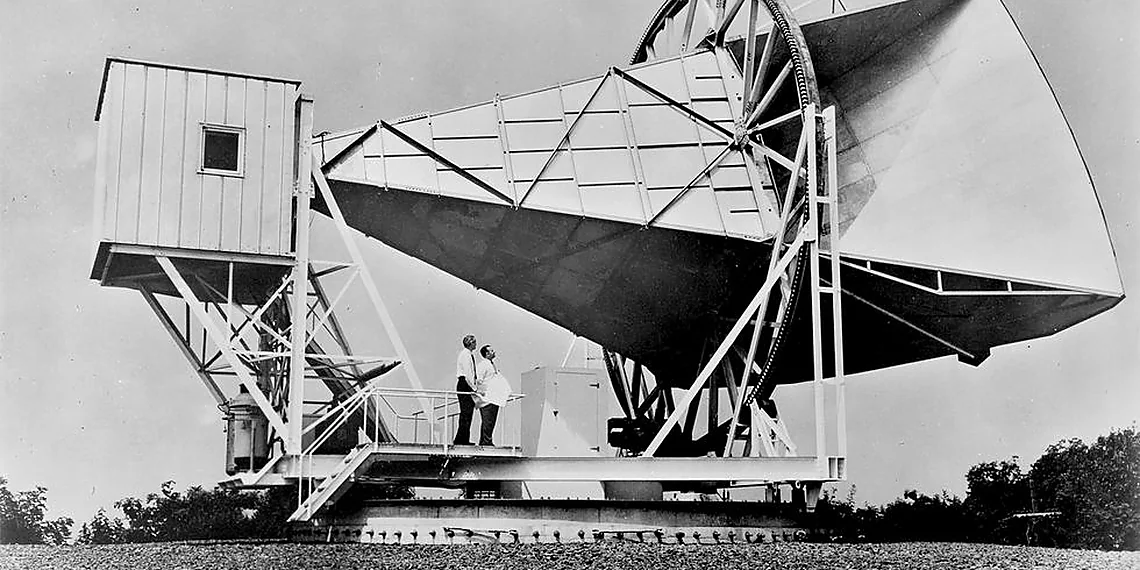
In 1964, Arno Penzias and Robert Wilson at Bell Labs were attempting to map radio signals from our own Milky Way galaxy using a massive, 85-foot horn antenna in Holmdel, New Jersey. Their goal was ambitious: to precisely chart the distribution of hydrogen gas throughout the galaxy by measuring the faint 21-centimeter emission line – a specific wavelength of radio waves emitted by neutral hydrogen atoms. However, their experiment was plagued by an inexplicable and intensely frustrating problem: a persistent, uniform background noise that they couldn’t eliminate despite meticulous efforts. They checked for atmospheric interference, insect infestations within the antenna, even pigeon droppings – anything that could be responsible – but nothing seemed to resolve the issue.
This ‘buzzing,’ as Penzias described it, was utterly baffling. Wilson initially suspected a faulty instrument or an overlooked source of terrestrial radio waves, and they spent weeks painstakingly trying to isolate and remove every potential culprit. They cleaned the antenna, recalibrated equipment, and even considered that nearby microwave ovens might be contributing to the signal. The noise remained stubbornly constant – a low-level hiss permeating their observations regardless of the time or location in the sky. Frustrated but also intrigued by this anomaly, they reluctantly reached out to radiophysicist Bernard Burke at Princeton University for assistance.
Burke’s subsequent conversation with Robert Dicke, another physicist at Princeton, proved pivotal. Dicke had been independently theorizing about the existence of a faint afterglow from the early universe – what we now know as cosmic microwave background radiation (CMB). This CMB was predicted to be the residual heat from the incredibly hot and dense state that existed just moments after the Big Bang. Dicke realized Penzias and Wilson’s persistent noise wasn’t an error, but potentially the very signal he had been searching for – a confirmation of his theoretical predictions about the universe’s origin.
Penzias and Wilson, initially hesitant to believe such an extraordinary explanation, eventually accepted that they had stumbled upon something truly remarkable. Their discovery of this uniform microwave background radiation provided compelling evidence supporting the Big Bang Theory, fundamentally changing our understanding of the cosmos. They shared the 1978 Nobel Prize in Physics for their accidental but groundbreaking contribution – a testament to how unexpected findings can revolutionize scientific knowledge and reshape our view of the universe’s beginnings.
Mapping the Milky Way
In 1960, Arno Penzias and Robert Wilson at Bell Labs were tasked with a seemingly straightforward project: mapping radio signals emanating from the Milky Way galaxy. They aimed to create detailed maps of these emissions using a newly constructed, massive horn antenna located in Holmdel, New Jersey. This antenna, originally designed for NASA’s Echo satellite communication experiments, was repurposed for astronomical observations as part of a broader effort to understand our galactic neighborhood.
The initial stages of the project were fraught with unexpected complications. Penzias and Wilson consistently detected an unusual background noise that they couldn’t eliminate, despite meticulously checking every aspect of their equipment and even attempting to rid the antenna of pigeon droppings – a surprisingly common issue! This persistent hum was uniform across all directions in the sky and defied any conventional explanation related to terrestrial radio sources or known astronomical phenomena.
Frustrated by this mysterious signal, which they initially dubbed ‘the beeping,’ Penzias and Wilson consulted with other researchers at Princeton University who were also studying cosmic microwave background radiation. This consultation ultimately revealed that their perplexing noise wasn’t an error, but rather the first detection of what would become a cornerstone piece of evidence supporting the Big Bang Theory – a discovery they initially struggled to understand.
The Persistent Buzz
In 1964, Arno Penzias and Robert Wilson, working at Bell Labs, were attempting to calibrate a massive horn antenna intended for radio astronomy research. They encountered an incredibly persistent and baffling problem: a low-level buzzing noise that permeated their measurements regardless of adjustments or location. Initially dismissing it as terrestrial interference – faulty equipment, atmospheric conditions, even pigeon droppings nesting within the antenna itself – they meticulously ruled out every conceivable source. They cleaned the horn, relocated the antenna, and performed numerous checks, yet the irritating buzz remained stubbornly present.
The frustrating nature of this ‘excess background radiation’ led them to believe it was some fundamental flaw in their experimental setup. Wilson, recognizing similarities between their signal and theoretical predictions from recent work on the Big Bang by Robert Dicke and others at Princeton University, eventually suspected something far more significant than a simple equipment malfunction. Dicke’s group had predicted that leftover radiation from the early universe would still be detectable as a faint glow across the entire sky.
Penzias and Wilson’s initial reaction was one of disbelief and frustration; they just wanted to get rid of the noise so they could perform their intended experiments. However, their dogged pursuit of eliminating this background signal ultimately led them to stumble upon what became arguably the most compelling evidence supporting the Big Bang Theory – a discovery that would earn them the Nobel Prize in Physics.
Cosmic Microwave Background
The cosmic microwave background (CMB) is faint radiation permeating the entire universe, considered a crucial piece of evidence supporting the Big Bang Theory. It’s essentially the ‘afterglow’ from the incredibly hot, dense early universe – a snapshot of conditions roughly 380,000 years after the Big Bang itself when the universe cooled enough for atoms to form and light to travel freely.
In 1964, radio astronomers Arno Penzias and Robert Wilson at Bell Labs were attempting to calibrate their newly refurbished horn antenna in New Jersey. They encountered a persistent, low-level noise that they couldn’t eliminate, regardless of adjustments or location changes. Initially believing it was terrestrial interference, they meticulously ruled out all possible sources – faulty equipment, bird droppings, even atmospheric conditions – but the noise remained.
Unbeknownst to Penzias and Wilson, this ‘noise’ was actually the CMB predicted by theoretical physicists Robert Dicke, James Peebles, David Wilkinson, and Paul Roll. Their independent calculations suggested the existence of such radiation based on the Big Bang model. Penzias and Wilson’s accidental discovery provided concrete observational evidence for a universe that began in an extremely hot and dense state, solidifying the Big Bang Theory as the prevailing cosmological model.
The Antenna’s Genesis
The story of how Bell Labs inadvertently provided crucial evidence for the Big Bang Theory begins not with cosmology, but with communication. In the late 1950s, Bell Labs was tasked with building a massive horn antenna in Holmdel, New Jersey, as part of Project Echo, NASA’s pioneering satellite communications program. The goal was ambitious: to bounce radio signals off a giant passive reflector satellite orbiting Earth, effectively creating an orbital mirror for long-distance communication. This project wasn’t about sending information *to* space; it was about demonstrating the feasibility of using satellites as relays for telephone calls and television broadcasts – a revolutionary concept at the time.
Project Echo’s success paved the way for even more advanced satellite technology, including Telstar, which *did* actively transmit signals. The Holmdel antenna, standing 50 feet tall and boasting an enormous parabolic reflector, was designed to be exceptionally sensitive to capture these faint signals from space. Its design incorporated several key innovations that went beyond simply amplifying the signal; it employed sophisticated noise reduction techniques to filter out unwanted interference, and its broad frequency range allowed for experimentation with different wavelengths. Crucially, this sensitivity would prove vital in detecting something far more profound than transatlantic phone calls.
The antenna’s versatility stemmed from a focus on wideband performance – it wasn’t tuned to a single frequency but designed to receive signals across a broad spectrum. This was essential for adapting to the evolving needs of satellite communication experiments, and ultimately allowed Arno Penzias and Robert Wilson, while calibrating the instrument in 1964, to detect a persistent, low-level background noise they initially attributed to terrestrial interference or even pigeon droppings! They meticulously eliminated all possible sources of error, unaware that this ‘noise’ held a monumental key to understanding the universe’s origins.
The broad frequency range and precise aiming capabilities of the Holmdel antenna weren’t originally intended for cosmological research. However, these very features allowed Penzias and Wilson to perceive and quantify what would later be recognized as cosmic microwave background radiation – the afterglow of the Big Bang. The accidental discovery, born from a communication project, provided undeniable evidence supporting Georges Lemaître’s theory and fundamentally reshaped our understanding of the universe’s beginnings.
Project Echo & Early Communication
Project Echo, launched by NASA in 1960, was a pioneering effort to establish satellite communication. The goal was simple but ambitious: to bounce radio signals off a large, passive reflector satellite orbiting Earth, effectively creating an orbital mirror for long-distance communications. Unlike later satellites like Telstar which actively transmitted and received signals, Project Echo relied solely on reflecting existing transmissions, significantly reducing the complexity and cost of the initial system.
To support Project Echo’s experiments, Bell Labs embarked on a significant engineering challenge: constructing a massive horn antenna at Holmdel, New Jersey. This 85-foot diameter dish, initially designed to receive signals from the Echo satellite, represented an unprecedented scale for ground-based antennas at the time. Its construction involved innovative techniques in parabolic reflector design and required meticulous alignment to ensure optimal signal reception.
While Project Echo itself proved successful in demonstrating passive satellite communication – famously used for a live transatlantic television broadcast – it also revealed limitations regarding signal degradation due to atmospheric interference. This initial purpose, however, inadvertently set the stage for groundbreaking scientific discoveries related to cosmology, as the antenna’s sensitivity would later become instrumental in detecting the cosmic microwave background radiation.
Technological Innovations
The Holmdel antenna, initially constructed by Bell Labs in 1960, was a marvel of engineering designed for transatlantic communication via satellite. Its primary purpose was to support Project Echo, NASA’s first communications satellite, and later Telstar, the first active communications satellite. The antenna’s horn reflector, measuring 50 feet across, was constructed from aluminum panels meticulously aligned to create an extremely precise parabolic shape. This design allowed for exceptional signal focusing, enabling it to receive faint signals from space with remarkable clarity.
A key feature contributing to the antenna’s sensitivity was its exceptionally wide frequency range – capable of operating over a broad spectrum of radio frequencies. This versatility proved invaluable not only for satellite communication but also for scientific research. Further enhancing performance were sophisticated aiming capabilities, allowing researchers to precisely point the antenna towards specific celestial objects. Noise reduction techniques, including cryogenic cooling of sensitive components and careful shielding from terrestrial interference, were integral to minimizing background noise and maximizing signal-to-noise ratio.
Beyond its immediate communication goals, the Holmdel antenna’s design facilitated groundbreaking cosmological observations. The ability to receive extremely weak signals across a wide frequency range, combined with precise pointing and low noise characteristics, would ultimately allow Arno Penzias and Robert Wilson to detect the cosmic microwave background radiation – pivotal evidence supporting the Big Bang Theory.
The Princeton Prediction
While Arno Penzias and Robert Wilson’s accidental discovery at Bell Labs is rightfully celebrated, it’s crucial to understand that they weren’t operating in a vacuum. A parallel, equally significant effort was underway at Princeton University, spearheaded by Robert Dicke, P. James Peebles, and David Todd Wilkinson. These physicists had independently arrived at a remarkable conclusion: if the universe began with an incredibly hot, dense state—the very foundation of the Big Bang Theory – then a faint afterglow, or remnant radiation, should still permeate the cosmos today. Their theoretical calculations, published in 1964, predicted the existence and approximate temperature of this cosmic microwave background (CMB) radiation, laying the groundwork for what Penzias and Wilson would soon stumble upon.
Dicke’s team’s theoretical framework was deeply rooted in Lemaître’s earlier work and the expanding universe model. They recognized that as the universe expanded and cooled, any initial heat would have stretched along with it, resulting in a very low-energy background radiation – essentially a ‘fossil’ from the early universe. Peebles contributed significantly to the theoretical calculations, while Wilkinson was tasked with building an instrument capable of detecting this incredibly faint signal. The challenge wasn’t just about detection; it was also about distinguishing the CMB from other sources of microwave noise in space.
The significance of Princeton’s prediction cannot be overstated. Had Penzias and Wilson not inadvertently detected the CMB, Dicke’s team would likely have been the ones to claim its discovery, given their advanced instrumentation and meticulous planning. The fact that Bell Labs found it first was largely a matter of chance, but it underscored the power of theoretical predictions driving experimental endeavors. When Penzias and Wilson contacted Princeton to report their findings, Dicke initially suspected they were interfering with his team’s planned experiment, highlighting the importance of the parallel work already underway.
Ultimately, the Bell Labs discovery served as a powerful validation of the Princeton team’s theory, solidifying the Big Bang Theory as the leading cosmological model. The collaboration that followed between the two groups – sharing data and insights – further propelled our understanding of the universe’s origins. This synergy exemplifies how theoretical predictions and experimental verification are essential components of scientific progress, particularly when tackling questions about the vastness and history of the cosmos.
Dicke, Peebles, and Wilkinson’s Theory
While Lemaître’s ideas were gaining traction, a separate and remarkably similar line of reasoning was developing at Princeton University. Robert Dicke, a physicist known for his work on atomic clocks, began considering the implications of an expanding universe. He realized that if the early universe was incredibly hot and dense – as required by models like Lemaître’s – then as it expanded, its radiation would have cooled but not disappeared entirely.
Dicke collaborated with P. James Peebles, a young astrophysicist who provided crucial theoretical calculations. Together, they determined that this leftover radiation should now appear as a faint afterglow permeating the entire universe: what we now call the cosmic microwave background (CMB). David Todd Wilkinson joined their team and contributed significantly to refining these predictions and devising methods for detecting it.
The Princeton group’s 1964 paper, published just weeks before Arno Penzias and Robert Wilson’s accidental discovery of the CMB at Bell Labs, laid out a detailed theoretical framework predicting its existence. While they didn’t initially know where to look, Dicke, Peebles, and Wilkinson had definitively articulated what should be found – a monumental contribution that solidified the Big Bang Theory’s position as the leading cosmological model.
Confirmation & Collaboration
While Georges Lemaître’s theoretical framework laid the groundwork for what would become known as the Big Bang Theory, it needed observational confirmation. Independently, a team led by Ralph Alpher and Robert Herman at Princeton University developed a detailed model predicting that the initial explosion should have left behind a faint afterglow – cosmic microwave background radiation (CMB). Their 1948 paper meticulously calculated the expected temperature of this CMB to be around 5 Kelvin (-272.45°C), a value remarkably close to absolute zero.
In 1964, Arno Penzias and Robert Wilson at Bell Telephone Laboratories (Bell Labs) stumbled upon an unusual persistent noise while calibrating a new microwave antenna intended for satellite communication. Initially believing it to be terrestrial interference, they systematically ruled out all possible sources. After consulting with Princeton researchers, including Alpher and Herman, the possibility that this signal was the CMB became increasingly plausible.
The subsequent collaboration between the Bell Labs team and the Princeton group proved crucial. The theoretical prediction of 5 Kelvin provided a concrete target for Penzias and Wilson’s observations, and their precise measurements validated the Princeton model with stunning accuracy. This confirmation not only cemented the Big Bang Theory as the prevailing cosmological model but also fostered a lasting partnership between academic theorists and industrial researchers in pushing the boundaries of scientific understanding.
Preserving a Legacy
The colossal horn reflector antenna at Bell Labs in Holmdel, New Jersey, stands as a silent witness to one of humanity’s greatest intellectual leaps: the confirmation of the Big Bang Theory. Originally built in 1960 for NASA’s Project Echo satellite communications experiments, its true significance wouldn’t be realized until 1964 when Arno Penzias and Robert Wilson used it to detect a faint microwave background radiation – the afterglow of that very initial explosion theorized by Georges Lemaître decades earlier. This discovery provided crucial evidence supporting the Big Bang Theory and earned Penzias and Wilson a Nobel Prize, forever linking this seemingly unremarkable antenna to a fundamental understanding of our universe’s origins.
Despite its profound scientific legacy, the Holmdel antenna faced an alarming threat: demolition. In the late 1990s, Bell Labs’ parent company, Lucent Technologies, planned to redevelop the site, which included tearing down the iconic structure. Recognizing the historical and scientific importance of this landmark, a dedicated community rallied to prevent its destruction. The antenna was officially designated a National Historic Landmark in 1998, offering some protection but not guaranteeing its survival against commercial pressures.
The ‘Save the Holmdel Antenna’ campaign gained momentum through grassroots efforts and online activism. A petition circulated widely, garnering thousands of signatures from scientists, historians, and concerned citizens worldwide. Public awareness campaigns highlighted the antenna’s contribution to science and its cultural significance, transforming it from a forgotten relic into a symbol of human ingenuity and perseverance. The outpouring of support demonstrated a collective understanding that preserving this structure was about more than just saving metal; it was about safeguarding a tangible connection to groundbreaking scientific achievement.
Ultimately, the community’s tireless efforts proved successful. Lucent Technologies reversed its demolition plans, and in 2003, the antenna was sold to Monmouth County, New Jersey. Today, it serves as part of Bell Works Park, a vibrant mixed-use development that incorporates the antenna as a centerpiece – a constant reminder of the accidental discovery that revolutionized our understanding of the Big Bang Theory and the power of community action in preserving scientific heritage.
National Historic Landmark & Near Demolition
The Holmdel Horn Antenna, instrumental in Arno Penzias and Robert Wilson’s 1964 discovery of cosmic microwave background radiation – a pivotal piece of evidence supporting the Big Bang Theory – was officially designated a National Historic Landmark in 2013. This recognition acknowledged its profound contribution to astrophysics and cosmology, solidifying its place as a monument to scientific breakthrough. The antenna’s design, initially intended for Project Echo communications satellite experiments, proved unexpectedly well-suited for detecting faint radio signals from the early universe.
Despite this prestigious designation, the antenna faced a serious threat in the late 2010s. Bell Labs’ Holmdel site was slated for redevelopment into luxury housing, and plans initially included demolition of the iconic horn antenna. The prospect of losing such an important landmark sparked significant concern within the scientific community and among local preservationists.
A dedicated grassroots effort, spearheaded by organizations like the Save the Holmdel Horn Antenna Foundation, successfully campaigned to preserve the structure. Through fundraising, public awareness campaigns, and negotiations with developers, they secured a commitment to relocate the antenna to Bell Works, a revitalized former Bell Labs campus, ensuring its continued accessibility for educational purposes and as a testament to humanity’s quest to understand the origins of the universe.
Community Saves the Antenna
For decades, a 50-foot horn reflector antenna at Bell Labs’ Holmdel facility stood as a silent monument to groundbreaking scientific achievement. Crucially, this seemingly unremarkable structure played an unexpected role in confirming the Big Bang Theory. In 1964, Arno Penzias and Robert Wilson, while attempting to troubleshoot radio interference, detected faint microwave background radiation – the afterglow of the universe’s early moments as theorized by Georges Lemaître. This discovery, later shared with Robert Dicke and James Peebles, provided compelling evidence supporting the Big Bang model and earned Penzias and Wilson a Nobel Prize in Physics.
Despite its historical significance, the antenna faced demolition in 2023 due to redevelopment plans for the Bell Labs campus. News of the potential loss sparked immediate concern within the scientific community and among local preservationists. Recognizing the importance of preserving this tangible link to a pivotal moment in cosmological understanding, a grassroots campaign quickly formed, leveraging online platforms like Change.org to launch petitions and raise public awareness. The hashtag #SaveTheAntenna gained traction on social media, amplifying the message and drawing attention to the antenna’s unique contribution to science.
The community’s efforts proved remarkably successful. Through sustained advocacy and significant public pressure, Bell Labs agreed to halt demolition plans and explore options for preserving the antenna as a historical landmark. While its future remains subject to ongoing discussions and potential relocation, the campaign underscored the power of collective action in safeguarding scientific heritage and ensuring that future generations can appreciate the legacy of discoveries made at Holmdel.
The story of Penzias and Wilson’s discovery at Bell Labs serves as a potent reminder that groundbreaking science often emerges from unexpected places, even seemingly minor inconveniences.
Their meticulous troubleshooting, initially seeking to eliminate a persistent noise, inadvertently unveiled the cosmic microwave background radiation – undeniable evidence supporting the Big Bang Theory and fundamentally reshaping our cosmological models.
This accidental finding wasn’t just about confirming an existing hypothesis; it opened entirely new avenues of research, pushing the boundaries of astrophysics and prompting deeper questions about the universe’s origins and evolution. It’s a narrative that echoes throughout scientific history, demonstrating the power of perseverance and rigorous observation.
The impact resonates far beyond the academic world, influencing popular culture and sparking widespread fascination with space exploration – even inspiring fictional portrayals, like those seen in shows drawing inspiration from complex physics concepts, perhaps reminiscent of how Sheldon Cooper might explain it on the Big Bang Theory, albeit with a touch more enthusiasm and less accuracy, of course. It’s a testament to science’s ability to capture the imagination and drive curiosity across generations. The implications continue to unfold as we refine our instruments and deepen our understanding of this faint echo from the early universe. This accidental discovery truly cemented Bell Labs’ place in scientific history and demonstrates the profound impact that careful observation can have on our comprehension of reality. “ ,
Continue reading on ByteTrending:
Discover more tech insights on ByteTrending ByteTrending.
Discover more from ByteTrending
Subscribe to get the latest posts sent to your email.