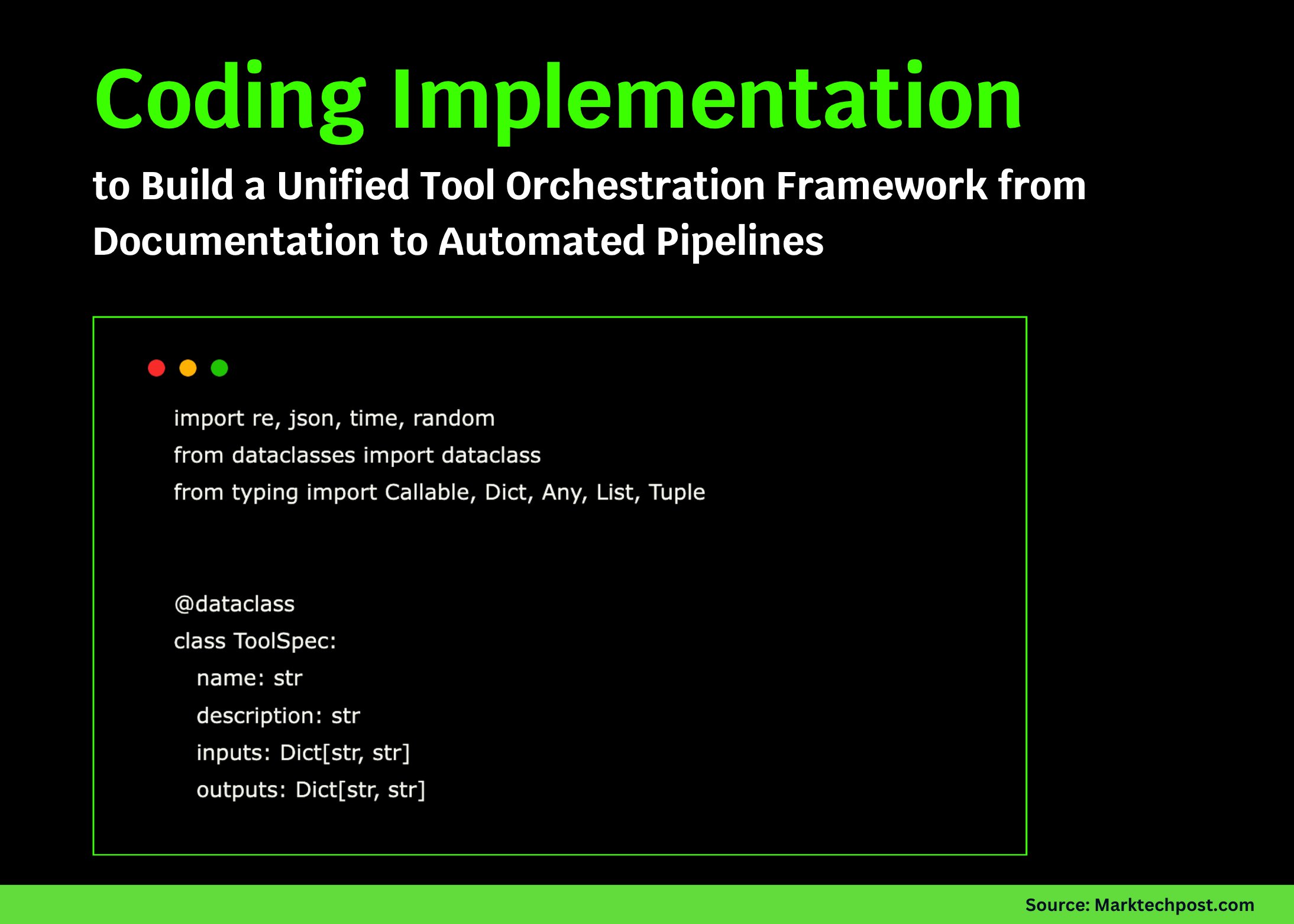


The modern data landscape is a sprawling ecosystem, fueled by an explosion of specialized tools designed to tackle increasingly complex challenges.
From machine learning model training to genomic sequencing analysis, researchers and engineers rely on a diverse toolkit – each performing a specific task with varying levels of complexity and compatibility.
This proliferation presents a significant hurdle: manually chaining these disparate tools together is time-consuming, error-prone, and simply unsustainable as workflows grow in scale and intricacy.
Enter the concept of Tool Orchestration, a rapidly evolving approach focused on automating and streamlining this integration process, essentially acting as a conductor for your data science or bioinformatics pipeline’s orchestra of instruments. It’s about moving beyond individual tool mastery to achieving efficient, repeatable results across an entire workflow – think automated pipelines that adapt based on inputs and dynamically manage dependencies between tools. The ability to define, execute, monitor, and manage these complex sequences is becoming a critical differentiator for teams aiming to maximize productivity and minimize operational overhead. Ultimately, Tool Orchestration allows users to focus on the science, not the scripting needed to make it happen.
Understanding the Problem: Tool Integration Challenges
The modern data landscape is characterized by an explosion of specialized tools designed to address specific needs within the data science lifecycle. From cloud storage solutions like AWS S3 or Google Cloud Storage, to data cleaning libraries such as Pandas and Dask, machine learning frameworks like TensorFlow and PyTorch, and model deployment platforms—the options are seemingly endless. However, this abundance presents a significant challenge: effectively integrating these diverse tools into cohesive workflows. The promise of leveraging the best-in-class capabilities of each tool is often hampered by the practical difficulties inherent in their interaction, leading to increased development time, operational overhead, and potential for errors.
The core issue stems from the fact that these tools were rarely designed with interoperability as a primary consideration. Each vendor prioritizes its own ecosystem, resulting in varying API designs, data formats, authentication methods, and documentation quality. This lack of standardization forces data scientists and engineers to spend considerable time developing custom connectors and adapters – essentially acting as translators between different systems – rather than focusing on the core value they bring: extracting insights from data. The cumulative effect of these individual integration hurdles is a complex web of dependencies that are difficult to manage, scale, and maintain.
Without proper orchestration, workflows become fragile and prone to failure. Manual intervention often becomes necessary for troubleshooting, monitoring, and re-running failed steps. This reliance on manual processes introduces human error, slows down iteration cycles, and ultimately limits the overall productivity of data science teams. The rise of automated tool orchestration platforms aims to address these challenges by providing a centralized framework for managing dependencies, scheduling tasks, handling errors, and ensuring reproducibility across diverse tools and environments.
The Fragmentation of Data Science Workflows
A typical data science workflow is rarely a linear process; it’s an iterative cycle involving numerous distinct stages. These commonly include data ingestion and storage, data cleaning and preprocessing (handling missing values, outliers, etc.), feature engineering (creating new variables from existing ones), model training and selection, hyperparameter tuning, model evaluation, deployment, and ongoing monitoring. Each of these steps frequently involves different tools, often chosen based on their specific strengths for that particular task.
The problem arises when these stages operate in silos. For example, a data scientist might use Spark for large-scale data cleaning, then export the processed data to a Pandas DataFrame for feature engineering, and finally feed it into a TensorFlow model for training. Each of these tools has its own way of handling data formats, dependencies, and execution environments. This fragmentation means that transferring data between steps often requires custom scripts or manual intervention, creating bottlenecks and increasing the risk of errors during the transition.
Furthermore, collaboration is hindered when different team members prefer different tools for similar tasks. Version control becomes more complex as workflows are not easily reproducible across various tool configurations. The lack of a unified orchestration layer makes it challenging to track dependencies, manage resources, and ensure consistency throughout the entire data science lifecycle.
API Inconsistencies and Documentation Gaps
One of the most significant obstacles to seamless tool integration is the inconsistency in Application Programming Interfaces (APIs) across different platforms. Even seemingly similar functionalities, like reading data from a file or performing a statistical calculation, can be implemented with vastly different API calls, parameter names, and error handling mechanisms. This necessitates developers to learn and adapt to each tool’s specific interface individually.
Compounding this issue is the often-inadequate documentation provided by vendors. While some tools boast comprehensive and well-maintained documentation, others suffer from incomplete examples, outdated information, or a lack of clarity regarding advanced features and edge cases. This forces developers to rely on trial and error, community forums, or reverse engineering to understand how different tools interact.
The effort required to bridge these gaps can be substantial. Building custom connectors often involves writing significant amounts of boilerplate code to handle authentication, data type conversions, and error mapping. Maintaining these connectors over time is also a challenge as APIs evolve and documentation remains unclear. This diverts valuable engineering resources away from higher-value activities like building predictive models or generating actionable insights.
The Framework: From Documentation to Pipelines
Automated Tool Orchestration is rapidly emerging as a critical capability for data science teams, machine learning engineers, and increasingly, software development groups. The core challenge lies in the proliferation of specialized tools – from data cleaning libraries to model training frameworks and deployment platforms – each with its own API, syntax, and operational quirks. Manually integrating these tools into reproducible workflows is time-consuming, error-prone, and hinders collaboration. Tool Orchestration aims to solve this by abstracting away the complexities of individual tool usage and creating a unified system for pipeline construction and execution. This allows users to focus on the logic of their analysis or model development rather than wrestling with disparate APIs.
The framework we’re detailing approaches this problem through a combination of automated interface generation, centralized management, and dynamic pipeline execution. It fundamentally shifts the paradigm from manually scripting tool interactions to defining pipelines based on documented capabilities. This allows for greater reusability, reproducibility, and scalability in complex data workflows. The system’s ability to automatically interpret documentation significantly reduces the barrier to entry for new tools within the ecosystem and fosters a more modular and adaptable approach to software development and data science.
Documentation Parsing & Interface Generation
The foundation of this framework lies in its ability to automatically extract actionable information from tool documentation. This process begins with parsing various sources, including docstrings (in Python), API specifications (like OpenAPI/Swagger for REST APIs), and even structured data formats like YAML or JSON that describe tool functionality. The parser is designed to be extensible, allowing it to incorporate new documentation standards as they emerge.
The parsed information isn’t simply stored; it’s transformed into standardized callable interfaces – essentially, simplified wrappers around the original tools. These interfaces present a consistent API regardless of the underlying implementation details. For example, a complex data cleaning function with numerous parameters might be exposed through a simpler interface that only requires essential inputs and handles default values internally. This abstraction shields users from the intricacies of each tool while still providing access to its full functionality.
This automated interface generation significantly reduces the effort required to integrate new tools into the orchestration system. Instead of manually writing adapter code, developers can simply provide the relevant documentation, and the framework generates the necessary interfaces. The generated interfaces are also validated against the original documentation to ensure correctness and prevent unexpected behavior. Furthermore, these generated interfaces facilitate type checking and auto-completion within development environments, improving developer productivity.
Centralized Tool Registry
To manage the growing number of integrated tools effectively, a centralized tool registry is maintained. This registry acts as a single source of truth for all registered tools and their associated metadata. Each entry in the registry includes details such as the tool’s name, version, description, documentation URL, standardized interface definition (generated through parsing), dependencies (e.g., required libraries or other tools), and access control information.
The registry is designed to be searchable and filterable, allowing users to easily discover available tools based on their functionality or capabilities. Version management is a crucial aspect; the registry tracks different versions of each tool, ensuring compatibility with existing pipelines and enabling rollback to previous versions if necessary. This also allows for A/B testing of new tool versions within pipelines before widespread adoption.
Beyond simple metadata, the registry facilitates dependency resolution. When constructing a pipeline, the framework consults the registry to identify all required tools and their dependencies. It then automatically resolves these dependencies, ensuring that all necessary components are available during pipeline execution. The registry also supports custom configuration options for each tool, allowing users to tailor tool behavior to specific needs without modifying the core orchestration logic.
Automated Pipeline Execution
Once a pipeline is defined – either through visual design or programmatic specification using the standardized tool interfaces – the framework handles its automated execution. The execution engine interprets the pipeline definition, resolves dependencies based on information stored in the central registry, and launches each tool instance in the correct order.
A key feature of the execution engine is its ability to handle complex dependencies between tools. Pipelines can specify data flow dependencies (e.g., tool B requires the output of tool A) or conditional logic (e.g., run tool C only if a certain condition is met). The engine manages these dependencies, ensuring that tools are executed in the correct sequence and with the necessary inputs.
Error management is also integrated into the execution process. If a tool fails during execution, the framework captures detailed error information, including stack traces and exit codes. It can then automatically retry failed tasks (with configurable retry policies) or halt pipeline execution and alert administrators. The entire execution history – including input parameters, outputs, and error messages – is logged for auditing and debugging purposes, ensuring full transparency and traceability of the workflow.
Coding Implementation: A Practical Example
Tool orchestration is rapidly becoming essential for data scientists and engineers tackling complex workflows, particularly in fields like machine learning, bioinformatics, and cloud computing. Traditionally, managing these workflows involved manually scripting sequences of tools – a time-consuming and error-prone process. Tool orchestration frameworks automate this, allowing users to define pipelines as code, manage dependencies, handle errors gracefully, and scale resources efficiently. This shift from manual execution to automated pipelines significantly boosts productivity, improves reproducibility, and enables more sophisticated data analysis.
At its core, tool orchestration involves abstracting the complexities of individual tools behind a standardized interface. This abstraction allows the orchestrator to interact with diverse tools regardless of their underlying implementation details – whether they are command-line utilities, cloud functions, or custom Python scripts. The framework handles execution order, data passing between tools (often through intermediate storage), logging, monitoring, and retry mechanisms. Modern tool orchestration systems often incorporate features like dynamic pipeline generation based on input parameters and support for distributed computing environments.
The benefits extend beyond just automation. Orchestration frameworks promote modularity; pipelines can be broken down into reusable components. They also facilitate version control of workflows, ensuring that experiments are reproducible. Furthermore, centralized management simplifies debugging and troubleshooting, allowing users to quickly identify bottlenecks or errors within the pipeline.
Creating Mock Bioinformatics Tools
To illustrate how tool orchestration works in practice, let’s create a couple of simplified mock bioinformatics tools. These won’t perform real analysis but will mimic the expected behavior of actual tools within a pipeline. For example, `tool_a` might simulate sequence alignment, and `tool_b` could represent variant calling. The key is that each tool presents a defined interface – typically through function signatures or class methods – that specifies its inputs and outputs.
In our mock setup, `tool_a` takes an input file path as a string and returns the number of aligned sequences found (an integer). Its interface might look like this: `def run(input_file): # Simulate alignment; return sequence count`. Similarly, `tool_b` accepts the output from `tool_a` (the sequence count) and produces a report file path as its result. Its interface could be `def run(sequence_count): # Simulate variant calling; return report file path`. This standardized structure – input, execution logic, output – is critical for the orchestration framework to understand how to connect these tools.
The beauty of this abstraction is that the orchestrator doesn’t need to know *how* `tool_a` aligns sequences or `tool_b` calls variants. It only needs to know their interfaces: what inputs they require and what outputs they produce. This allows for seamless integration of diverse tools, even if their underlying implementations change.
Defining an Automated Pipeline
Now let’s demonstrate how to define a pipeline using the orchestration framework’s API. This involves specifying the sequence of tools and how their outputs are connected as inputs for subsequent steps. The definition will likely involve creating objects representing each tool, configuring their input parameters (e.g., file paths), and then linking them together in a directed acyclic graph – the pipeline itself.
Imagine we want to create a simple pipeline that first runs `tool_a` on an initial data file, and then passes the result (the sequence count) to `tool_b`. The framework’s API would allow us to define this as something like: `pipeline = Pipeline([tool_a.with_input(‘data.txt’), tool_b.with_input(tool_a.output)])`. This concise code clearly expresses the dependencies and order of execution. The framework handles resolving these dependencies, ensuring that `tool_b` doesn’t execute until `tool_a` has successfully completed and produced its output.
Beyond simple linear chains, pipelines can become significantly more complex with branching logic (e.g., conditional execution based on intermediate results), parallelization of independent tasks, and error handling mechanisms. The orchestration framework provides the tools to manage this complexity, allowing users to build robust and scalable data processing workflows without getting bogged down in low-level implementation details.
Beyond the Basics: Future Directions & Scalability
The burgeoning field of automated tool orchestration aims to streamline complex analytical pipelines by automating the sequencing, execution, and management of disparate data tools. Early iterations often focused on simple sequential workflows – a data extraction step followed by transformation, then loading into a target system. However, real-world data science projects frequently involve intricate dependencies, conditional logic, and iterative refinement processes that far exceed these basic capabilities. This necessitates a shift beyond the ‘basics’ towards a more flexible, scalable, and intelligent orchestration framework capable of adapting to evolving project needs and leveraging modern distributed computing resources.
Looking ahead, several key areas promise significant advancements in tool orchestration. These include support for highly complex workflows incorporating branching logic, error handling, and retry mechanisms; integration with cloud-based infrastructure for elastic resource allocation; and the ability to dynamically generate workflows based on real-time data characteristics or user requirements. Successfully addressing these challenges will unlock unprecedented levels of efficiency and empower data scientists to focus on higher-value analytical tasks rather than manual pipeline management.
Scalability is paramount. Current orchestration solutions often struggle when faced with large datasets, computationally intensive operations, or the need for concurrent execution across multiple tools. Future frameworks must incorporate distributed computing principles – allowing workflows to be broken down into smaller tasks and executed in parallel across a cluster of machines – alongside dynamic resource allocation capabilities that automatically scale compute resources up or down based on workload demands.
Integration with Cloud Platforms
A crucial step towards broader adoption and enhanced scalability is seamless integration with major cloud platforms like Amazon Web Services (AWS) and Microsoft Azure. Currently, many orchestration frameworks require significant configuration to interact with these environments, often involving manual provisioning of resources or custom connectors. Future iterations should leverage native cloud APIs and services – such as AWS Step Functions, Azure Logic Apps, or Kubernetes – to automate resource management, deployment, and monitoring within the cloud.
Specifically, integration could involve automatically deploying containerized tool instances on managed Kubernetes clusters, dynamically scaling compute resources based on workload demands using auto-scaling groups, and utilizing serverless functions for lightweight data transformations. This would abstract away much of the operational overhead associated with managing infrastructure, allowing users to focus solely on defining their analytical workflows.
Furthermore, cloud integration facilitates cost optimization. By leveraging pay-as-you-go pricing models and dynamically adjusting resource allocation, organizations can significantly reduce the financial burden of running complex data pipelines. Features like spot instance utilization for non-critical tasks would further enhance cost efficiency while maintaining performance.
Dynamic Workflow Generation
The concept of dynamically generating workflows, rather than relying on statically defined sequences, represents a significant paradigm shift in tool orchestration. Imagine a scenario where the optimal data transformation steps depend directly on the characteristics of the input data – its size, format, or quality. A dynamic workflow generation framework could automatically analyze these factors and construct a tailored pipeline accordingly.
This capability could be achieved through various techniques, including machine learning models trained to predict appropriate tool sequences based on historical data patterns, rule-based systems that adapt workflows based on predefined criteria (e.g., if data quality falls below a threshold, trigger a specific cleansing step), or even generative AI approaches capable of designing entire pipelines from high-level specifications.
The benefits are substantial: increased agility in responding to changing data conditions, improved pipeline efficiency by avoiding unnecessary processing steps, and reduced development time as analysts spend less time manually configuring workflows. This also allows for automated A/B testing of different workflow configurations to optimize performance and accuracy.
The journey through automated tool orchestration reveals a profound shift in how data science teams operate, moving from fragmented manual processes to streamlined, reproducible pipelines.
We’ve seen firsthand how this approach not only accelerates project timelines but also significantly reduces the risk of human error and improves overall team efficiency – freeing up valuable time for more strategic work.
The ability to dynamically manage dependencies, scale resources on demand, and ensure consistent execution across environments represents a paradigm shift in data science workflow management.
Ultimately, embracing automated tool orchestration isn’t just about optimizing existing processes; it’s about unlocking entirely new possibilities for innovation and experimentation within the field of data science itself. This allows for more robust model development and deployment cycles than ever before possible with traditional methods – truly a revolution in how we build solutions from raw data to actionable insights, especially when considering complex workflows requiring multiple steps and diverse tools. The power of Tool Orchestration lies in its ability to handle this complexity gracefully and reliably.
Source: Read the original article here.
Discover more tech insights on ByteTrending ByteTrending.
Discover more from ByteTrending
Subscribe to get the latest posts sent to your email.