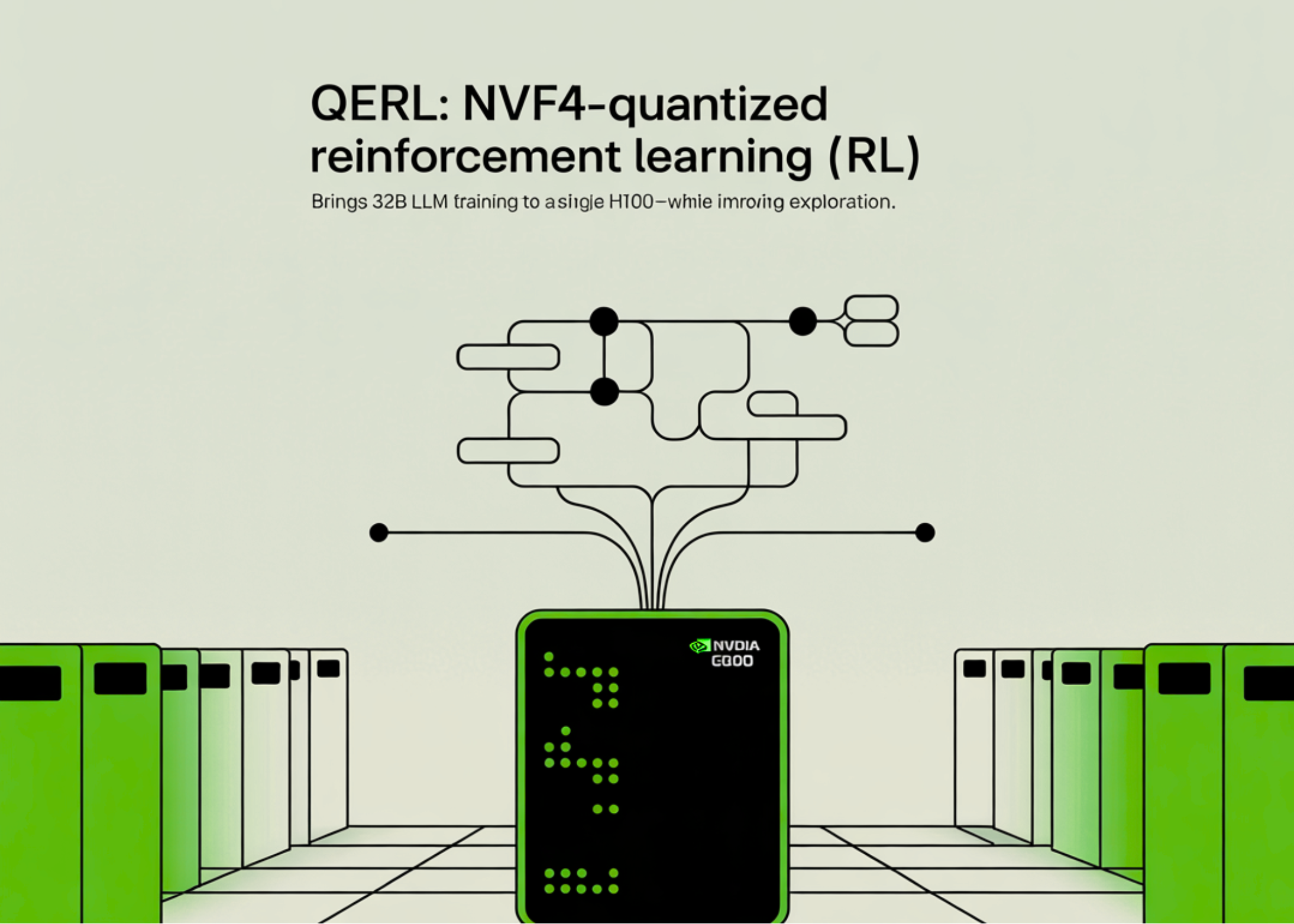



Imagine what you could build if you could run Reinforcement Learning (RL) post-training on a 32B LLM in 4-bit NVFP4—on a single H100—with BF16-level accuracy and 1.2–1.5× step speedups? NVIDIA researchers, collaborating with MIT, HKU, and Tsinghua, have open-sourced QeRL (Quantization-enhanced Reinforcement Learning), an innovative training framework that enables efficient Reinforcement Learning (RL) post-training using 4-bit precision while maintaining gradient stability through LoRA. This groundbreaking approach allows for faster experimentation and deployment of large language models. The research team impressively reports >1.5× speedups in the rollout phase, approximately ~1.8× end-to-end vs QLoRA in specific configurations, and has achieved the first demonstration of RL training for a 32B policy on a single H100-80GB GPU.
Understanding QeRL’s Impact on the Reinforcement Learning Loop
Traditionally, RLHF/GRPO/DAPO pipelines are heavily time-consuming due to the large number of rollouts (token generation). QeRL significantly alters this by strategically shifting the policy’s weight path to NVFP4 (FP4) with dual-level scaling. Crucially, it maintains logits and gradients in higher precision via LoRA, ensuring backpropagation stability while leveraging hardware-efficient FP4×BF16 kernels (Marlin). Consequently, this leads to faster prefill and decoding during rollouts without the need for a separate full-precision policy, streamlining the overall training process.
The Role of Marlin Kernels
To achieve these performance gains, the researchers skillfully integrate Marlin-based FP4 kernels into both rollout and prefill stages. Furthermore, LoRA (Low-Rank Adaptation) is employed to limit the number of trainable parameters, focusing optimization efforts where they have the most impact. This targeted approach directly addresses the bottleneck in RL cost and latency associated with long reasoning traces.
Quantization: More Than Just Precision Reduction
A particularly insightful discovery made during development is that deterministic FP4 quantization unexpectedly raises policy entropy, initially flattening token distributions. This behavior actually improves exploration compared to baseline methods like 16-bit LoRA and NF4-based QLoRA. Recognizing the potential of this phenomenon, QeRL introduces Adaptive Quantization Noise (AQN). AQN utilizes channel-wise Gaussian perturbations mapped into LayerNorm scale parameters, which are then annealed with an exponential schedule.
Controlling Exploration Through Adaptive Noise
This innovative approach maintains kernel fusion integrity (avoiding extra weight tensors) while enabling a smooth transition from the exploration phase to exploitation. In controlled experiments, QeRL demonstrably achieves faster reward growth and higher final scores on math-reasoning tasks under both GRPO and DAPO algorithms. This confirms the hypothesis that structured noise within the parameter space can serve as a valuable driver for exploration in RL environments. The use of quantization, therefore, is not merely about reducing precision; it’s a powerful tool for enhancing training efficiency.
Looking Ahead: The Future of Quantization-Enhanced Reinforcement Learning
The success of QeRL highlights a significant opportunity to push the boundaries of what’s possible with large language models. By leveraging 4-bit FP4 (NVFP4) quantization and introducing techniques like Adaptive Quantization Noise, NVIDIA has demonstrated that even resource-constrained environments can be utilized for advanced RL training. Furthermore, this work underscores the potential of carefully controlled quantization to significantly enhance the exploration phase of Reinforcement Learning, ultimately leading to improved model performance. Future research will likely focus on exploring further ways to leverage quantization and related techniques to optimize LLMs and streamline RL training workflows, paving the way for more accessible and efficient AI development.
Source: Read the original article here.
Discover more tech insights on ByteTrending.
Discover more from ByteTrending
Subscribe to get the latest posts sent to your email.