
Imagine a world where complex medical reports are instantly understandable. In healthcare, the ability to quickly analyze and interpret these crucial documents is vital for both providers and patients; however, they often remain underutilized due to their intricate nature and the time needed for analysis. This complexity involves interpreting multiple parameters, comparing results to standard ranges, and identifying trends—tasks that can be overwhelming.
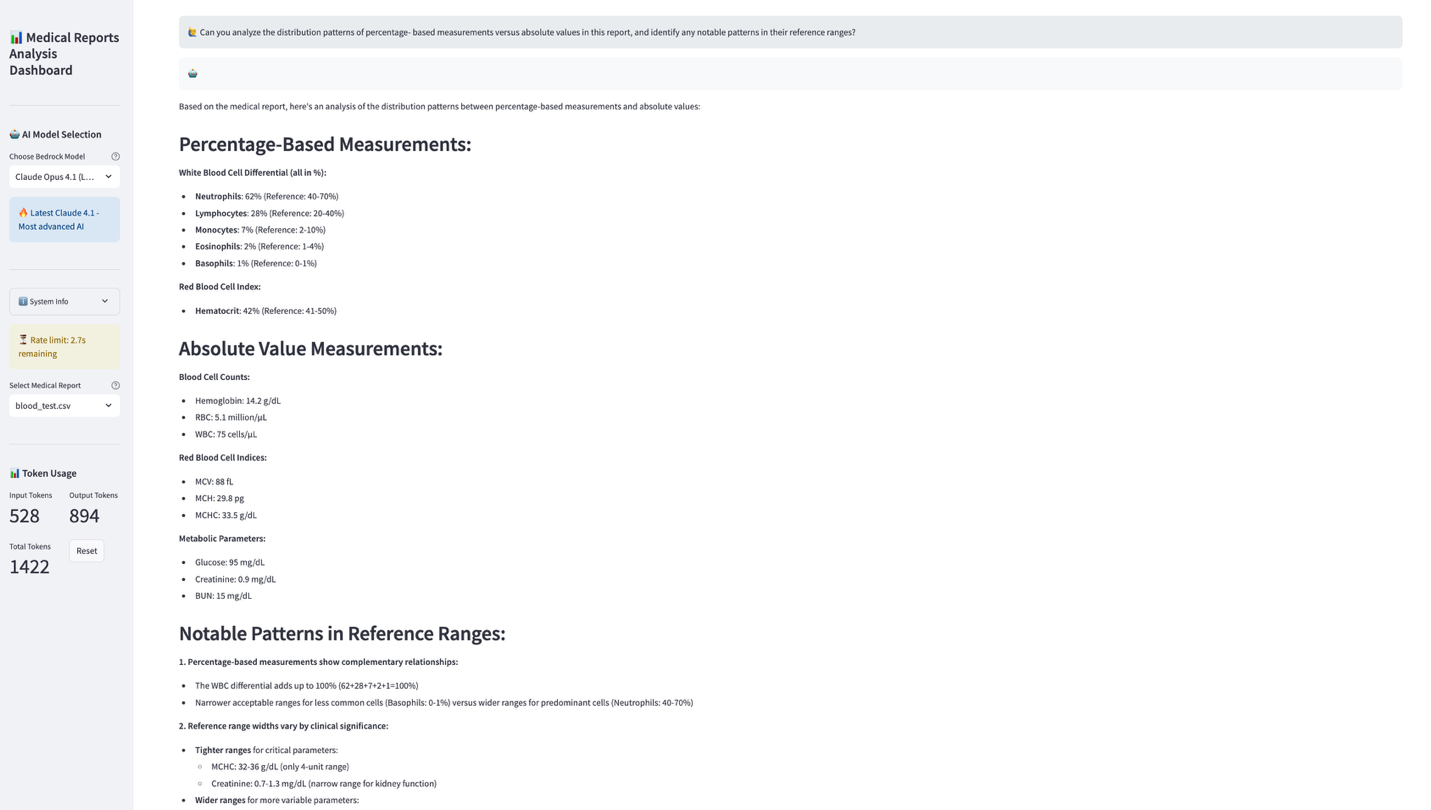
This post showcases a conceptual Medical Reports Analysis Dashboard demonstrating how healthcare professionals could interact with medical data more effectively. It’s a convergence of powerful technologies: Amazon Bedrock’s AI capabilities, LangChain’s document processing prowess, and Streamlit’s user-friendly interface, transforming complex data into accessible insights through a context-aware chat system.
Understanding the Medical Reports Analysis Dashboard Solution
At its core, the dashboard leverages large language models (LLMs) available via Amazon Bedrock, including Anthropic’s Claude series and Amazon Nova Foundation Models. For example, options like Claude Opus 4.1 and Amazon Nova Pro offer varying levels of performance to balance accuracy, speed, and cost. LangChain manages document retrieval and maintains conversation context; therefore, it ensures relevant responses.
Data Flow and Processing
The data flow begins with medical reports stored securely in Amazon S3. Subsequently, LangChain processes these documents, allowing users to query the system via a Streamlit frontend. Amazon Bedrock analyzes queries within the medical context, while LangChain retrieves pertinent information. As a result, the results are then presented through interactive visualizations using Plotly.


LLM Selection and Integration
Choosing the right LLM is crucial for effective medical report analysis. Amazon Bedrock provides access to various models, each with its strengths and weaknesses. Furthermore, understanding these differences enables tailoring the solution to specific needs and optimizing performance. Notably, factors such as response time, cost, and accuracy should be considered when selecting a model.
Visualizing Health Insights from Medical Reports
The dashboard’s visual components provide immediate clarity; therefore, range comparison charts highlight normal versus actual values, bar charts compare parameters, and trend lines reveal changes over time. Streamlit manages the user interface, session state, and conversation history for a seamless experience. For instance, consider a patient with fluctuating blood pressure readings. The dashboard could present this data as a clear trend line, allowing clinicians to quickly assess the situation and adjust treatment plans.
Exploring the Layered Architecture
The architecture of this solution is structured into four distinct layers, promoting modularity and scalability. Each layer plays a crucial role in processing and presenting medical report data effectively.
- User Interface Layer: This includes Streamlit’s web application providing a chat interface and Plotly-powered data visualizations.
- Processing Layer: LangChain handles document processing, conversation retrieval, and data parsing.
- AI Inference Layer: Amazon Bedrock provides the LLMs for natural language understanding and report interpretation.
- Data Storage Layer: Amazon S3 securely stores the medical reports.
This layered design makes it easier to update individual components without impacting the entire system, which is particularly beneficial as requirements evolve.
Future Possibilities for Medical Report Analysis
The Medical Reports Analysis Dashboard represents a significant step towards democratizing access to medical data. Consequently, future enhancements could include integration with Electronic Health Record (EHR) systems, personalized risk assessments based on historical data, and automated report generation for patients. The combination of AI, document processing, and interactive visualizations has the potential to revolutionize healthcare delivery and patient engagement.
Source: Read the original article here.
Discover more tech insights on ByteTrending.
Discover more from ByteTrending
Subscribe to get the latest posts sent to your email.