


Salesforce’s AI platform team leverages customized large language models (LLMs), fine-tuned versions of open-source models like Llama, Qwen, and Mistral, to power agentic AI applications such as Agentforce. Deploying these Bedrock-powered models traditionally presented significant operational challenges: teams often spent considerable time optimizing infrastructure components like instance families, serving engines, and configurations. Consequently, this process was not only time-consuming and difficult to maintain with frequent releases but also expensive due to GPU capacity reservations designed for peak usage.
Fortunately, Salesforce addressed these issues by embracing Amazon Bedrock Custom Model Import. This innovative solution enables teams to import and deploy customized models through a unified API, thereby minimizing infrastructure management while seamlessly integrating with valuable Amazon Bedrock features such as Knowledge Bases, Guardrails, and Agents. This strategic shift allows Salesforce to concentrate its efforts on model development and core business logic rather than the complexities of underlying infrastructure.
This article details how Salesforce successfully integrated Amazon Bedrock Custom Model Import into their machine learning operations (MLOps) workflow, demonstrating the ability to reuse existing endpoints without requiring any application changes. Furthermore, we’ll examine scalability benchmarks and share key metrics regarding operational efficiency and cost optimization gains, ultimately providing practical insights for streamlining your own deployment strategies.
Streamlining Integration with Amazon Bedrock
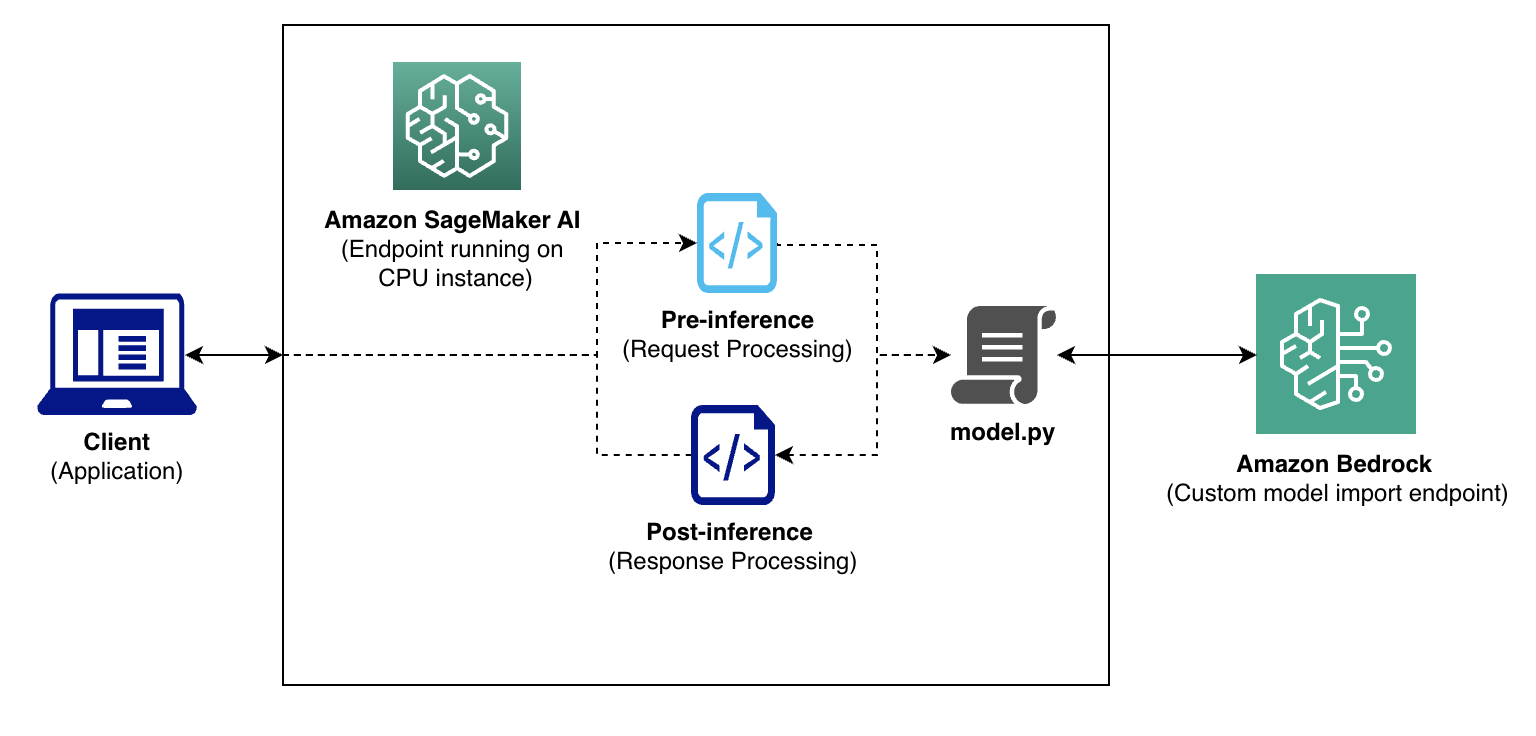
Salesforce’s transition from Amazon SageMaker Inference to Amazon Bedrock Custom Model Import demanded a meticulous approach to integration within their existing MLOps pipeline. The primary objective was to preserve the functionality of current API endpoints and model serving interfaces, ensuring zero downtime and eliminating the need for modifications to downstream applications. This strategic approach enabled them to harness the serverless capabilities of Amazon Bedrock while safeguarding investments in established infrastructure and tooling.
Maintaining Endpoint Stability
The integration strategy revolved around establishing a seamless bridge between existing deployment workflows and Amazon Bedrock managed services, mitigating operational risks during migration. As illustrated in the deployment flow diagram (not provided), Salesforce enhanced their model delivery pipeline with a single additional step: utilizing the Amazon Bedrock Custom Model Import API after saving model artifacts to an Amazon S3 bucket. This lightweight control plane operation—which takes approximately 5–7 minutes depending on model size—adds minimal overhead to the overall deployment timeline, preserving the efficiency of their existing release process.
Leveraging Existing Infrastructure
Notably, this approach allows Salesforce to continue utilizing familiar tools and processes. Consequently, the integration was relatively straightforward, minimizing disruption to ongoing development efforts. For example, teams could continue using established CI/CD pipelines with only minor adjustments to accommodate the new Amazon Bedrock API call.
Benefits Realized Through Custom Model Import
The adoption of Amazon Bedrock Custom Model Import brought about substantial advantages for Salesforce’s LLM deployment processes. These benefits extend beyond mere technical improvements and contribute to increased operational efficiency and overall business agility.
Reduced Operational Burden
By delegating infrastructure management responsibilities to Amazon Bedrock, the team gained valuable time to focus on model development, optimization, and experimentation with new AI techniques. This shift in focus allows for faster iteration cycles and more innovative solutions.
Simplified Deployment Workflow
The unified API provided by Amazon Bedrock significantly simplified the deployment process, eliminating the need for complex manual configurations. Furthermore, this standardization reduces the potential for errors and ensures consistency across deployments.
Quantifiable Metrics & Cost Savings
Salesforce’s implementation of Amazon Bedrock Custom Model Import yielded significant improvements in operational efficiency and a tangible reduction in costs. The following table summarizes key performance indicators:
| Metric | Before Bedrock Custom Model Import | After Bedrock Custom Model Import |
|---|---|---|
| Model Release Time | Approximately 60 minutes | Approximately 53-57 minutes (reduction of 5-7 mins) |
| GPU Capacity Utilization | Frequently over-provisioned | Optimized through serverless scaling |
| Engineer Time Spent on Infrastructure | Significant portion of time | Reduced, allowing focus on model development |
The team is actively exploring additional tools and automation techniques to further optimize the MLOps process, including automated endpoint creation. As a result, Salesforce can continue to refine its approach to LLM deployment and maximize the value derived from Amazon Bedrock.
Conclusion: A Strategic Shift in MLOps
Amazon Bedrock Custom Model Import has proven to be an invaluable asset for Salesforce, dramatically simplifying LLM deployment and driving substantial operational efficiencies. By embracing this serverless solution, Salesforce can allocate its resources towards advancing AI capabilities and enhancing customer experiences. This transition underscores the increasing importance of managed services and serverless architectures in modern MLOps workflows, offering a path toward greater agility and cost-effectiveness.
Source: Read the original article here.
Discover more tech insights on ByteTrending.
Discover more from ByteTrending
Subscribe to get the latest posts sent to your email.