ByteTrending
  • Home
    • About ByteTrending
    • Contact us
    • Privacy Policy
    • Terms of Service
  • Tech
  • Science
  • Review
  • Popular
  • Curiosity
Donate
No Result
View All Result
ByteTrending
No Result
View All Result
Home Curiosity
Related image for exoplanet formation

Spiral Arm Motion Solves Exoplanet Formation Mystery

ByteTrending by ByteTrending
October 4, 2025
in Curiosity, Science
Reading Time: 3 mins read
0
Share on FacebookShare on ThreadsShare on BlueskyShare on Twitter

Related Post

Related image for early universe supernova

Echoes of Creation: Unveiling a Supernova from the Universe’s Dawn

February 4, 2026
Related image for early universe supernova

Echoes of Creation: Unveiling a Supernova from the Universe’s Dawn

February 4, 2026

Decoding Universe’s ‘Red Dots’: A Breakthrough in Astrophysics

February 4, 2026

Decoding Universe’s ‘Red Dots’: A Breakthrough in Astrophysics

February 4, 2026

The prevalence of exoplanets throughout our galaxy begs the question: how do these distant worlds form? Understanding the process of exoplanet formation is a crucial step in unraveling the mysteries of planetary systems, including our own. Recent research has provided valuable insights into this complex phenomenon, shedding light on how gas and dust are transported within protoplanetary disks to facilitate planet creation.

The Challenge of Gas Giant Formation

For decades, astronomers have grappled with a significant puzzle concerning the formation of gas giants like Jupiter and Saturn. The conventional model suggests that these massive planets require substantial quantities of gas to accrete rapidly during the early stages of a star’s life. However, this dense material is typically concentrated close to the star where temperatures are high enough for efficient accretion. Consequently, forming giant planets further out, beyond the so-called “snow line,” poses a considerable challenge due to the dispersed nature of available materials.

Observing IM Lupi: A Unique System

A recent study published in Nature Astronomy focuses on IM Lupi, a young star located approximately 467 light-years away. The system boasts a protoplanetary disk – the birthplace of planets – and exhibits unusual behavior that provides valuable clues about exoplanet formation. Observations using the Atacama Large Millimeter/submillimeter Array (ALMA) have revealed a distinctive feature: spiral arms within the disk that appear to be moving inward.
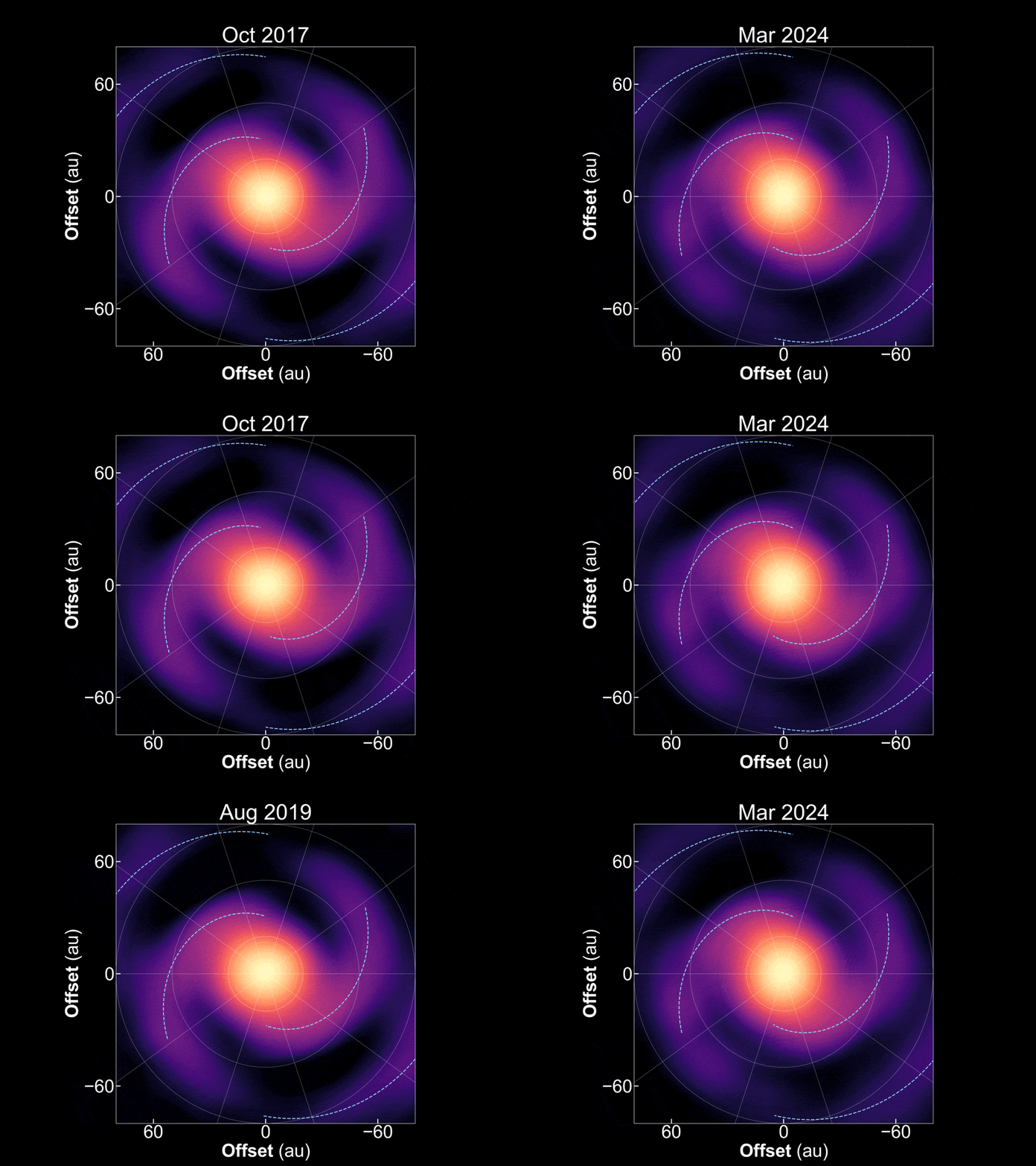
Spiral arms of IM Lupi over 7 years.
The spiral arms of IM Lupi, captured by ALMA. Credit: ALMA (ESO/NAOJ/NRAO), Tomohiro Yoshida et al.

Importantly, these spiral arms are not static structures; they actively transport gas and dust from the outer reaches of the disk toward the inner regions closer to the star. This dynamic movement is crucial for concentrating material where planets can readily form.

Spiral Arms as a Delivery System

Tomohiro Yoshida and his colleagues propose that these spiral arms function as an efficient delivery system for gas and dust. The inward motion of these arms effectively overcomes the distance barrier, allowing material from far beyond the snow line to be transported closer to the star where planet formation can occur more efficiently. Furthermore, this process enables the creation of gas giants in regions previously deemed unsuitable.

The team’s simulations convincingly demonstrate that this mechanism could explain how massive planets form at greater distances than was once believed possible. Consequently, the observed spiral arm pattern in IM Lupi suggests that similar processes may be prevalent in other young star systems, potentially accounting for the existence of exoplanets found far from their host stars. Notably, this challenges existing models and expands our understanding of how planetary systems develop.

Implications for Our Own Solar System

This discovery also holds significant implications for comprehending the formation of our own solar system. It’s plausible that a similar mechanism involving spiral arms played a vital role in the creation of Jupiter and Saturn, transporting icy material inward to facilitate their development as gas giants. Therefore, ongoing research focused on protoplanetary disk dynamics and the behavior of spiral arms will continue to refine our models concerning planet formation.


Ultimately, the study highlights the intricate and dynamic nature inherent in planetary system formation, demonstrating that processes beyond simple accretion are crucial for shaping the architecture of planetary systems throughout the galaxy. As a result, future observations utilizing advanced telescopes will undoubtedly reveal even more detailed insights into these fascinating cosmic nurseries and further illuminate the complexities of exoplanet formation.


Source: Read the original article here.

Discover more tech insights on ByteTrending.

Share this:

  • Share on Facebook (Opens in new window) Facebook
  • Share on Threads (Opens in new window) Threads
  • Share on WhatsApp (Opens in new window) WhatsApp
  • Share on X (Opens in new window) X
  • Share on Bluesky (Opens in new window) Bluesky

Like this:

Like Loading…

Discover more from ByteTrending

Subscribe to get the latest posts sent to your email.

Tags: ExoplanetsIM LupiplanetsSpiralStars

Related Posts

Related image for early universe supernova
Popular

Echoes of Creation: Unveiling a Supernova from the Universe’s Dawn

by ByteTrending
February 4, 2026
Related image for early universe supernova
Popular

Echoes of Creation: Unveiling a Supernova from the Universe’s Dawn

by ByteTrending
February 4, 2026
Related image for red dots universe
Popular

Decoding Universe’s ‘Red Dots’: A Breakthrough in Astrophysics

by ByteTrending
February 4, 2026
Next Post
Related image for materials

LLMs Unlock Materials Data: Automated Property Extraction

Leave a ReplyCancel reply

Recommended

Related image for Ray-Ban hack

Ray-Ban Hack: Disabling the Recording Light

October 24, 2025
Generative Video AI supporting coverage of generative video AI

Generative Video AI Sora’s Debut: Bridging Generative AI Promises

May 5, 2026
Related image for Ray-Ban hack

Ray-Ban Hack: Disabling the Recording Light

October 28, 2025
Diagram comparing Amazon Bedrock and OpenSearch for hybrid RAG search implementation.

Hybrid RAG search Amazon Bedrock vs OpenSearch: Which Search

May 5, 2026
Generative AI inference deployment supporting coverage of Generative AI inference deployment

SageMaker vs Bare Metal for Generative AI Inference Deployment

May 24, 2026
AI agent performance loop supporting coverage of AI agent performance loop

AI Agent Performance Loop: How to Keep AI Agents Reliable After

May 24, 2026
AI sparsity hardware supporting coverage of AI sparsity hardware

AI Sparsity Hardware: How Hardware Sparsity Can Make Massive AI

May 15, 2026
Cybersecurity consultant skills supporting coverage of Cybersecurity consultant skills

Cybersecurity Consultant Skills: What Changes for Enterprise AI

May 15, 2026
ByteTrending

ByteTrending is your hub for technology, gaming, science, and digital culture, bringing readers the latest news, insights, and stories that matter. Our goal is to deliver engaging, accessible, and trustworthy content that keeps you informed and inspired. From groundbreaking innovations to everyday trends, we connect curious minds with the ideas shaping the future, ensuring you stay ahead in a fast-moving digital world.
Read more »

Pages

  • Contact us
  • Privacy Policy
  • Terms of Service
  • About ByteTrending
  • Home
  • Authors
  • AI Models and Releases
  • Consumer Tech and Devices
  • Space and Science Breakthroughs
  • Cybersecurity and Developer Tools
  • Engineering and How Things Work

Categories

  • AI
  • Curiosity
  • Popular
  • Review
  • Science
  • Tech

Follow us

Advertise

Reach a tech-savvy audience passionate about technology, gaming, science, and digital culture.
Promote your brand with us and connect directly with readers looking for the latest trends and innovations.

Get in touch today to discuss advertising opportunities: Click Here

© 2025 ByteTrending. All rights reserved.

No Result
View All Result
  • Home
    • About ByteTrending
    • Contact us
    • Privacy Policy
    • Terms of Service
  • Tech
  • Science
  • Review
  • Popular
  • Curiosity

© 2025 ByteTrending. All rights reserved.

%d