
Video Friday Showcases Exciting Robotics Developments
Video Friday is your weekly selection of awesome robotics videos, collected by your friends at IEEE Spectrum robotics. We also post a weekly calendar of upcoming robotics events for the next few months. Furthermore, we encourage you to send us your event suggestions via email.
Upcoming Robotics Events
- ACTUATE 2025: September 23–24, San Francisco
- CoRL 2025: September 27–30, Seoul
- IEEE Humanoids: September 30 – October 2, Seoul
- World Robot Summit: October 10–12, Osaka, Japan
- IROS 2025: October 19–25, Hangzhou, China
Funding and the Future of Humanoid Robotics
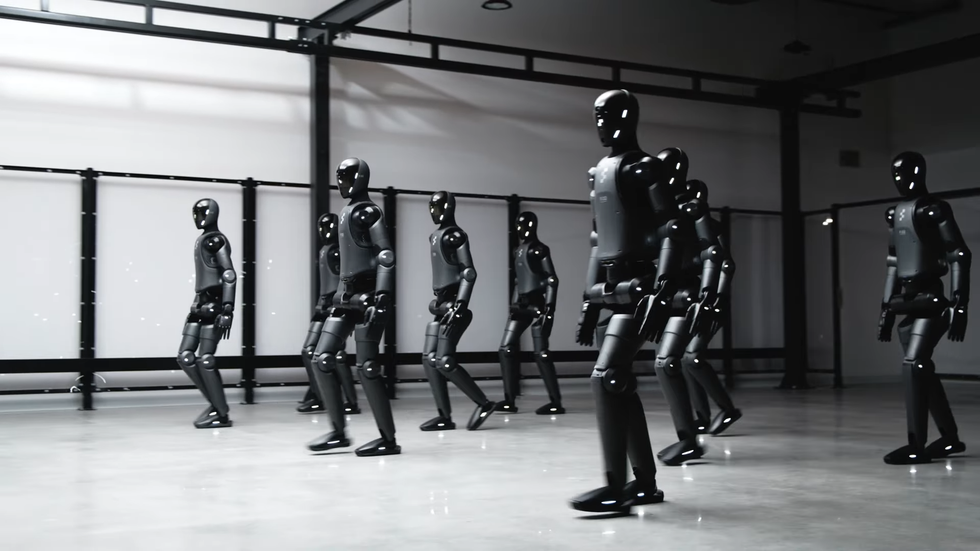
A billion dollars represents a significant investment, particularly when it’s actual capital rather than just a valuation. Figure, which already possessed considerable resources, is now poised to expand its operations even further. Notably, this funding will likely accelerate development and deployment across several key areas.
Robots often succeed in simulation but fail in reality. With PACE, we introduce a systematic approach to sim-to-real transfer.

Advancements in Robotic Hand Dexterity
Anthropomorphic robotic hands are crucial for enabling robots to effectively interact with humans and operate within human environments. While many designs attempt to mimic the kinematics and structure of a human hand, achieving true dexterity requires matching passive compliant properties as well. Consequently, researchers have developed ADAPT-Teleop, which combines a robot hand with human-matched kinematics, skin, and passive dynamics, alongside a robotic arm for intuitive teleoperation. This is an important step in improving robotics.
Anthropomorphic robotic hands are essential for robots to learn from humans and operate in human environments.
Innovative Power Solutions & Engineering Challenges
One particularly exciting demonstration features a robot that walks without any electronic components inside its body, powered by wires transmitting electricity from external motors. This innovative approach minimizes the robot’s internal complexity and weight. Furthermore, another video showcases an engineering sprint where teams built hole-digging robots, highlighting challenges in locomotion and terrain adaptation.


This robot can walk without any electronic components in its body…
AI for Rugged Terrain Navigation
Finally, researchers at the University of Michigan have developed an AI model that allows humanoid robots to navigate challenging terrain. This advancement is expected to accelerate the development of embodied AI for tasks like autonomous search and rescue, ecological monitoring in unexplored places, and other demanding applications.
Training humanoid robots to hike could accelerate development of embodied AI…
Conclusion
This week’s Video Friday offers a compelling overview of the current state and future direction of robotics, from substantial funding rounds to innovative engineering solutions. The showcased advancements underscore the potential for robots to transform numerous industries and tackle increasingly complex tasks.
Source: Read the original article here.
Discover more tech insights on ByteTrending.
Discover more from ByteTrending
Subscribe to get the latest posts sent to your email.