

Fraud continues to cause significant financial damage globally, with U.S. consumers alone losing $12.5 billion in 2024—a 25% increase from the previous year according to the Federal Trade Commission. This surge stems not from more frequent attacks, but from fraudsters’ increasing sophistication. As fraudulent activities become more complex and interconnected, conventional machine learning approaches fall short by analyzing transactions in isolation, unable to capture the networks of coordinated activities that characterize modern fraud schemes.
Graph neural networks (GNNs) effectively address this challenge by modeling relationships between entities—such as users sharing devices, locations, or payment methods. By analyzing both network structures and entity attributes, GNNs are effective at identifying sophisticated fraud schemes where perpetrators mask individual suspicious activities but leave traces in their relationship networks. However, implementing GNN-based online fraud prevention in production environments presents unique challenges: achieving sub-second inference responses, scaling to billions of nodes and edges, and maintaining operational efficiency for model updates. In this post, we show you how to overcome these challenges using GraphStorm, particularly the new real-time inference capabilities of GraphStorm v0.5.
The Evolution of GNN Fraud Prevention
Previous solutions required tradeoffs between capability and simplicity. Our initial DGL approach provided comprehensive real-time capabilities but demanded intricate service orchestration—including manually updating endpoint configurations and payload formats after retraining with new hyperparameters. This approach also lacked model flexibility, requiring customization of GNN models and configurations when using architectures beyond relational graph convolutional networks (RGCN). Subsequent in-memory DGL implementations reduced complexity but encountered scalability limitations with enterprise data volumes. We built GraphStorm to bridge this gap, by introducing distributed training and high-level APIs that help simplify GNN development at enterprise scale.
Early Challenges in Deploying Real-Time Fraud Detection
Initially, deploying fraud prevention solutions using graph neural networks presented significant hurdles. The need for manual endpoint updates and payload formatting was time-consuming and prone to errors. Furthermore, the lack of flexibility in model architectures restricted innovation and limited the adaptability of these systems to evolving fraud patterns.
The GraphStorm Advantage: Simplifying GNN Development
GraphStorm emerged as a solution, streamlining the development process through distributed training and user-friendly APIs. This facilitated easier creation and deployment of GNN models at enterprise scale, addressing prior limitations and opening new possibilities for effective fraud prevention.
Introducing GraphStorm v0.5: Real-Time Inference
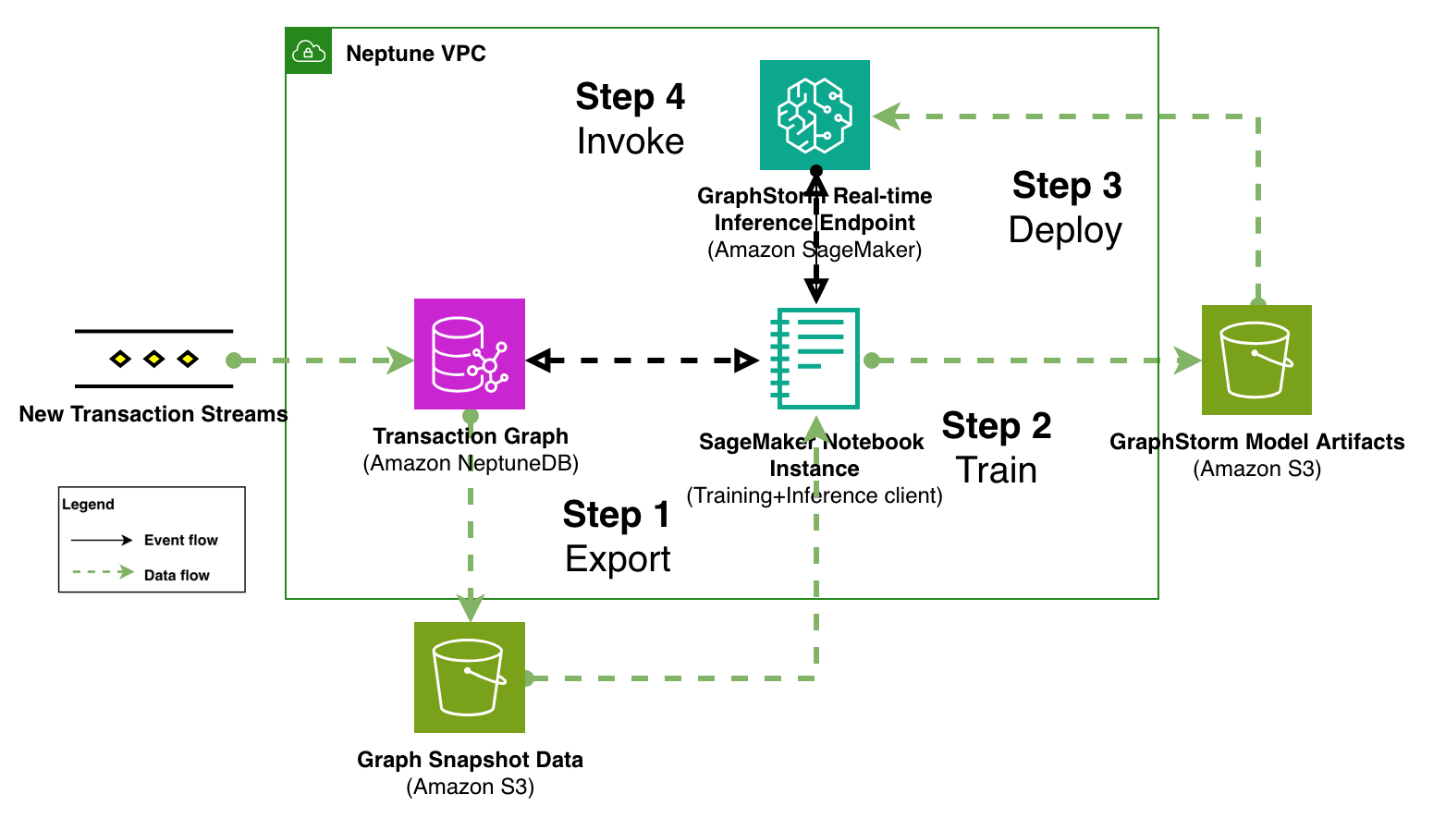
In a recent blog post, we illustrated GraphStorm’s enterprise-scale GNN model training and offline inference capability and simplicity. While offline GNN fraud prevention can identify fraudulent transactions after they occur—preventing financial loss requires stopping fraud before it happens. GraphStorm v0.5 makes this possible through native real-time inference support through Amazon SageMaker AI. GraphStorm v0.5 delivers two innovations: streamlined endpoint deployment that reduces weeks of custom engineering—coding SageMaker entry point files, packaging model artifacts, and calling SageMaker deployment APIs—to a single-command operation, and standardized payload specification that helps simplify client integration with real-time inference services. These capabilities enable sub-second node classification tasks like fraud prevention, empowering organizations to proactively counter fraud threats with scalable, operationally straightforward GNN solutions.
A Real-World Fraud Prevention Solution
To showcase these capabilities, this post presents a fraud prevention solution. Through this solution, we show how a data scientist can leverage GraphStorm v0.5 to build and deploy a real-time fraud detection system. The process includes training a GNN model using GraphStorm’s distributed training framework, packaging the trained model for deployment on Amazon SageMaker, and deploying it as a real-time inference endpoint. The streamlined deployment process significantly reduces operational overhead, allowing data scientists to focus on model improvement rather than infrastructure management. Standardized payloads ensure seamless integration with existing fraud detection pipelines. The resulting system offers sub-second latency, enabling immediate action against potential fraudulent transactions while scaling effectively to handle billions of nodes and edges in complex transaction graphs.
By embracing GraphStorm v0.5’s new capabilities, organizations can significantly enhance their fraud prevention strategies, minimizing financial losses and protecting customers from increasingly sophisticated threats. The combination of GNN power and simplified deployment creates a powerful weapon against fraud, enabling proactive protection in the digital age.
Source: Read the original article here.
Discover more tech insights on ByteTrending.
Discover more from ByteTrending
Subscribe to get the latest posts sent to your email.