

AI agents are evolving beyond basic single-task helpers into more powerful systems capable of planning, critiquing, and collaborating to solve complex problems. Deep Agents—a recently introduced framework built on LangGraph—bring these capabilities to life, enabling multi-agent workflows that mirror real-world team dynamics. However, deploying and managing such agents in production poses a significant challenge, particularly concerning security and scalability. This is where Amazon Bedrock AgentCore Runtime provides a valuable solution. By offering a secure, serverless environment specifically designed for AI agents and tools, Runtime facilitates the deployment of Deep Agents at enterprise scale without the complexities of infrastructure management.
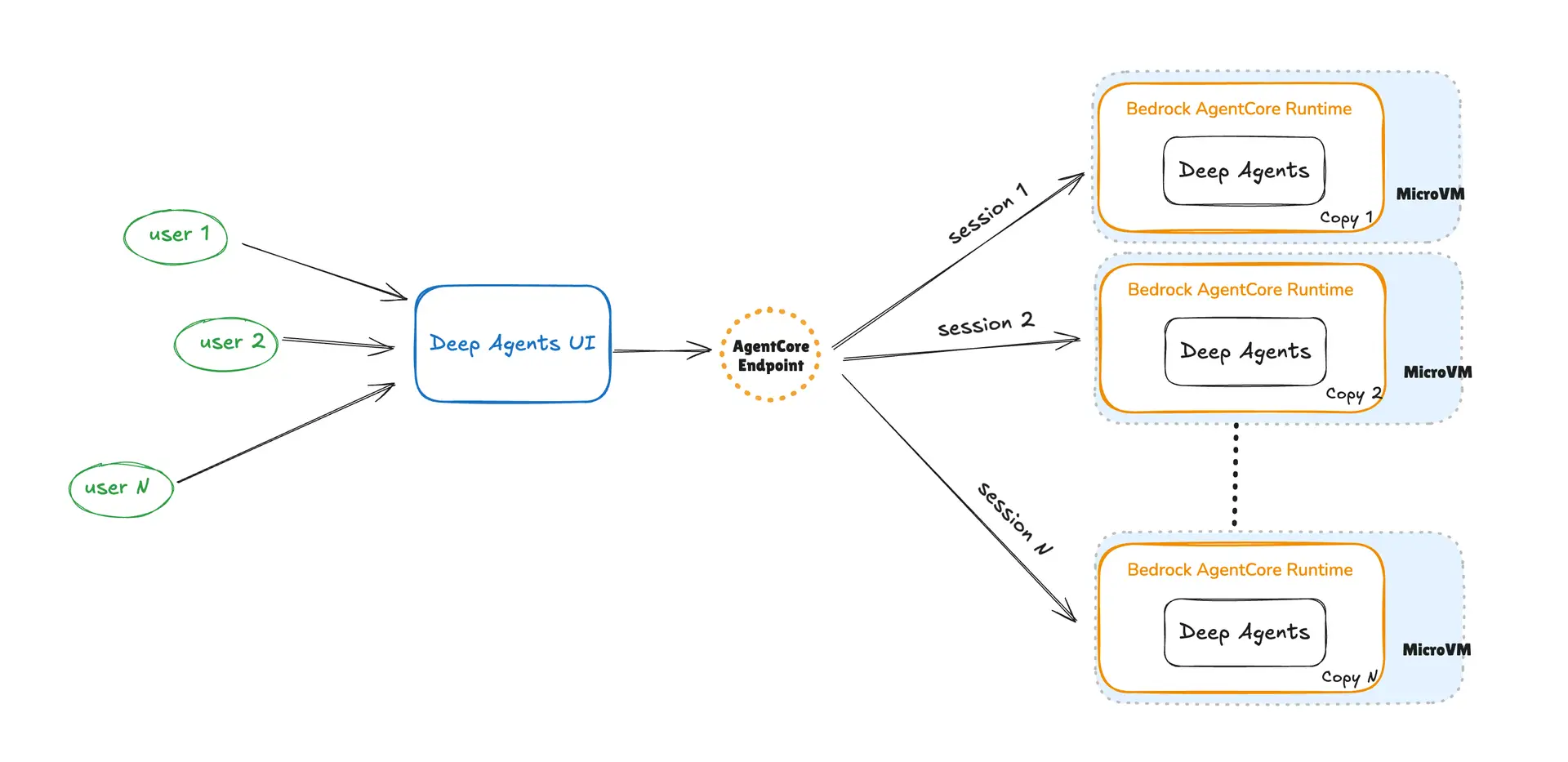
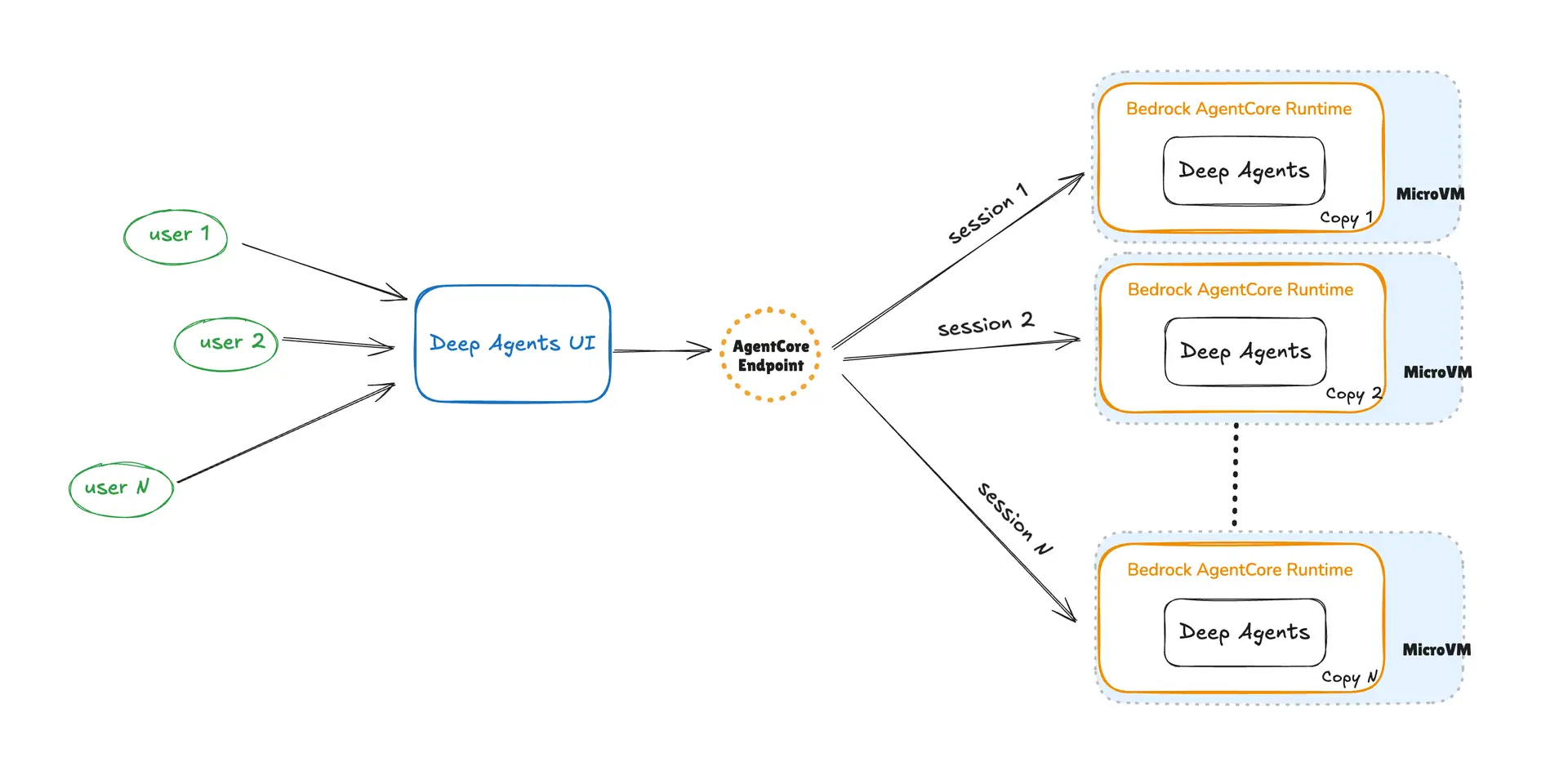
In this post, we demonstrate how to deploy Deep Agents on AgentCore Runtime. As indicated in the following figure, AgentCore Runtime dynamically scales any agent and provides session isolation by allocating a new microVM for each new session.
What are Deep Agents?
Deep Agents represent a significant advancement in AI agent technology, moving beyond simple sequential actions to encompass more sophisticated decision-making processes. For example, instead of just retrieving information and responding, Deep Agents can analyze the results, identify potential issues, and proactively adjust their approach. Furthermore, they often involve multiple agents working together—a concept inspired by human team collaboration. Initially introduced by LangChain, Deep Agents utilize LangGraph to orchestrate these complex workflows. As a result, developers can define intricate agent interactions, allowing them to tackle more challenging tasks than previously possible with simpler agent designs.
The Role of LangGraph
LangGraph plays a crucial role in enabling Deep Agent functionality. It provides the framework for defining and executing multi-agent workflows—essentially mapping out how different agents interact and pass information between each other. Notably, LangGraph allows for iterative refinement, where an agent’s output can be fed back into the system for further analysis or adjustment. Similarly, it facilitates error handling and recovery, ensuring that even if one agent fails, the entire workflow doesn’t collapse. Consequently, LangGraph becomes essential for building robust and resilient Deep Agent systems.
Challenges of Production Deployment
While Deep Agents offer incredible potential, deploying them in a production environment presents unique challenges. Security is paramount; ensuring that agents can access necessary resources without compromising data integrity or exposing vulnerabilities is critical. Moreover, scalability becomes an issue as the complexity and volume of agent interactions increase. Managing infrastructure to handle fluctuating demand requires significant expertise and ongoing maintenance. Therefore, developers need solutions that simplify deployment and provide a secure, scalable foundation for Deep Agent operations.
Introducing Amazon Bedrock AgentCore Runtime
Amazon Bedrock AgentCore is a flexible platform designed to address these challenges. It provides a secure, serverless environment specifically tailored for AI agents and tools. AgentCore Runtime dynamically scales agent workloads, offering significant advantages over traditional deployment methods. In addition, it guarantees session isolation by allocating a new microVM for each new session, further enhancing security and preventing potential conflicts between different users or applications. Importantly, AgentCore supports a wide range of agent frameworks, including Deep Agents, providing developers with the freedom to choose their preferred tools.
Security Features of AgentCore
One of the most compelling aspects of AgentCore is its robust security architecture. The use of microVMs ensures that each session operates in a completely isolated environment, preventing unauthorized access or data leakage. Furthermore, AgentCore integrates seamlessly with other AWS services, leveraging existing security protocols and infrastructure. For example, it supports fine-grained access control policies to restrict agent access only to authorized resources. Therefore, organizations can confidently deploy Deep Agents on AgentCore knowing that their sensitive data is well protected.
Scalability and Performance
AgentCore’s serverless nature inherently provides excellent scalability. The platform automatically adjusts the underlying infrastructure based on demand, ensuring consistent performance even during peak usage periods. This eliminates the need for manual scaling or capacity planning, freeing up developers to focus on building innovative agent applications. Moreover, AgentCore’s optimized runtime environment further enhances performance, minimizing latency and maximizing throughput. Consequently, Deep Agents can operate efficiently and reliably, delivering a seamless user experience.
Deploying Deep Agents with AgentCore
The deployment process is streamlined thanks to the integration of AgentCore with other AWS services and its flexible framework. Developers can leverage existing CI/CD pipelines to automate deployments and ensure consistent configurations. Furthermore, AgentCore provides detailed monitoring and logging capabilities, enabling proactive identification and resolution of potential issues. For instance, you can track agent performance metrics, identify bottlenecks, and debug errors efficiently. As a result, deploying Deep Agents on AgentCore becomes a straightforward process that minimizes operational overhead.
In conclusion, Amazon Bedrock AgentCore Runtime provides a powerful and secure platform for deploying complex AI agents like Deep Agents. By addressing the challenges of security, scalability, and manageability, AgentCore empowers developers to unlock the full potential of these advanced agent technologies. The combination of Deep Agents’ sophisticated capabilities with AgentCore’s robust infrastructure promises to revolutionize how we interact with and leverage artificial intelligence in various industries.
Source: Read the original article here.
Discover more tech insights on ByteTrending.
Discover more from ByteTrending
Subscribe to get the latest posts sent to your email.