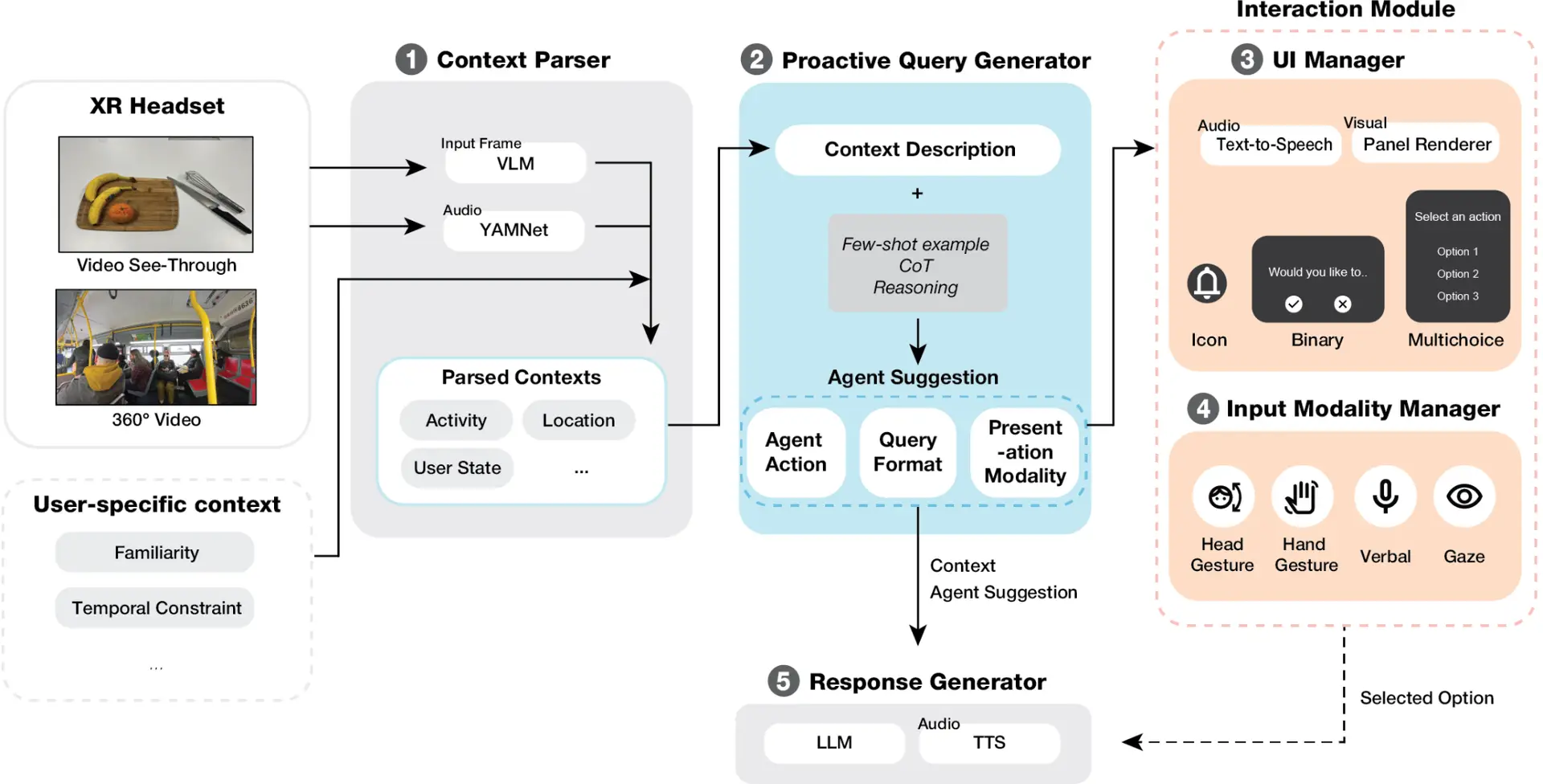


Augmented reality (AR) holds immense potential for blending the digital and physical worlds seamlessly. However, creating truly useful and engaging AR experiences requires addressing a key challenge: how to design proactive agents – virtual entities within our environment – that offer assistance without being disruptive. Google Research’s Sensible Agent framework aims to tackle this, enabling proactive yet unobtrusive interactions. Let’s explore what makes this approach significant for the future of sensible agent technology.
Understanding Proactive AR Agents and the Core Challenge
Currently, many AR systems rely on explicit user commands, leading to a reactive interaction model. For example, imagine an AR assistant guiding you through cooking; constantly demanding your attention isn’t ideal. Proactive agents, capable of anticipating needs and offering assistance without constant prompting, represent the next evolution in augmented reality. However, proactive behavior runs the risk of overwhelming users if not carefully managed.
The central issue is finding a balance between helpfulness and intrusiveness. A truly useful sensible agent should provide timely information or suggestions but shouldn’t distract from the user’s primary task or feel overly controlling. Sensible Agent seeks to resolve this tension by introducing a framework that prioritizes user context and preferences, fundamentally changing how we interact with AR.
Key Components of the Framework
The sensible agent architecture relies on several interconnected components working in harmony. Firstly, contextual awareness is paramount; the system continuously monitors user environment, activity, and gaze direction to determine appropriate interaction timing. Furthermore, predictive modeling uses machine learning models to forecast potential user actions based on past behavior and current context. Notably, a prioritization mechanism then determines which interactions are most relevant, considering urgency and user load. Finally, information is presented unobtrusively – through subtle visual cues or spatial audio – minimizing disruption.

How Sensible Agent Operates: A Layered Approach
Sensible Agent goes beyond merely predicting what the user wants; it focuses on understanding when and how to deliver that information effectively. The framework employs a layered approach, ensuring a thoughtful interaction sequence. Initially, the system performs a situation assessment based on sensor data like camera input and microphone recordings. Subsequently, predictive models forecast potential user actions – for example, anticipating that the user is likely to reach for a spice rack. Following prediction, an appropriate interaction is selected, such as displaying information about paprika in the AR overlay.
Ultimately, a presentation strategy chooses the most unobtrusive delivery method; perhaps a subtle highlight around the paprika container instead of a distracting pop-up window. Furthermore, to continuously improve its accuracy and relevance, the system incorporates user feedback, enabling adaptive learning and ensuring that the sensible agent becomes increasingly attuned to individual preferences over time.
Example Prioritization Logic
The prioritization process is crucial for delivering helpful assistance without overwhelming the user. The following code snippet illustrates a simplified conceptual example:
// Example (Conceptual) - Prioritization Logic
function prioritizeInteraction(predictedAction, urgency, userLoad) {
  if (urgency == 'high' && userLoad < 0.2) {
    return 'visual_cue'; // Subtle highlight
  } else if (userLoad < 0.5) {
    return 'audio_prompt'; // Brief audio cue
  }
  return 'no_interaction';
}
Expanding Applications Beyond the Kitchen
While Google Research initially showcased examples such as cooking assistance, the potential of Sensible Agent extends across numerous industries. For example, in manufacturing and maintenance, it can guide workers through complex procedures with minimal disruption. Similarly, in healthcare, surgeons or nurses could benefit from real-time information and guidance during operations. In addition, educational settings could leverage sensible agent technology to create personalized learning experiences that adapt to individual student needs. Meanwhile, navigation systems can offer subtle, context-aware directions without overwhelming the user’s visual field; therefore, the possibilities are vast.
The Future is Proactive and Contextual
Sensible Agent represents a significant advancement in AR interaction design. By thoughtfully prioritizing user context, predicting needs, and delivering information unobtrusively, this framework has the potential to unlock augmented reality’s full promise – creating genuinely helpful digital assistants that seamlessly integrate into our daily lives. Ultimately, sensible agent technology promises a future where AR enhances, rather than disrupts, our experiences.
Source: Read the original article here.
Discover more tech insights on ByteTrending.
Discover more from ByteTrending
Subscribe to get the latest posts sent to your email.