
The cosmos holds countless wonders, and among the most spectacular is starbirth – the dramatic emergence of new stars from vast clouds of gas and dust. Witnessing a star’s birth is akin to observing creation itself, and thanks to instruments like NASA’s James Webb Space Telescope (JWST), we’re gaining unprecedented insight into this awe-inspiring process. This article explores the science behind starbirth, revealing how these celestial bodies ignite and shape galaxies.
The Anatomy of a Stellar Nursery
Before stars can form, they require specific ingredients: massive quantities of hydrogen gas, helium, and trace amounts of heavier elements. These materials congregate within colossal molecular clouds—cold, dense regions spread across vast interstellar distances. Consequently, these clouds aren’t uniform; they contain pockets of higher density where gravity begins to exert its influence. Furthermore, shockwaves from nearby supernovae or the radiation pressure from existing stars can trigger further compression.
Gravitational Collapse and Fragmentation
As a molecular cloud core becomes sufficiently dense, gravity overwhelms internal gas pressure, initiating gravitational collapse. However, this isn’t a uniform process; instead, the collapsing cloud fragments into smaller, denser clumps. Each of these clumps has the potential to form one or more stars. Notably, as these fragments contract, they heat up, initially emitting infrared radiation.
The Protostar Phase
Following fragmentation, each clump continues to collapse and heat up, forming a protostar—a nascent star still accreting mass from its surrounding cloud. During this phase, the protostar is often shrouded in a swirling disk of gas and dust called an accretion disk. This disk not only feeds material onto the growing star but also plays a critical role in the formation of planetary systems later on. Moreover, powerful jets of gas are frequently ejected along the protostar’s poles, clearing away surrounding material.
Ignition: From Protostar to Star
The protostar phase can last for millions of years. As more mass accumulates and gravitational pressure intensifies, the core temperature continues to rise. Eventually, when the core reaches approximately 10 million Kelvin (18 million degrees Fahrenheit), nuclear fusion ignites – hydrogen atoms begin fusing into helium, releasing immense amounts of energy in the process. This marks the birth of a true star and the cessation of accretion.
The Role of Feedback
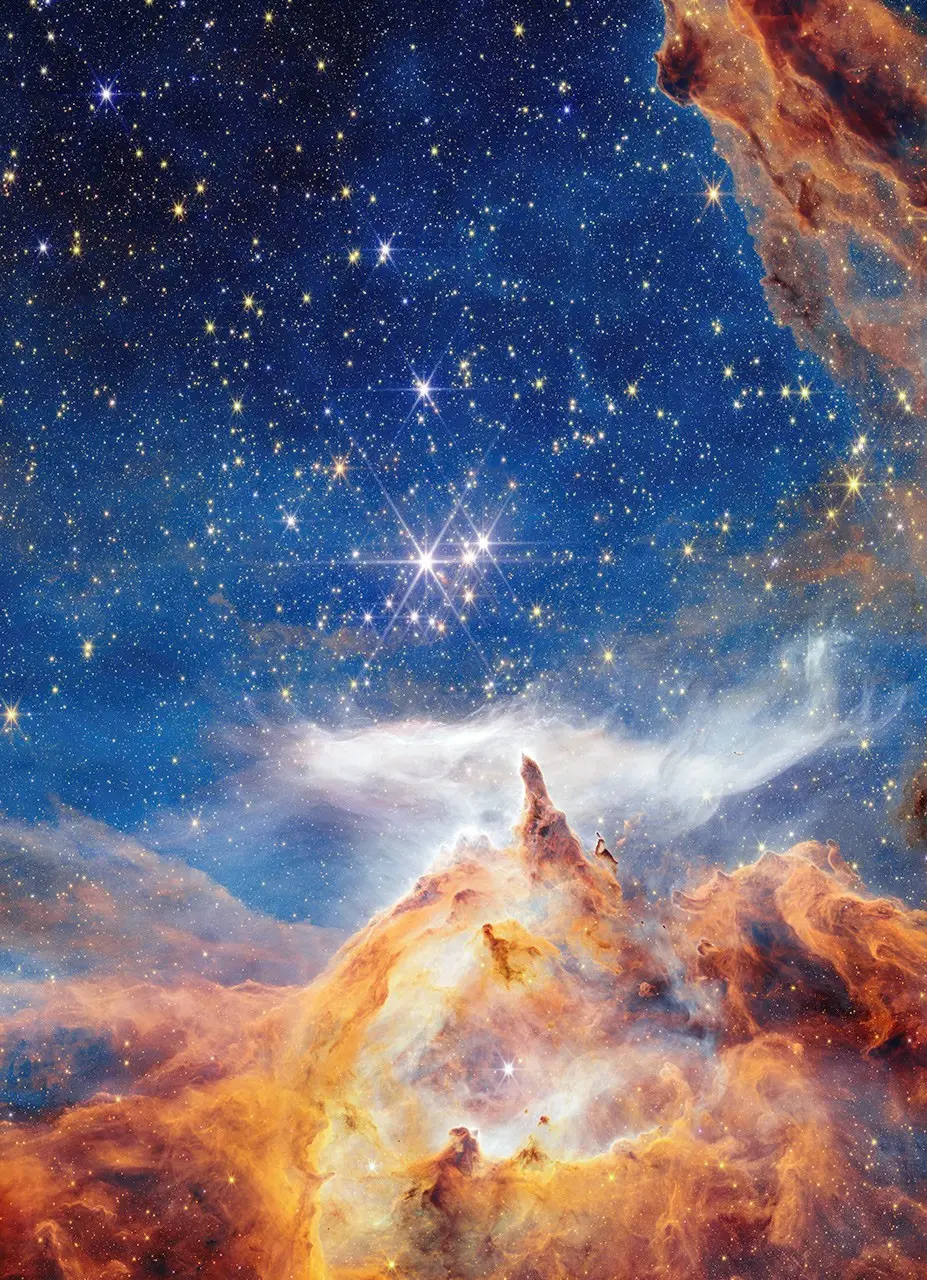
Once nuclear fusion begins, the newly born star starts exerting its own influence on surrounding material. Its intense radiation pressure and stellar winds push away the remaining gas and dust from the cloud. This “feedback” process halts further star formation within that region and can even trigger collapse in nearby regions, continuing the cycle of starbirth. For example, in Pismis 24, this feedback is actively sculpting the surrounding environment.
Observing Star Birth with JWST
Directly observing protostars is challenging because they are often deeply embedded within dusty molecular clouds. However, JWST’s infrared capabilities allow scientists to peer through these obscuring layers and witness starbirth in unprecedented detail. The telescope’s advanced instruments can analyze the composition of protostellar disks and even map the distribution of molecules involved in star formation – a crucial step for understanding how planetary systems form.
The Significance of Star Birth
Understanding starbirth is fundamental to comprehending the evolution of galaxies. Stars are not only the engines that power galaxies but also the primary source of heavy elements—the building blocks of planets and life—which are synthesized within their cores through nuclear fusion. As a result, each episode of starbirth enriches the interstellar medium with these crucial elements.
Furthermore, the study of star formation helps us understand our own origins. The Sun, along with our entire solar system, formed from a similar process billions of years ago. By unraveling the mysteries of starbirth, we gain insights into the conditions that gave rise to Earth and potentially other life-bearing planets throughout the universe.
Source: Read the original article here.
Discover more tech insights on ByteTrending.
Discover more from ByteTrending
Subscribe to get the latest posts sent to your email.