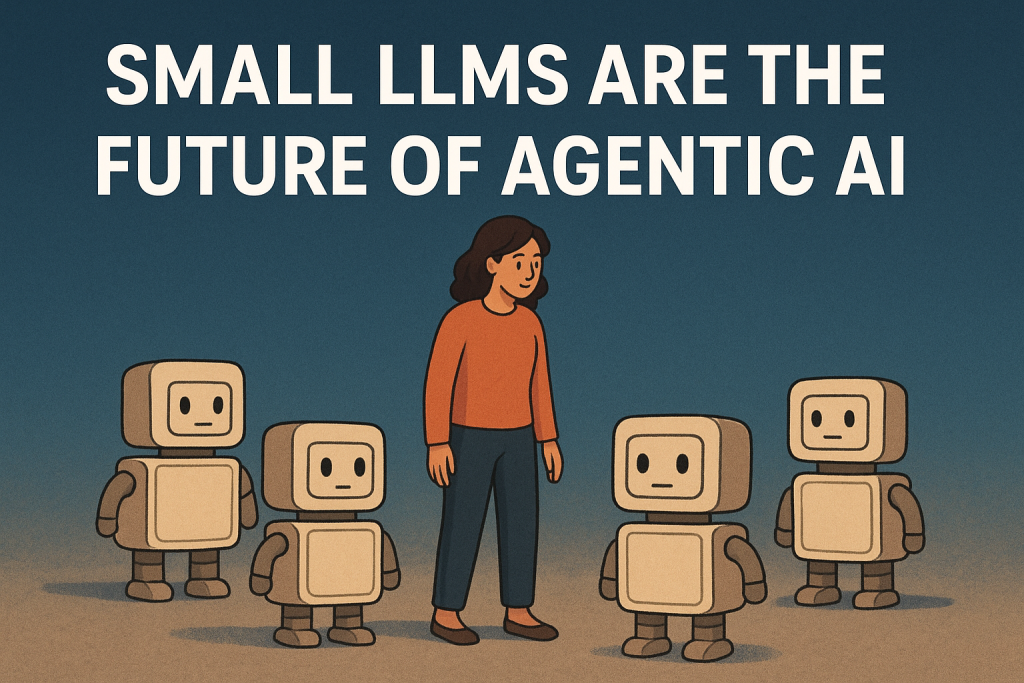


The Rise of Small Language Models in Agentic AI
For months, the conversation surrounding Large Language Models (LLMs), such as GPT-4 and Gemini, dominated discussions within the artificial intelligence field. Their impressive capabilities sparked excitement, but also raised concerns regarding resource consumption and accessibility. However, a compelling alternative is now emerging: Small Language Models (SLMs). A recent paper from Machine Learning Mastery highlights why these smaller models are poised to become integral components of agentic AI systems – AI agents capable of autonomous task completion. In essence, SLMs offer a more practical approach for building sophisticated AI solutions.
Why Small is Smart: Advantages of Small Language Models
The advantages of SLMs are numerous and address many limitations associated with their larger counterparts. Their reduced size allows for significant improvements in various areas, making them highly attractive for a wide range of applications.
Resource Efficiency
LLMs demand substantial computational resources for both training and inference processes, resulting in high costs and potential environmental impact. SLMs, owing to their smaller parameter count, require considerably less power and memory. Consequently, this makes them more accessible to a wider range of users and facilitates deployment on resource-constrained devices like edge computing platforms or even smartphones. Furthermore, the lower barrier to entry encourages innovation across various sectors.
Faster Inference & Lower Latency
The sheer size of LLMs contributes directly to slower response times – often referred to as latency. SLMs, with their reduced complexity, offer significantly faster inference speeds, which is absolutely crucial for real-time applications and interactive agentic AI systems where responsiveness is paramount. For example, in a chatbot application, SLMs allow for nearly instantaneous replies, enhancing user experience.
Fine-tuning Flexibility
While LLMs are powerful generalists, they frequently require extensive fine-tuning to excel in specific tasks. The smaller size of SLMs makes them more amenable to efficient and cost-effective fine-tuning on custom datasets. This allows developers to tailor SLMs precisely to the needs of their agentic AI applications, resulting in specialized solutions.
Improved Explainability
The often opaque nature of LLMs – frequently referred to as a “black box” – hinders understanding and debugging efforts. Notably, SLMs, being simpler in design, offer a degree of increased explainability; this makes it easier to trace decision-making processes within an agentic AI system. This enhanced transparency is a critical factor for building trust and ensuring safety.
Cost Effectiveness
The costs associated with training and deploying LLMs are substantial. SLMs drastically reduce these expenses, enabling broader experimentation and wider adoption of agentic AI technologies. Therefore, smaller language models democratize access to advanced AI capabilities.
- LLMs: High cost, high latency, less explainable
- Small Language Models (SLMs): Low cost, low latency, more explainable
SLMs in Agentic AI: A Powerful Combination
The paper from Machine Learning Mastery explores how SLMs can be effectively integrated into agentic AI frameworks. These agents typically involve a combination of components, including planning modules, memory systems, and action execution engines. SLMs are proving particularly valuable in the planning and reasoning stages, demonstrating their versatility within complex systems.
Task Decomposition & Planning
Agentic AI often necessitates breaking down intricate tasks into smaller, more manageable sub-tasks. SLMs can be leveraged to generate these task decompositions, creating a roadmap for the agent’s actions. Their ability to understand natural language instructions is particularly beneficial in this process.
Reasoning and Decision Making
SLMs are capable of analyzing information from diverse sources – such as web searches, databases, and internal knowledge bases – and making informed decisions regarding subsequent actions. They effectively serve as a reasoning engine within the agentic AI system; consequently, improving overall performance.
Tool Use & Interaction
Agentic AI agents often require interaction with external tools and APIs to accomplish complex goals. SLMs can be trained to understand tool descriptions and generate appropriate API calls, enabling sophisticated automation workflows. For example, an agent might use a small language model to translate a user’s request into SQL queries to retrieve data from a database.
# Example: Small Language Model generating a query
user_request = "Find all customers in California"
query = slm.generate(prompt=f"Translate this request into SQL: {user_request}")
# query might be something like: SELECT * FROM Customers WHERE State = 'CA'
Conclusion: A New Era for AI Agents
While LLMs will continue to hold a place in certain advanced applications, the rise of SLMs signals a significant shift towards more accessible, efficient, and explainable agentic AI. The ability to effectively fine-tune these models opens up exciting possibilities for creating specialized agents tailored to specific domains and use cases. The future of agentic AI isn’t solely about larger models; it’s about smarter design – and small language models are a crucial element of that evolving landscape. Consequently, expect SLMs to play an increasingly important role in the development of next-generation AI assistants.
Source: Read the original article here.
Discover more from ByteTrending
Subscribe to get the latest posts sent to your email.