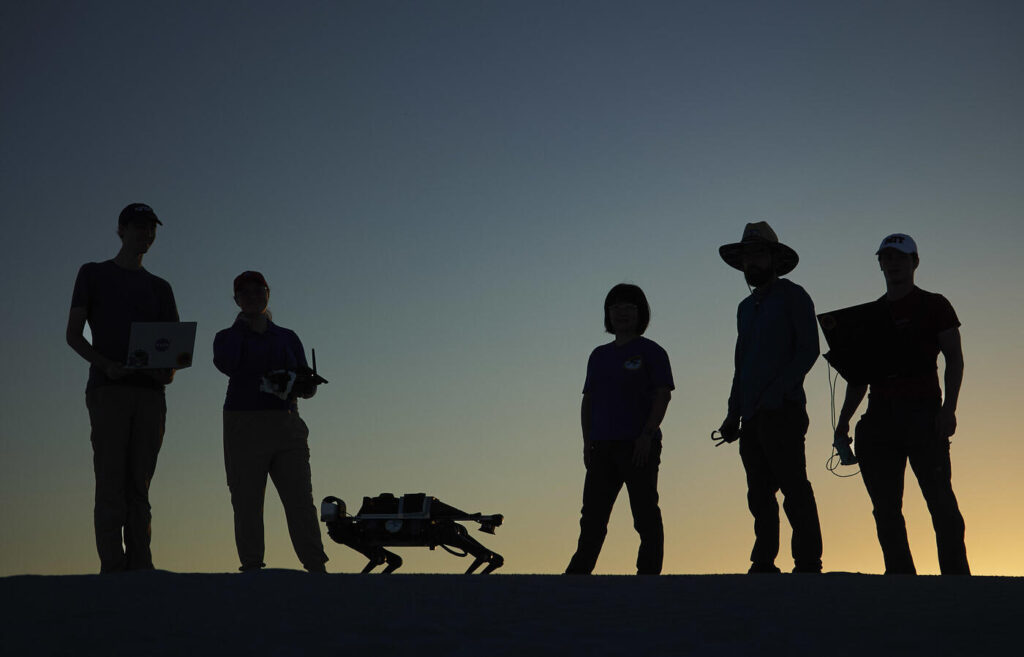


The pursuit of robotic exploration beyond Earth has taken a significant stride forward, as researchers successfully conducted extensive field tests in New Mexico’s White Sands National Park. These trials are instrumental in preparing robots for Martian science missions, aiming to equip them with the necessary autonomy and resilience for operations alongside astronauts. The recent experiments represent a crucial step towards realizing robotic exploration capabilities on both the Moon and Mars.
Simulating the Martian Environment: A Vital Training Ground
White Sands National Park serves as an invaluable analog environment, closely mimicking conditions found on Mars, which makes it ideal for testing. Previously, similar tests were conducted in lunar-like landscapes on Mount Hood in Oregon, demonstrating the potential of legged robots in challenging terrain. Furthermore, this location allows scientists to refine robotic navigation and operational strategies before deployment in a truly extraterrestrial setting.
Understanding Mars Analog Environments
The selection of White Sands wasn’t arbitrary; its geological features bear striking resemblances to Martian landscapes. For example, the gypsum dunes and undulating terrain offer realistic challenges for locomotion and sensor analysis. Consequently, the data collected here directly informs the design and programming of robots destined for Mars. On the other hand, researchers must also consider factors like temperature fluctuations when designing these missions.
The LASSIE Project: A Collaborative Approach to Robotic Exploration
The Legged Autonomous Surface Science in Analog Environments (LASSie) project embodies a collaborative spirit, uniting experts from diverse fields. This NASA-funded initiative brings together engineers, cognitive scientists, geoscientists, and planetary scientists from Oregon State University, the University of Southern California, Texas A&M University, the Georgia Institute of Technology, the University of Pennsylvania, Temple University, and NASA Johnson Space Center.
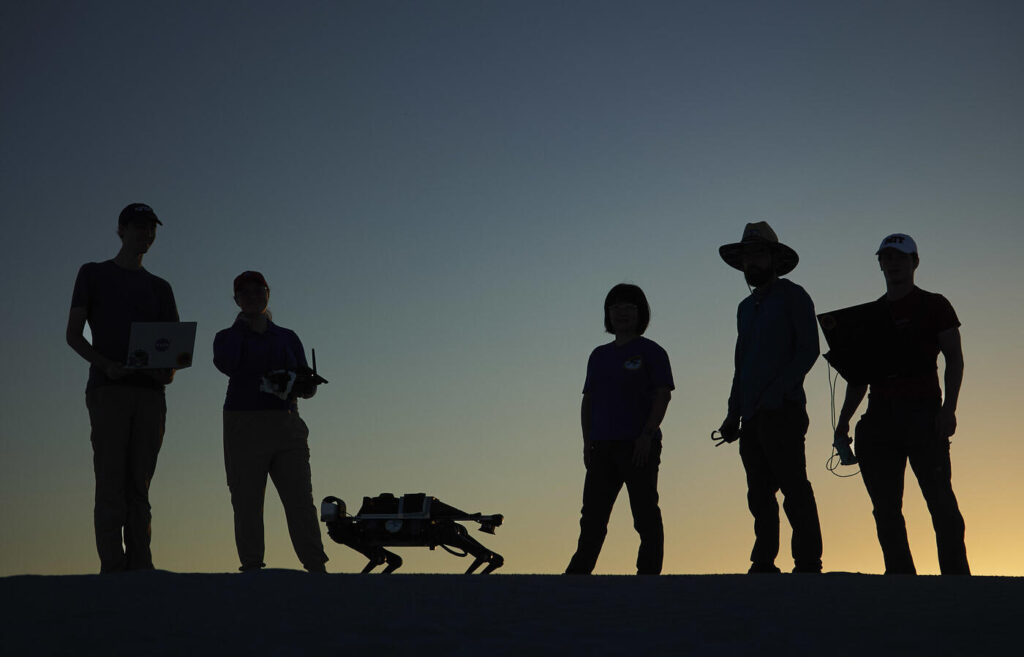
The team’s combined expertise is vital for tackling the complexities of robotic planetary exploration.
Data Acquisition & Analysis
Recent field work in White Sands marked the second visit to the park, following previous sessions on Mount Hood in 2023 and 2024. These tests are centered around gathering detailed data from the robot’s feet, meticulously analyzing its mechanical responses to surface interactions. This data is then used to refine algorithms crucial for ensuring reliable performance on the Moon or Mars; notably, each step provides valuable information about ground stability.
Autonomous Decision-Making: The Key to Martian Success
The experiments at White Sands presented unique challenges. Triple-digit temperatures necessitated restricting fieldwork to early morning hours due to heat concerns for both researchers and the robots’ power supply. Despite these limitations, significant progress was made in enhancing the robot’s autonomous capabilities.
Refined algorithms enabled the robot to operate with greater independence, making its own decisions—a critical requirement for future Mars missions where independent operation alongside astronauts is paramount for maximizing scientific output. The ability of these machines to adapt and react autonomously will be essential for overcoming unforeseen challenges in a remote environment; therefore, continued development in this area remains a key priority.
Looking ahead, the focus involves further algorithm refinement and testing within increasingly complex environments. This iterative process brings us ever closer to establishing a sustainable robotic presence on the surface of Mars and unlocking unprecedented scientific discoveries through advanced robots.
Source: Read the original article here.
Discover more tech insights on ByteTrending.
Discover more from ByteTrending
Subscribe to get the latest posts sent to your email.