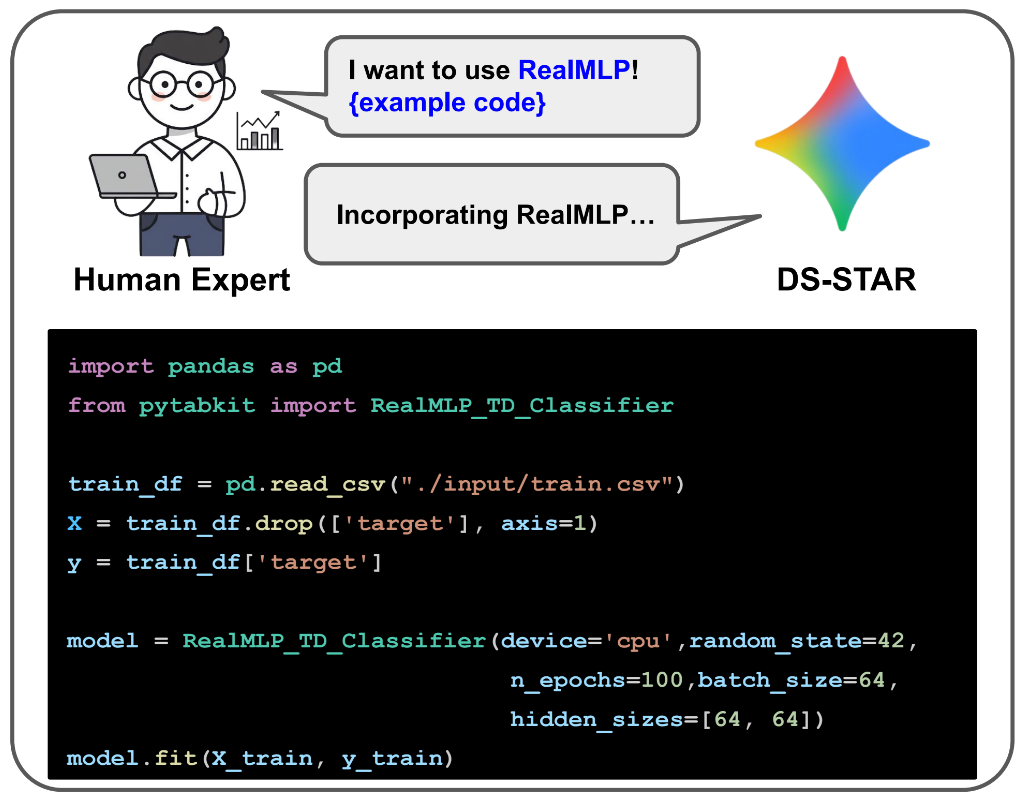


- Google has unveiled MLE-STAR, a groundbreaking machine learning engineering (ML) agent designed to revolutionize how we develop and deploy ML models. This innovative system isn’t just about automating tasks; it’s about creating an intelligent partner that can handle the complexities of the entire ML lifecycle – from data preparation to model training and deployment – with minimal human intervention. The project, detailed in a recent research blog post, represents a significant step towards democratizing access to advanced ML capabilities. MLE-STAR (Machine Learning Engineering Agent for State-of-the-Art Reasoning) is built upon the PaLM 2 model and leverages a sophisticated architecture combining several key components. At its core, it’s an agent that can autonomously explore different approaches to solving ML problems. Unlike traditional pipelines where each step is meticulously defined, MLE-STAR dynamically adapts its strategy based on feedback and observed results. This adaptability is crucial for tackling the inherent uncertainties in real-world ML projects. The system operates through a series of interconnected modules: Problem Formulation: MLE-STAR receives a high-level problem description – for example, ‘predict customer churn’ or ‘detect fraudulent transactions.’ Plan Generation: It then generates a plan outlining the steps needed to address the problem. This includes selecting appropriate datasets, defining evaluation metrics, and choosing suitable algorithms. Execution & Monitoring: The agent executes the plan, monitoring progress and identifying potential issues. Crucially, it can automatically adjust its approach if initial attempts fail – perhaps switching to a different algorithm or refining data preprocessing techniques. Result Reporting: Finally, it generates a report summarizing the findings, including model performance metrics and recommendations for further improvement. MLE-STAR demonstrates that ML agents can tackle a range of tasks with impressive speed and accuracy – significantly reducing the time and effort required for ML development. The team is already exploring extensions of MLE-STAR’s capabilities, including incorporating more complex reasoning abilities and enabling it to collaborate with human experts. This represents a paradigm shift in how we approach machine learning, moving towards a future where intelligent agents play a central role in driving innovation. The potential applications of MLE-STAR are vast, spanning across numerous industries. Imagine using it to automatically optimize marketing campaigns, personalize customer experiences, or even accelerate scientific discovery. The use of automated systems is key to accelerating progress. The core concept revolves around automating repetitive and complex tasks, freeing up human experts to focus on strategic decision-making and creative problem-solving. This aligns perfectly with the goals of many modern ML initiatives – maximizing efficiency while maintaining a high level of innovation. Furthermore, the modular design of MLE-STAR is particularly noteworthy. By breaking down the ML lifecycle into discrete components, Google has created a system that’s highly adaptable and scalable. This allows it to be easily integrated into existing workflows and deployed across a wide range of applications. The agent’s ability to dynamically adjust its approach based on feedback – using reinforcement learning – is what truly sets it apart. It’s not simply following a pre-defined script; it’s actively learning and improving over time. This iterative process is essential for tackling the challenges inherent in real-world ML projects, where data is often noisy, incomplete, and constantly evolving. The fact that MLE-STAR utilizes chain-of-thought reasoning, mirroring PaLM 2’s capabilities, further enhances its intelligence. By articulating its thought process step-by-step, it can not only solve complex problems more effectively but also provide valuable insights into the underlying data. This transparency is crucial for building trust in ML systems and ensuring that they’re aligned with human values. In conclusion, MLE-STAR represents a significant advancement in machine learning engineering – a powerful tool that has the potential to transform how we approach this rapidly evolving field. Its autonomous capabilities, coupled with its adaptable architecture and intelligent reasoning abilities, make it a game-changer for organizations seeking to unlock the full power of ML.
Source: Read the original article here.
Discover more tech insights on ByteTrending.
Discover more from ByteTrending
Subscribe to get the latest posts sent to your email.