Agentic AI is revolutionizing the financial services industry through its ability to make autonomous decisions and adapt in real time, moving well beyond traditional automation. Imagine an AI assistant that can analyze quarterly earnings reports, compare them against industry expectations, and generate insights about future performance. This seemingly straightforward task involves multiple complex steps: document processing, data extraction, numerical analysis, context integration, and insight generation.
Financial analysis workflows present unique technical challenges for generative AI that push the boundaries of traditional large language model (LLM) implementations. This domain requires architectural patterns designed to handle the inherent complexities of financial workflows to assist analysts. Although agentic AI systems drive substantial improvements in operational efficiency and customer experience, delivering measurable productivity gains across operations, they also present unique implementation challenges around governance, data privacy, and regulatory compliance. Financial institutions must carefully balance the transformative potential of agentic AI—from dynamic financial coaching to real-time risk assessment—with the need for robust oversight and control frameworks.
This post details how LangGraph, Strands Agents, and MCP can be combined to build an intelligent financial analysis agent capable of dynamic workflows and complex data integrations, offering a robust architecture for financial applications. The core challenge here is building adaptable systems that can handle the unpredictable nature of financial markets. This requires more than just static models; it demands systems that learn, adapt, and respond in real-time.
The following screenshot figure demonstrates how this solution operates in practice:

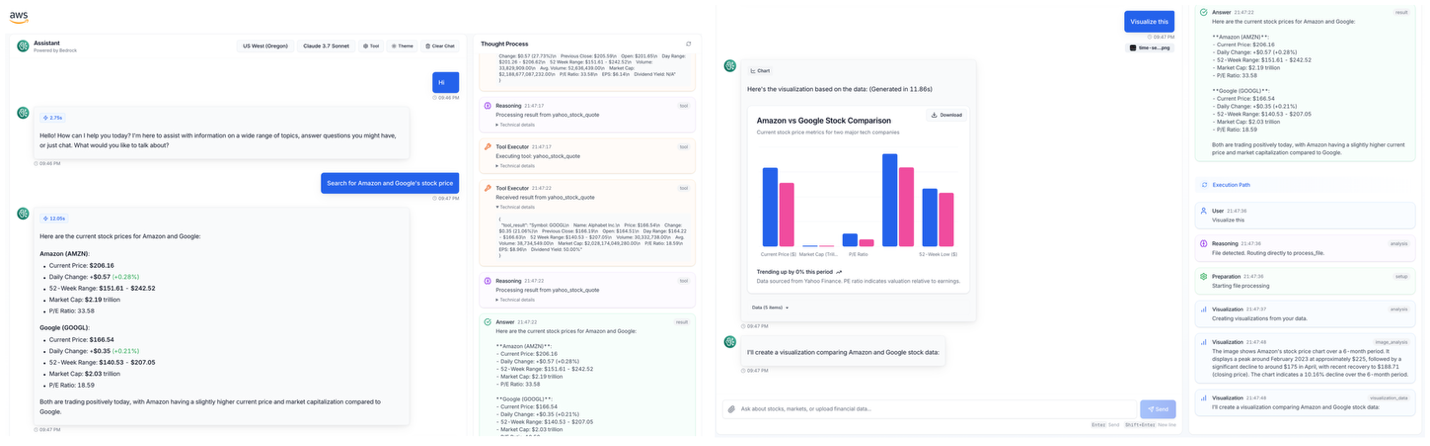
The reference architecture discussed in this post emerged from experimenting with different patterns for financial domain applications. We hope these insights help you navigate similar challenges in your own projects, whether in finance or other complex analytical domains.
Understanding the challenges in financial analysis workflows
Before diving into the solution implementation details, it’s worth understanding the core challenges that informed our architectural decisions. These challenges aren’t unique to our project; they’re inherent to the nature of financial analysis and appear in many complex analytical applications. Our first challenge involved dynamic and adaptive analysis flows. Financial analysis workflows are inherently dynamic, with analysts constantly adjusting their approach based on observed patterns and intuition. An analyst might shift focus from revenue analysis to operational metrics, or dive deeper into specific industry segments based on emerging insights. This requires an orchestration strategy that can handle flexible, nonlinear execution paths while maintaining analytical coherence and context throughout the process. In addition to this, we were faced with complex integration across multiple data sources.
In our second challenge, we were faced with complex integration across multiple data sources. Financial analysis requires seamless integration with various internal and external systems, from proprietary databases to public industry data APIs. Each integration point introduces potential compatibility issues and architectural complexity. The challenge lies in building a system that can reliably pull data from these disparate sources, transform it into a consistent format, and make it available for analysis. This often involves dealing with inconsistent data formats, varying levels of data quality, and the need to reconcile data from different systems. A robust approach here utilizes techniques like ETL (Extract, Transform, Load) processes, coupled with schema validation and data cleaning routines.
Successfully navigating these challenges requires a layered architecture. LangGraph provides the orchestration layer, Strands Agents bring structured reasoning capabilities, and MCP facilitates tool integration. This combination allows for building an intelligent financial analysis agent capable of dynamic workflows and complex data integrations. The interplay between these technologies is key to creating a truly adaptive system.
Source: Read the original article here.
Discover more tech insights on ByteTrending.
Discover more from ByteTrending
Subscribe to get the latest posts sent to your email.