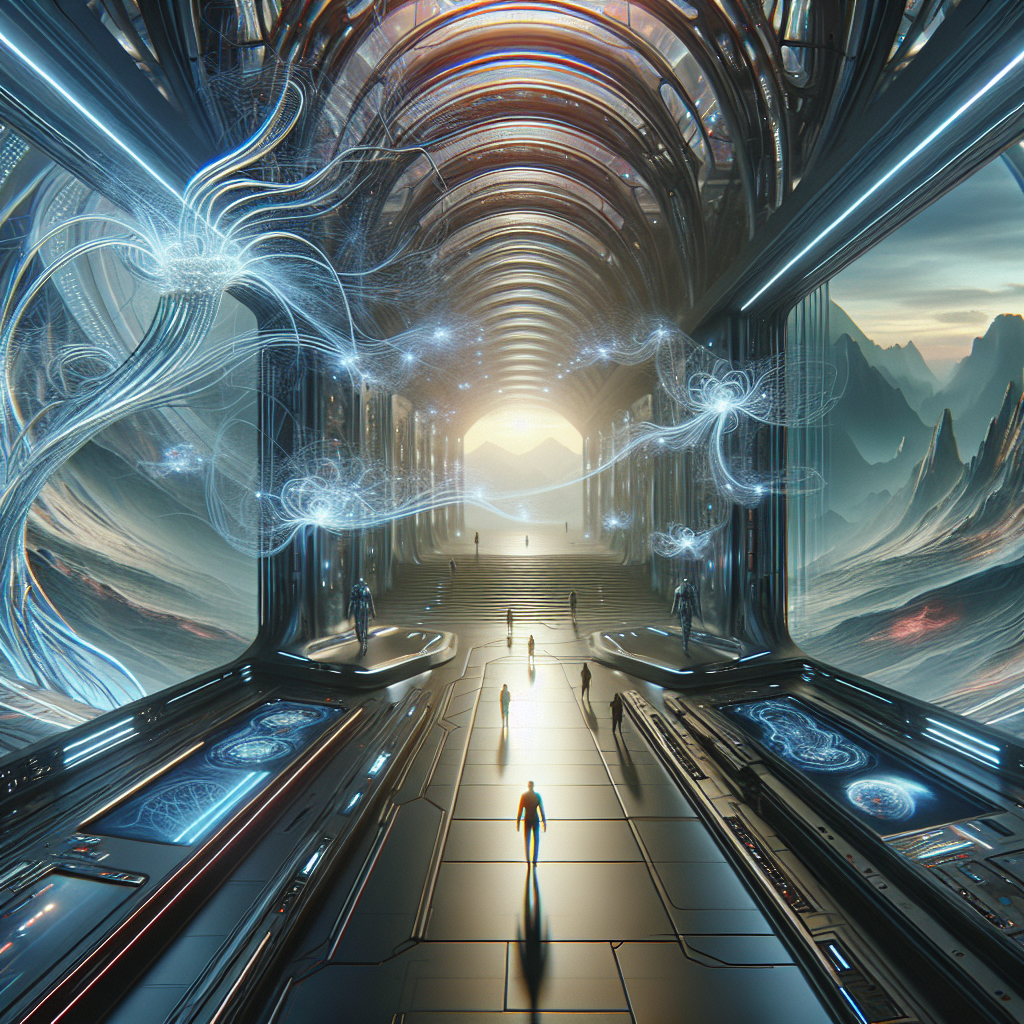


– The field of artificial intelligence (AI) is constantly evolving, seeking new methods to enhance capabilities like spatial reasoning and navigation. A recent research framework, MindJourney, is addressing a significant limitation in vision-language models (VLMs) – their struggle to interpret dynamic, 3D environments. This innovative approach offers the potential to revolutionize robotics and virtual reality applications by enabling AI agents to understand and interact with complex spatial settings. The core of MindJourney lies in its ability to simulate a 3D space through video generation, ultimately improving spatial interpretation for tasks like navigation and planning. This allows for more sophisticated interactions than traditional VLMs which are typically limited to static image understanding.
Traditional vision-language models excel at identifying objects within still images; however, they frequently falter when confronted with the complexities of interactive 3D spaces. A prime example is a seemingly simple question: “If I sit on the couch that is on my right and face the chairs, will the kitchen be to my right or left?”—a task demanding an agent’s capacity to interpret its position and movement within a three-dimensional environment. Humans overcome this challenge by mentally exploring a space, imagining moving through it, and combining these mental snapshots to determine spatial relationships. MindJourney replicates this process for AI agents, allowing them to “roam” a virtual space before answering spatial questions. This method represents a significant stride forward in bridging the gap between how humans understand space and how AI systems perceive it.
How MindJourney Navigates 3D Space
To effectively navigate this simulated 3D space, MindJourney employs a “world model”—specifically, a video generation system trained on extensive collections of videos captured from a single moving viewpoint. These videos showcase actions such as forward movement and turns left or right, mirroring the techniques used by 3D cinematographers. Through this training, the system learns to predict how a new scene would appear from different perspectives—a critical ability for spatial reasoning. At inference time, the model can generate photo-realistic images of a scene based on possible movements from the agent’s current position, expanding and refining its understanding with each iteration.
This iterative process involves generating multiple possible views while the VLM acts as a filter, selecting the most likely perspectives. These selected viewpoints are then incorporated into subsequent generations, while less promising paths are discarded. This dynamic approach avoids the computational expense of evaluating thousands of potential movement sequences by prioritizing informative perspectives. Figure 1 illustrates this key aspect of MindJourney’s operation.
Source: Read the original article here.
Discover more tech insights on ByteTrending.
Discover more from ByteTrending
Subscribe to get the latest posts sent to your email.