

– AI assistants that forget what you told them 5 minutes ago aren’t very helpful. While large language models (LLMs) excel at generating human-like responses, they are fundamentally stateless—they don’t retain information between interactions. This forces developers to build custom memory systems to track conversation history, remember user preferences, and maintain context across sessions, often solving the same problems repeatedly across different applications.
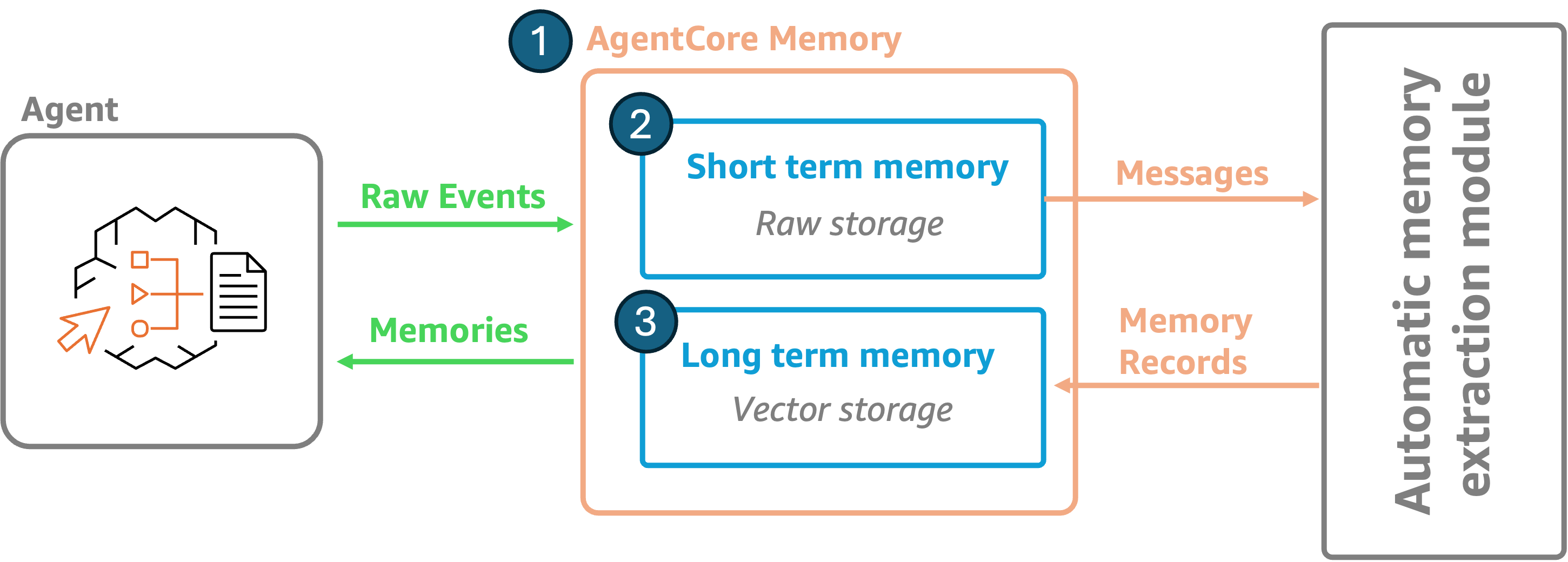
At the AWS Summit New York City 2025, we introduced Amazon Bedrock AgentCore Memory, a service for agent memory management. AgentCore Memory makes it easy for developers to build context-aware agents by eliminating complex memory infrastructure management while providing full control over what the AI agent remembers. It provides powerful capabilities for maintaining both short-term working memory (capturing immediate conversation context within a session) and long-term intelligent memory (storing persistent insights and preferences across sessions), so AI agents can retain context, learn from interactions, and deliver truly personalized experiences.
AgentCore Memory transforms one-off conversations into continuous, evolving relationships between users and AI agents. Instead of repeatedly asking for the same information (“What’s your account number?”) or forgetting critical preferences (“I’m allergic to shellfish”), agents can maintain context and build upon previous interactions naturally. AgentCore Memory seamlessly integrates with other agent-building tools, so that developers can enhance existing agents with persistent memory capabilities without managing complex infrastructure. Unlike do-it-yourself memory solutions that require developers to manually orchestrate multiple components—raw conversation storage, vector databases, session caching systems, and custom retrieval logic—AgentCore Memory offers a fully managed service with built-in storage, intelligent extraction and efficient retrieval.
In this blog post, we explore the specific challenges that AgentCore Memory solves, introduce its core concepts, and share best practices.
The memory problem in AI agents
The ability to remember is the foundation of meaningful human relationships. We remember past conversations, learn preferences over time, and build shared context that deepens our connections. Developers building AI agents have traditionally faced significant technical challenges implementing these same fundamental capabilities, creating a substantial gap between human-like understanding and machine interactions.
When implementing memory for AI agents, developers encounter several fundamental challenges:
- Context window constraints: Modern LLMs have limited capacity to process conversation history. Developers must implement context window management strategies (often manually pruning or summarizing earlier exchanges) to handle ongoing customer conversations to stay within token limits.
- State management complexity: Without dedicated memory systems, developers often build custom solutions for tracking conversation history, user preferences, and agent state—reinventing similar solutions across projects.
- Memory recall challenges: Storing raw conversation data isn’t enough. Without intelligent extraction and structured memory organization, developers must implement complex systems to identify and surface relevant information at the right time.
- Persistence without intelligence: Most existing solutions focus on data storage rather than intelligent memory formation, providing no built-in mechanisms to extract releva
}}
Source: Read the original article here.
Discover more tech insights on ByteTrending.
Discover more from ByteTrending
Subscribe to get the latest posts sent to your email.