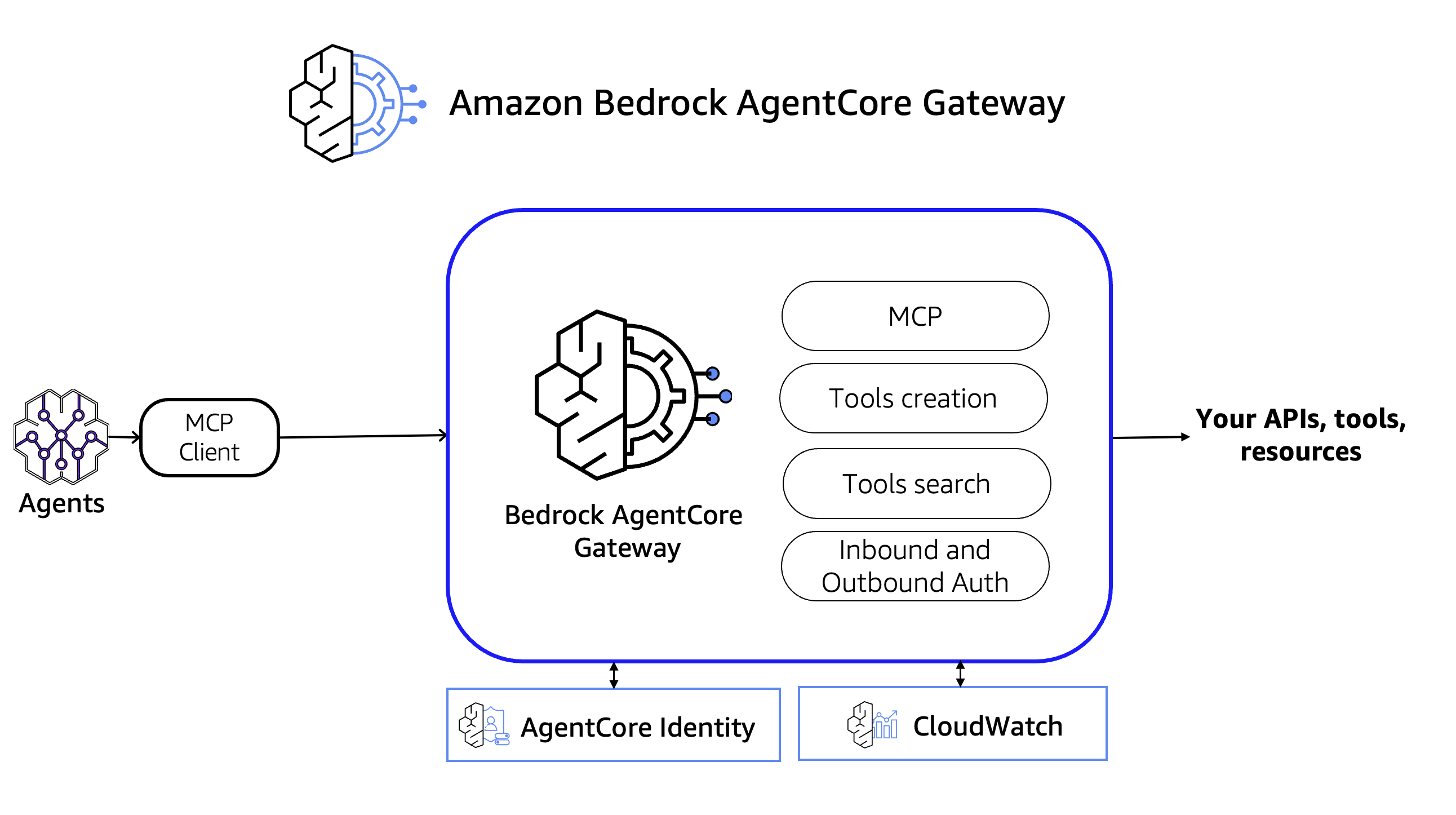

To fulfill their tasks, AI Agents need access to various capabilities including tools, data stores, prompt templates, and other agents. As organizations scale their AI initiatives, they face an exponentially growing challenge of connecting each agent to multiple tools, creating an M×N integration problem that significantly slows development and increases complexity. Although protocols such as Model Context Protocol (MCP) and Agent2Agent (A2A) have emerged to address interoperability, implementing these solutions requires substantial engineering effort. Organizations must build MCP servers, convert existing APIs, manage infrastructure, build intelligent tools discovery, and implement security controls, all that while maintaining these integrations over time as protocols rapidly evolve and new major versions are released. As deployments grow to hundreds of agents and thousands of tools, enterprises need a more scalable and manageable solution. Introducing Amazon Bedrock AgentCore Gateway, a fully managed service that revolutionizes how enterprises connect AI agents with tools and services. AgentCore Gateway serves as a centralized tool server, providing a unified interface where agents can discover, access, and invoke tools. Built with native support for the MCP, Gateway enables seamless agent-to-tool communication while abstracting away security, infrastructure, and protocol-level complexities. This service provides zero-code MCP tool creation from APIs and AWS Lambda functions, intelligent tool discovery, built-in inbound and outbound authorization, and serverless infrastructure for MCP servers. You can focus on building intelligent agent experiences rather than managing connectivity with tools and services. The following diagram illustrates the AgentCore Gateway workflow.
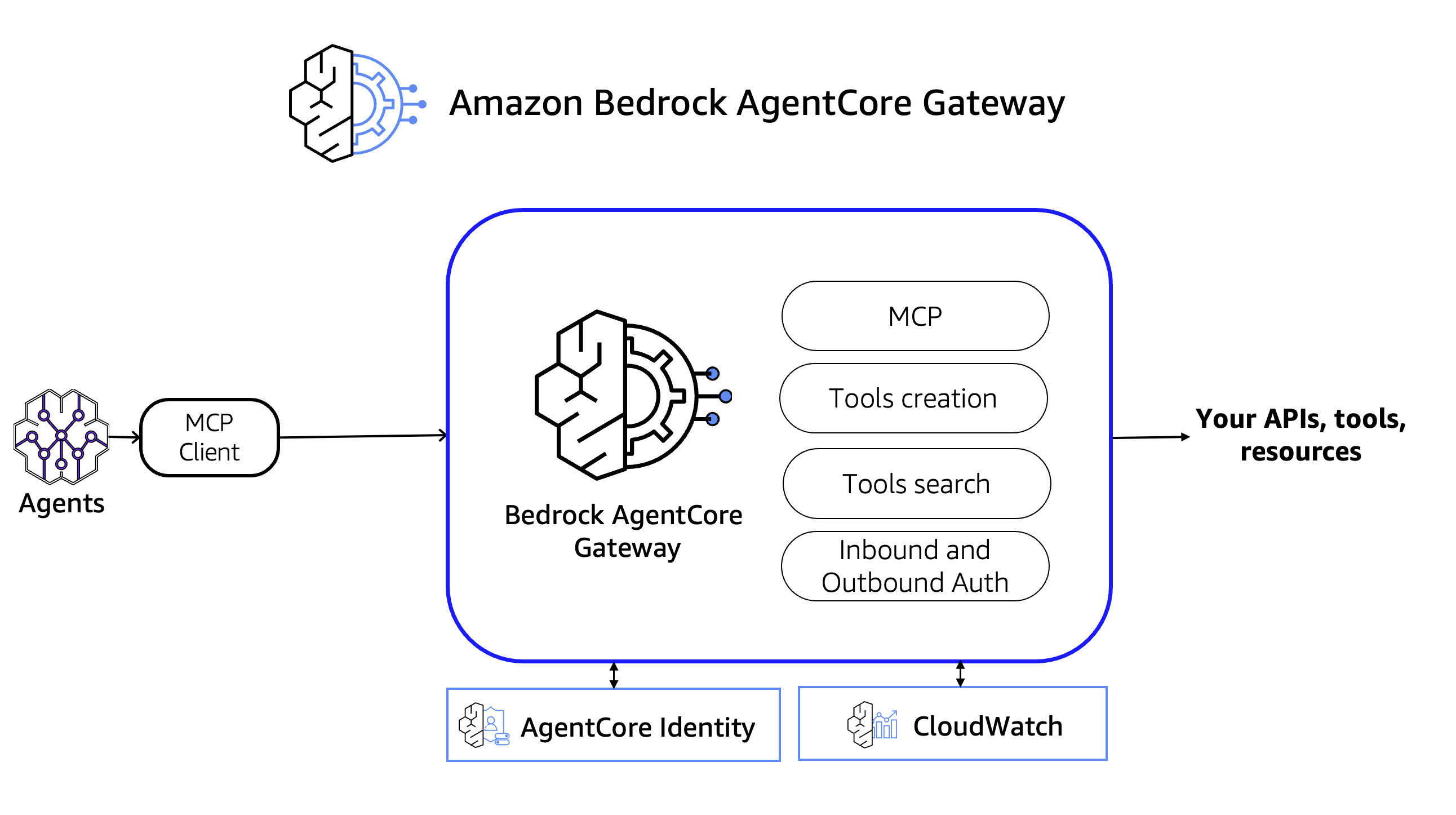
Key capabilities of Amazon Bedrock AgentCore Gateway include powerful and secure API integration functionality that transforms existing REST APIs into MCP servers. This integration supports both OpenAPI specifications and Smithy models, so organizations can seamlessly convert their enterprise APIs into MCP-compatible tools. Beyond API integration, Gateway provides built-in support for Lambda functions so developers can connect their serverless computing resources as tools with defined schemas. Gateway provides the following key capabilities: Security Guard – Manages OAuth authorization so only valid users and agents can access tools and resources. We will dive deeper into security in the following section. Translation – Converts agent requests using protocols such as MCP into API requests and Lambda invocations, alleviating the need to manage protocol integration or version support. Composition – Combines multiple APIs, functions, and tools into a single MCP endpoint for streamlined agent access. Target extensibility – Allows agents to discover and utilize new tools seamlessly. The Amazon Bedrock AgentCore Gateway introduces a comprehensive set of capabilities designed to revolutionize tool integration for AI agents. The AgentCore Gateway workflow is illustrated in the diagram above, detailing the seamless flow from agent request to tool execution. Furthermore, it simplifies complex integrations by abstracting away underlying infrastructure and protocol complexities, allowing developers to focus solely on building intelligent agent experiences. This dramatically reduces development time and operational overhead. In addition, security is at the core of AgentCore Gateway with its built-in OAuth 2.0 authorization and granular access control. Security Guard manages user and agent permissions, ensuring secure tool usage and protecting sensitive data. Therefore, organizations can confidently deploy AI agents knowing that their tools are protected against unauthorized access. To summarize, here’s a table comparing the key features of AgentCore Gateway with traditional tool integration methods: | Feature | AgentCore Gateway | Traditional Approach | Security | Scalability | Complexity |
| Feature | AgentCore Gateway | Traditional Approach |
|---|---|---|
| Tool Integration | Seamless, MCP-based | Complex, API conversions |
| Security | OAuth 2.0, granular control | Manual configuration, vulnerable |
| Infrastructure | Serverless, managed | Self-managed servers, high maintenance |
| Scalability | Highly scalable, elastic | Limited scalability, manual scaling |
Source: Read the original article here.
Discover more tech insights on ByteTrending.
Discover more from ByteTrending
Subscribe to get the latest posts sent to your email.